Aquarium Maintenance Schedule Calculator
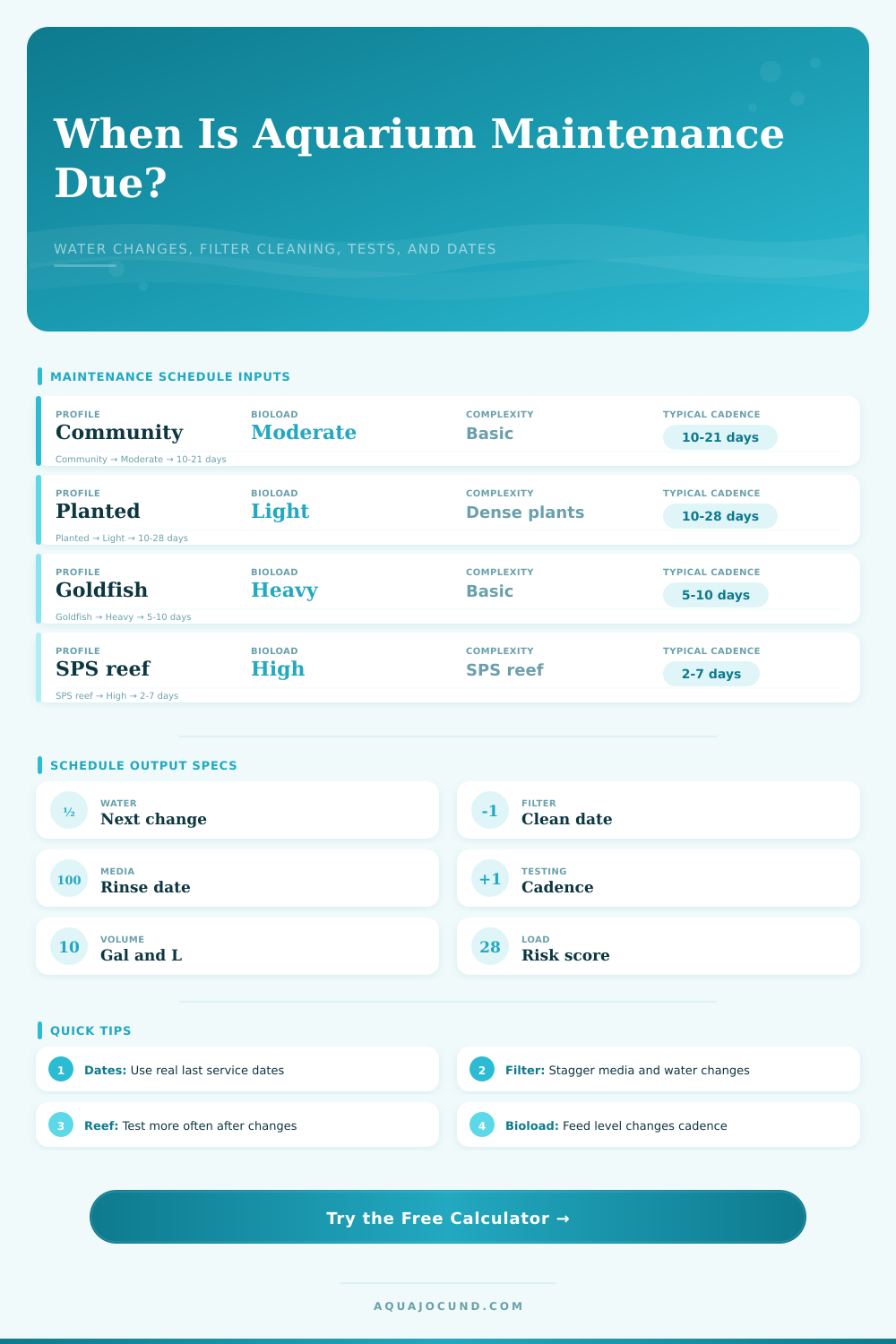
Calculate water-change intervals, filter and media cleaning dates, testing cadence, and the next maintenance dates from tank type, bioload, and complexity.
Schedule Breakdown
| Tank Type | Base Change | Base Test | Typical Change Size | Use Case |
|---|---|---|---|---|
| Freshwater community | 14 days | 14 days | 25% | General planted or non-planted community tank |
| Nano freshwater | 10 days | 10 days | 30% | Small water volume with faster parameter swings |
| Low-tech planted | 18 days | 21 days | 25% | Plant uptake helps stabilize nitrate |
| High-tech planted | 7 days | 7 days | 45% | CO2 and fertilization reset style schedule |
| Goldfish or messy cichlids | 7 days | 7 days | 35% | High waste freshwater stocking |
| Aquatic turtle | 5 days | 7 days | 35% | Very high solids and protein waste |
| Marine FOWLR | 14 days | 10 days | 20% | Fish-only saltwater with live rock |
| Mixed or SPS reef | 7 days | 3-7 days | 10-15% | Coral nutrient and alkalinity stability |
| Modifier | Longer Interval | Neutral | Shorter Interval | What It Changes |
|---|---|---|---|---|
| Bioload | Very light or light | Moderate | Heavy or very heavy | Water-change, filter, and test cadence |
| Plant mass | Dense low-tech plants | Basic plants | CO2 and high fertilizer demand | Nutrient reset timing |
| Reef complexity | Soft coral | Mixed reef | SPS or high-feed reef | Testing and smaller frequent changes |
| Feeding | Light feeding | Normal feeding | Heavy feeding or grow-out | Organic load and filter service |
| Filter/Media Style | Mechanical Cleaning | Biomedia Rinse | Flow Check | Schedule Note |
|---|---|---|---|---|
| Sponge filter | 14 days | 45 days | 14 days | Squeeze gently in removed tank water |
| HOB cartridge or pad | 21 days | 45 days | 14 days | Rinse pad, avoid replacing all media together |
| Canister with biomedia | 30 days | 60 days | 21 days | Clean prefilter before deep media service |
| Matten or large foam wall | 45 days | 90 days | 30 days | Large foam tolerates longer spacing |
| Sump with filter sock | 4 days | 45 days | 7 days | Socks clog quickly under high solids |
| Reef roller or fleece | 14 days | 60 days | 7 days | Check roll movement and bypass path |
| Media reactor | 21 days | 45 days | 7 days | Flow changes before media looks dirty |
| Planted minimal mechanical | 30 days | 75 days | 21 days | Low solids but flow still needs checking |
| Common Tank | Dimensions | Volume | 25% Change | 30% Change |
|---|---|---|---|---|
| 10 gallon | 20 x 10 x 12 in / 51 x 25 x 30 cm | 10 gal / 38 L | 2.5 gal / 9.5 L | 3.0 gal / 11 L |
| 20 long | 30 x 12 x 12 in / 76 x 30 x 30 cm | 20 gal / 76 L | 5.0 gal / 19 L | 6.0 gal / 23 L |
| 40 breeder | 36 x 18 x 16 in / 91 x 46 x 41 cm | 40 gal / 151 L | 10 gal / 38 L | 12 gal / 45 L |
| 75 gallon | 48 x 18 x 21 in / 122 x 46 x 53 cm | 75 gal / 284 L | 18.8 gal / 71 L | 22.5 gal / 85 L |
| 120 gallon | 48 x 24 x 24 in / 122 x 61 x 61 cm | 120 gal / 454 L | 30 gal / 114 L | 36 gal / 136 L |
I see it all too often: Most new aquarium keepers view maintaining their tanks like a necessary chore instead of managing a system. They go for days (or weeks) without thinking about the tank until something happens, such as noticing the water turning cloudy or their fish becoming lethargic, at which point they freak out and do huge water change. While I totally get that reaction, it’s not helpful for keeping things biologically stable.
Rhythm is what creates stability. And stability = happy, healthy fish. The above tool helps you create that rhythm by converting your tank set-up parameters into a realistic calendar. It removes guesswork and puts you on a schedule that matches your actualy biological situation.
Why You Need a Schedule for Your Aquarium
Bioload relative to volume is the basis for every schedule. That’s why a 10g betta tank is no smaller than a 90g reef system. Smaller tanks has smaller volumes. So, they have quicker swinging parameters. An ammonia spike in a nano tank can kills within hours. That same ammonia spike could dilute until it is no longer important and be filtered out before it becomes a problem in a larger volume.
To do this, the calculator takes into account tank size (volume) as well as its fill level. It knows that a densely-vegetated tank have more biological filtration from plants than a bare bottom goldfish bowl. Decorations aren’t just decorations. Plants are biological filters. They’re competing with your fish for the waste. By entering the details of what you’ve got in there, whether plant or a reef setup, the calculator accounts for expected nutrient uptake, which impacts how often you’ll have to change water.
The biggest mistake is filter upkeep. You want things so clean that you end up hurting them. Your filter media contain good bacteria. That’s what breaks down deadly ammonia. Rinse your filter media under your kitchen tap? You’ve just stripped off the chlorine sensitive colonies and crashed your nitrogen cycle.
The calculator will remind you not to do this (and thus prevent you from doing this) with the staggered date for cleaning. It tells you too that if you have both biological (the good bacteria stuff) and mechanical (removes debris) filters, you can clean the latter more often than the former. Why? This helps preserve a healthy colony while keeping the media flowing.
Don’t forget to test cadence. It’s equally important but all too often forgotten until something go wrong. Testing isn’t just confirmation that everything is okay. Testing is also the way to spot trends that could turn into trouble. Alkalinity gradually decreasing? Nitrate slowly rising? These are whispers that will turn into screams if left unaddressed.
While testing recommendations are based off the sensitivity of your livestock, you should monitor delicate tropicals and SPS corals more closely then you do hardy goldfish. What you don’t measure, you can’t manage. The tool creates a baseline for testing, but feel free to adjust the pace upwards if things start looking odd.
All of this hinges on one thing: what they eat. What’s their poop like? How much do they poop? Turtles that poop a lot need more or more frequent water changes than those that don’t. This influences the risk score in the calculator as well.
The goal isn’t to punish yourself with more work. It’s simply to match the effort to the amount of demand being put on the ecosystem. You’ll get a better idea of how much maintenance you’re going to have to do by plugging some numbers into the calculator.
Now that you know what works best given your lifestyle and the demands of your livestock, run with it. Consistency is better then intensity every time.