Aquarium Yearly Maintenance Cost Calculator
Estimate annual aquarium maintenance from water changes, salt or conditioner, filter media, food, testing, electricity, service visits, and livestock load.
📏Tank volume and water changes
This sets how many water-change events happen in one year.
🧪Consumables, testing, and service
Includes dechlorinator, remineralizer, salt mix, or additive cost per changed gallon.
Use this for fertilizer, polishing floss, replacement prefilters, or similar recurring items.
Adds a cushion for impellers, tubing, nets, buckets, spare media bags, and small maintenance replacements.
Cost Breakdown
📊Maintenance cost driver grid
⚖Maintenance category comparison
📘Reference tables
| Water profile | Consumable per gal | Typical use | Cost note |
|---|---|---|---|
| Freshwater tap with conditioner | $0.005 to $0.020 | Most freshwater tanks | Conditioner cost usually exceeds utility water cost. |
| RO/DI freshwater remineralized | $0.060 to $0.180 | Shrimp, soft-water, sensitive setups | Includes purified water plus remineralizer estimate. |
| Brackish salt mix | $0.080 to $0.180 | Low to moderate salinity systems | Lower salt dose than marine water. |
| Saltwater fish-only mix | $0.250 to $0.450 | Marine fish systems | Salt mix and purified water dominate changed water cost. |
| Reef salt mix | $0.350 to $0.650 | Coral reef systems | Higher mix cost and testing frequency are common. |
| Category | Calculation basis | Low yearly pattern | High yearly pattern |
|---|---|---|---|
| Water changes | Gallons changed x cost per gallon | 10% every 14 days | 30% weekly or more |
| Filter media | Monthly cost x active months | Reusable sponge, small floss use | Frequent carbon, GFO, resin, pads |
| Food | Monthly food x load factor x 12 | Light nano or shrimp tank | Goldfish, cichlids, predators, reef feeding |
| Testing | Monthly testing x 12 | Basic freshwater checks | Reef alkalinity, calcium, magnesium, nitrate, phosphate |
| Electricity | Watts x hours x rate | Small filter and heater add-on | Large pumps, lights, UV, heating or cooling load |
| Paid service | Visit cost x visits per year | Full DIY | Weekly, biweekly, or monthly maintenance visits |
| Common tank | Dimensions | Volume | 20% weekly changed |
|---|---|---|---|
| 5 gallon | 16 x 8 x 10 in / 41 x 20 x 25 cm | 5 gal / 19 L | 52 gal / 197 L per year |
| 10 gallon | 20 x 10 x 12 in / 51 x 25 x 30 cm | 10 gal / 38 L | 104 gal / 394 L per year |
| 20 long | 30 x 12 x 12 in / 76 x 30 x 30 cm | 20 gal / 76 L | 208 gal / 787 L per year |
| 40 breeder | 36 x 18 x 16 in / 91 x 46 x 41 cm | 40 gal / 151 L | 416 gal / 1575 L per year |
| 75 gallon | 48 x 18 x 21 in / 122 x 46 x 53 cm | 75 gal / 284 L | 780 gal / 2953 L per year |
| 125 gallon | 72 x 18 x 22 in / 183 x 46 x 56 cm | 125 gal / 473 L | 1300 gal / 4921 L per year |
| System type | Water change range | Testing range | Maintenance cost pressure |
|---|---|---|---|
| Betta or nano freshwater | 20% to 35% weekly | Low to moderate | Small volume keeps consumables low. |
| Shrimp aquarium | 10% to 20% weekly | Moderate | RO/DI and remineralizer can matter more than food. |
| Community freshwater | 20% to 30% weekly | Low to moderate | Food and media scale with stocking. |
| Cichlid or goldfish | 25% to 50% weekly | Moderate | Bioload increases food, media, and water volume. |
| Saltwater fish-only | 10% to 20% weekly | Moderate to high | Salt mix and electricity raise the annual total. |
| Reef aquarium | 10% to 20% weekly | High | Salt, tests, media, and dosing add recurring cost. |
💡Maintenance cost tips
When most folks look at aquarium they go by sticker on the glass. It costs only two hundred bucks. How hard could it be?” They get home with their new fifty-five gallon tank in hand and realize the sticker price doesn’t include any of the things you need, like six gallons of cloudy water or a bottle of salt mix that exceeds the cost of lunch.
The truth is, though, that you’re not paying for fish alone. That’s just the headline cost. The actual cost are the invisible hum of maintenance that won’t shut off. Every kilowatt of electricity, every sponge replacement, and every dropped gallon of water need to be tracked if you want to get a clear picture.
Real Cost of Keeping an Aquarium
That’s where the tool comes into play. It spares you from having to do math yourself (and therefore saves you the trouble of figuring out recurring totals/conversions). After plugging in your tank size and care schedule, the calculator above do the rest.
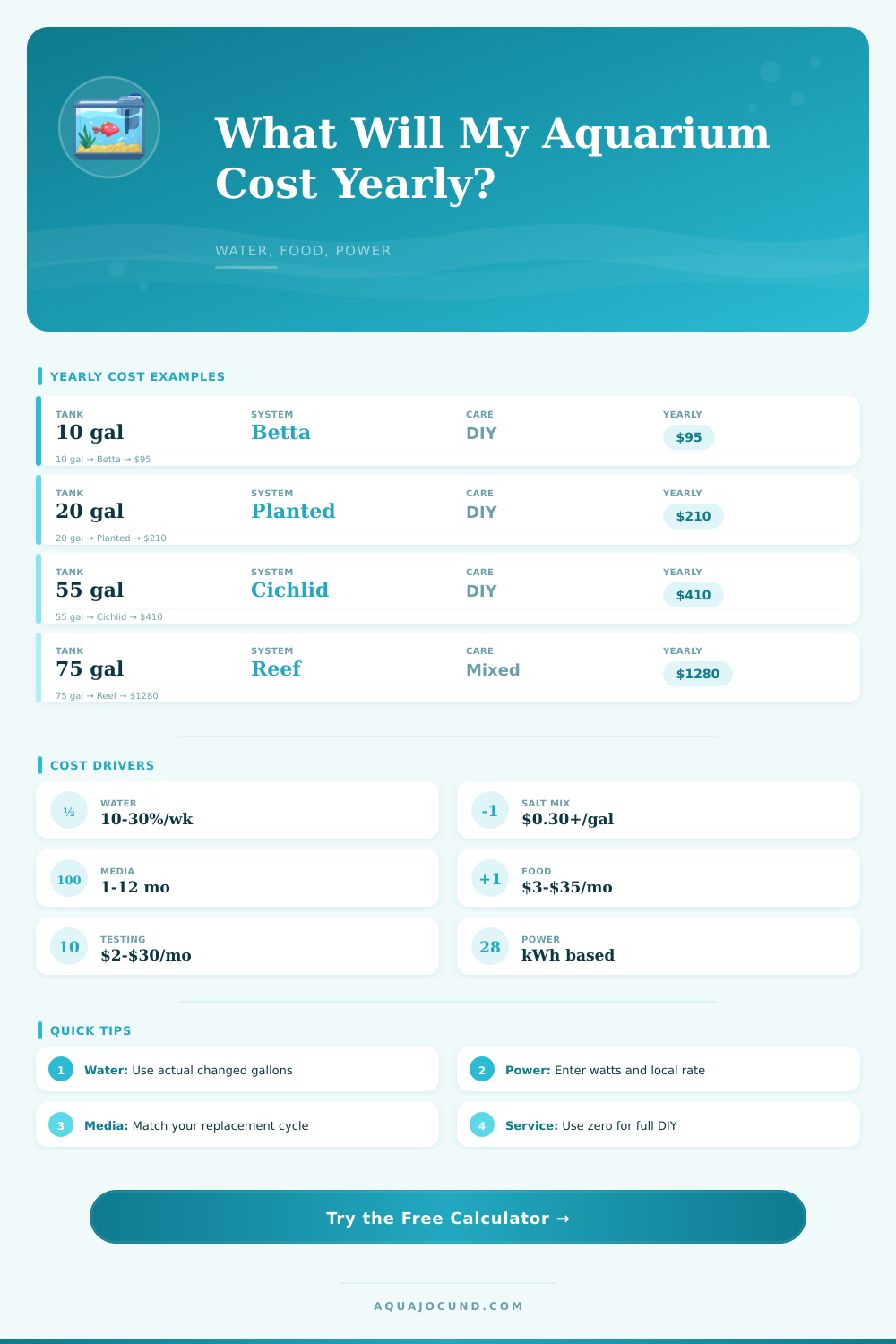
First things first. Your workload is set by tank size; the bigger the tank, the more water you have to change and the bigger bucket(s) you have to carry. But the system type matters just as much, perhaps even more than size. Sure, a small planted tank may not need a big canister or HOB for filtration. But man, those tanks will burn through carbon media and fertilizeers quickly! You’ll notice that when selecting your exact profile, the tool takes into account the correct consumption rates rather than guessing. This makes all the difference in final number.
Water volume is typically the largest variable. It scales linearly to size of the tank and how frequently you change it. A small tank with 20% weekly changes mean you have a few gallons to manage each week. A reef system with 30% weekly changes move hundreds of gallons a year.
Source, Your source for water will shift the cost per gallon. In most municipalities, tap water + conditioner is inexpensive. Salt mix or other remineralizers add up quickly. You’ll want to plug in utility cost as well as the additive cost so you can see the true weight of this line item. Most hobbyists only think about additives when their budget goes sideways.
The other silent power sucker nobody thinks about are electricity. In colder climates heaters is always on. High output lights run for extended hours each day. Enter watts and hours into calculator and it will tell you how much all of that costs for twelve months. It is not usually a massive number alone. But it’s always there. Even when the fish aren’t doing anything other then breathing, you’re paying it.
And there’s the wear item buffer. Tubing cracks. Impellers fail. Nets get lost in substrate. Ten percent added to total covers these eventual replacements without breaking the bank when they occur.
The cost of food doesn’t usually dominate the budget except for those keeping really large cichlid (or other species) or sharks. Testing supplies are more telling than food costs. Reef keepers use calcium and alkalinity reagents regularily (monthly), while freshwater guys has basic kits that will last indefinitely. This page has a reference table breaking down how these categories play out in various systems.
After running the numbers, it’s a good idea to take a look at your biggest line item. Do you find yourself changing water frequently? Maybe you can change the water less often. Or, you could improve filtration to reduce buildup. Are your electricity costs high? Are you running pieces of equipment that don’t pull their weight?
In other words, go from fuzzy worry to hard numbers. What gets measured gets managed. How much will it be each year? What’s the breakdown between categories? That tells you precisely where to pinch pennies or spend more wisely to strengthen things.
When Sunday evening rolls around and the filter dies, we’ll have some idea about what to do… because a bit of forethought stops a world of freakout. Turns out this tank wasn’t merely a box of glass after all. It’s a living ecosystem requiring consistent care and an honest accounting from the start. You should of prepared better.