🧪 Aquarium Magnesium Chloride Calculator
Calculate MgCl2 dose, daily split, water-change effect, purity correction, and chloride ppm impact.
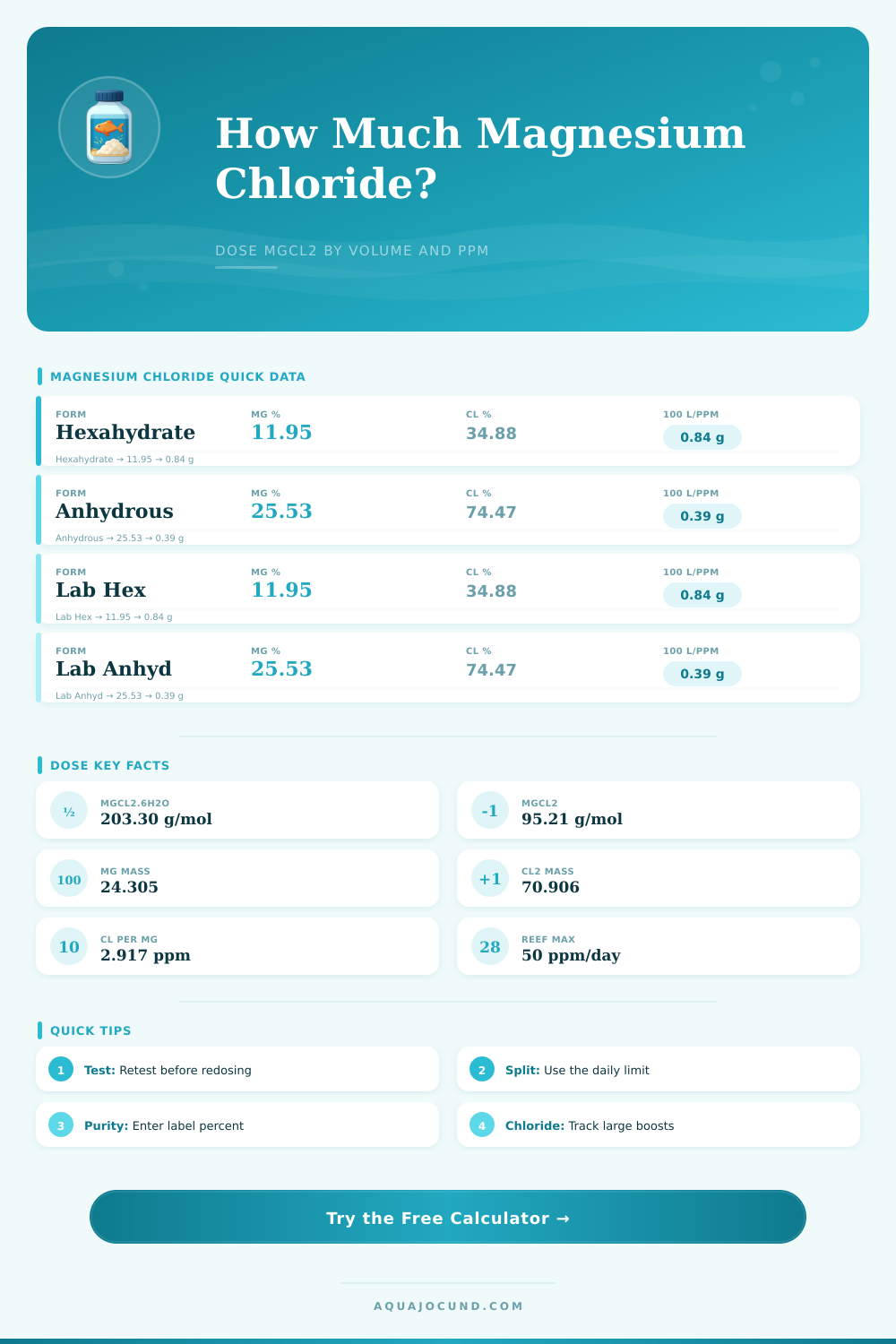
| Product Type | Formula Basis | Mg Fraction | Cl Fraction | Grams per 100 L per 1 ppm Mg |
|---|---|---|---|---|
| Magnesium chloride hexahydrate flakes | MgCl2·6H2O | 0.1195 | 0.3488 | 0.837 g |
| Magnesium chloride hexahydrate crystals | MgCl2·6H2O | 0.1195 | 0.3488 | 0.837 g |
| Lab grade hexahydrate | MgCl2·6H2O | 0.1195 | 0.3488 | 0.837 g |
| Anhydrous magnesium chloride powder | MgCl2 | 0.2553 | 0.7447 | 0.392 g |
| Lab grade anhydrous | MgCl2 | 0.2553 | 0.7447 | 0.392 g |
| Dry blend, hexahydrate basis | MgCl2·6H2O | 0.1195 | 0.3488 | 0.837 g before purity |
| Tank | Volume | 10 ppm Hexahydrate | 50 ppm Hexahydrate | 50 ppm Anhydrous |
|---|---|---|---|---|
| 10 gallon | 37.9 L | 3.2 g | 15.9 g | 7.4 g |
| 20 gallon | 75.7 L | 6.3 g | 31.7 g | 14.8 g |
| 40 breeder | 151 L | 12.7 g | 63.4 g | 29.5 g |
| 55 gallon | 208 L | 17.4 g | 87.1 g | 40.7 g |
| 75 gallon | 284 L | 23.8 g | 119.0 g | 55.5 g |
| 125 gallon | 473 L | 39.6 g | 197.9 g | 92.6 g |
| Water Change | Current Tank Mg | New Water Mg | Post-Change Mg Formula |
|---|---|---|---|
| 0% | 1200 ppm | 1320 ppm | 1200 ppm |
| 10% | 1200 ppm | 1320 ppm | 1212 ppm |
| 25% | 1200 ppm | 1320 ppm | 1230 ppm |
| 50% | 1200 ppm | 1320 ppm | 1260 ppm |
Magnesium is a necessary element for reef tanks. Magnesium help to maintain calcification in the tank and helps to stabilize the pH levels of the water. Magnesium also helps to prevent tissue recession in the corals in the reef tank.
Magnesium levels in reef tanks, however, often drop due to two main reasons: the organisms in the reef tank use magnesium, and magnesium leave the system during water changes. To compensate for these drops in magnesium levels, a person must add magnesium back to the water in which the reef tank inhabitant live. One way to add magnesium to the water in a reef tank is to use magnesium chloride.
How to Add Magnesium Chloride to Your Reef Tank
Magnesium chloride products dissolve easy in the water in the reef tank. Additionally, magnesium chloride raises the magnesium levels in the reef tank without adding sulfate to the water. The downside to using magnesium chloride, however, is that adding magnesium chloride also add chloride to the water.
For every gram of magnesium that is added with magnesium chloride, approximately three gram of chloride are also added to the system. Because chloride can increase the salinity of the water in the reef tank, the person must continuously monitor the salinity of the reef tank when use magnesium chloride to add magnesium to the water. The calculator included on this page can help calculate the correct amount of magnesium chloride to add to the reef tank.
This calculator takes into account the volume of the reef tank, the current magnesium level in the tank, and the target magnesium level that the reef tank should have. This calculator, however, does not account for the salinity of the tank; the person must ensure that the salinity of the tank can handle the amount of chloride that will be added to the water when magnesium chloride is added. Magnesium chloride products has different purity levels.
The purity level affects the amount of magnesium chloride that must be added to the reef tank. For example, some magnesium chloride products are hexahydrate flakes with a purity level of around 97 percent magnesium. Other magnesium chloride products are anhydrous material with a purity level of around 99 percent magnesium.
If the incorrect purity level is entered into the calculator, the amount of magnesium chloride that is added to the reef tank can be under-dose or overdosed. To avoid adding too much or too little magnesium chloride to the water, the person should enter the purity percentage of the product to be used into the calculator. Water changes can affect the magnesium levels in a reef tank.
Water changes involve adding water to the reef tank that already contains organisms and chemistry to new water that has been treated to be safe for marine life. Water changes will change the magnesium levels in the reef tank because the new water has a different concentration of magnesium. The calculator included on this page accounts for the magnesium levels in new water.
Therefore, it will dose the amount of magnesium chloride necessary to achieve the desired magnesium levels in the tank after water changes. In instances when a tank undergoes large water changes, it is suggested that the magnesium level after the water change is used as the starting point for any future magnesium level corrections. Reef aquarium owners should also limit the daily increase in the magnesium levels in the tank.
Marine organisms in reef tanks are best adjusted to slow changes to the chemistry of the water rather than rapid changes. Most reef tank owners will limit the increase in magnesium levels to a maximum of 50 ppm per day. The calculator included on this page can help determine the amount of magnesium chloride to add to the reef tank each day to reach the target magnesium levels.
By using this daily dose calculation, aquarium owners can test the magnesium levels in their reef tank and add more magnesium chloride only if the magnesium test reveal that more magnesium chloride is needed. The reference tables on this page show the differences between the types of magnesium chloride products. The tables show the amount of magnesium in each type of magnesium chloride per gram of magnesium chloride.
Additionally, the tables also show the amount of chloride that is added to the reef tank when each type of magnesium chloride is added to the water. Thus, the person can use the tables to choose the type of magnesium chloride that best suit the salinity of the reef tank. When calculating the amount of magnesium to add to a reef tank using the calculator on this page, it is important to use the actual volume of water in the reef tank.
The advertised size of the reef tank is often not the same as the actual volume of water that is in the tank. The actual volume of water can be less than the advertised size of the reef tank because the rocks, sand, and other tank equipment displaces some of the water in the tank. By calculating how much magnesium to add based on the advertised size of the reef tank, people will add to much magnesium to the reef tank.
Adding too much magnesium to the reef tank can lead to incorrect magnesium levels and salinity levels in the tank. The calculator also calculates the amount of chloride that will be added to the reef tank if magnesium chloride is added. The calculator provides the amount of chloride as an output.
The amount of chloride helps reef aquarium owners to understand if splitting the dose of magnesium chloride into smaller parts or performing a water change with lower salinity water to compensate for the amount of chloride that will be added to the system. Thus, providing this value as an output allows aquarium owners to make an informed decision about the management of salinity in their reef tank. The demand for magnesium in a reef tank can change.
The growth rate of the corals in the reef tank can change. The amount of food that is fed to the organisms in the reef tank can change. For these reasons, it is recommended that the magnesium levels are tested every two weeks to ensure that the levels of magnesium in the reef tank remain steady.
By testing the magnesium levels in the tank more frequently, aquarium owners can prevent the magnesium levels in the tank from drifting away from the target magnesium levels that is desired for the health of the reef tank inhabitants. The magnesium level calculator on this page helps aquarium owners to turn magnesium level test results into the amount of magnesium chloride to be added to the reef tank.