
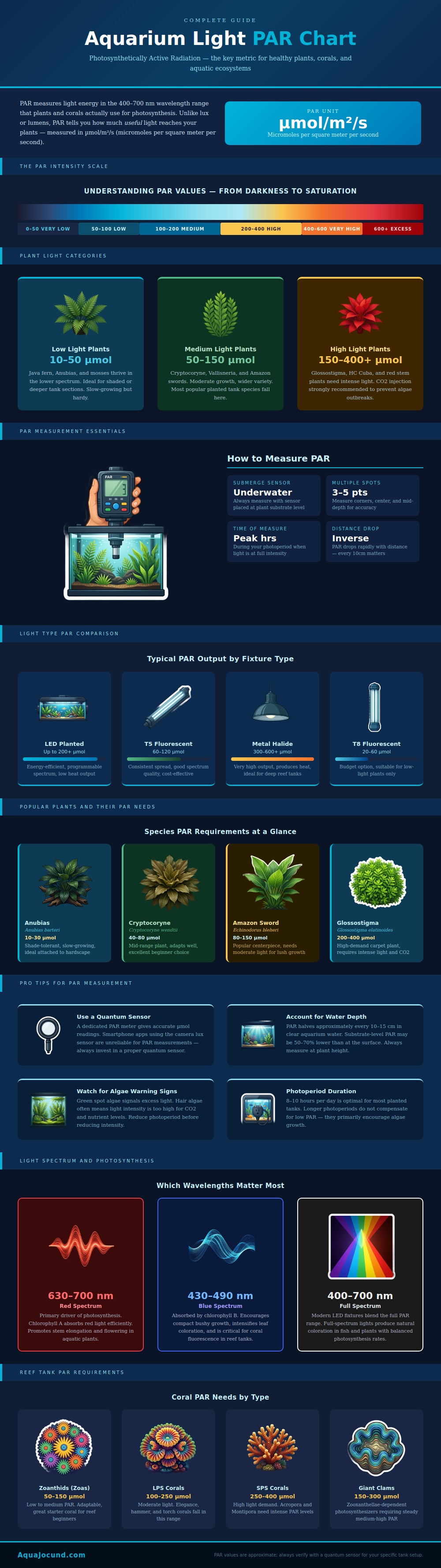
Yes you did it. You loaded up the truck, purchased the plants, and got the lights. You filled the tank with substrate and water, turned them all on, and nothing grow. Why not? Because new aquarium keeper make the mistake of equating bright with healthy. Bright isn’t what plants want; they requires the light used for photosynthesis (PAR).
Lumen measures light that we can see with our eyes. The rest is there to look pretty for us. PAR consist of the wavelengths between 400 and 700 nanometers that plant use to make their tissues. This chart displays the effect on various light sources with depth (above).
Why Bright Light Is Not Good for Plants
This means most hobbyist are measuring their lighting wrong. They test it at the surface of the tank but fail to realize that energy is absorbed quickly as it goes down in the water column. By the time those photons reach the soil where plant roots reside, they is much dimmer. If you don’t factor in this decay, you’ll guess incorrecty about what your plants are getting.
The loss of intensity is why dedicated quantum sensors matter. Not only can they shows you the decrease in intensity, but they also go beyond the lux readings from a phone app that’s calibrated for human eyes and NOT chlorophyll absorption. In other words, you require a tool that reads like a plant, not a person viewing colors.
Half the battle is understanding the spectrum. Photosynthetic plants grows well under red light because it drives photosynthesis. However, it also stimulates plant growth (e.g., expanding leaves and stems). Blue light encourages compact growth and intensifies coloration. That’s why reef tanks are often lit with very blue tinted fixtures… They stimulates coral fluorescence. A full spectrum approach, however, is more balanced and mimics natural sunlight, providing both drivers for consistent development.
As you can see from the fixture comparison graphic, the extremely high output of metal halide lights make them ideal for deep reef uses. Fluorescent tubes don’t have enough oomph to get much beyond low-medium levels. LED technology filled the gap because it let you precisely adjust specific wavelengths while avoiding excess energy and heat.
The lighting plan isn’t supposed to drive plant selection; rather, the plants dictate it. It’s pointless to attempt to make Glossostigma work with a low-PAR set-up. High-light species such as this carpet type requires serious amounts of light (plus a shot of CO2) to stay alive. Not providing enough light causes it to melt away.
On the flip side, subjecting Anubias and Java Fern to high-intensity conditions invite an algae bloom. Why? Because there’s more energy then the plants can handle. There are excess nutrients that will find their way to unwanted competitors. The lower part of the spectrum is where shade-tolerant types excel. And they can do so with a maximum of perhaps 200 micromoles per square meter.
Same can be said for reef keeping. Zoanthids can survive in lower lighting conditions than demanding SPS corals like Acropora, which need high levels of light. Matching the light source output to the organism’s natural habitat is the difference between a colorful coral and a bleached one. Brightest doesn’t mean best. Right means best. Right means matching the amount of usable light with what you have.
Getting it right takes time… Get several readings at different times of the day when light cycles are longest. Readings should be taken from the corners, middle, and all depths. Vary the locations and you’ll see if you have an even spread or not.
An inconsistent spread lead to some plants thriving while others wither up in the same tank, a sure sign you need to adjust the fixture height. Going up will weaken the punch near the bottom but broaden the beam’s width; going down intensifies it but narrows its width. The balancing act of depth vs. Breadth never ends.
Bottom line: the secret to good aquascaping is balancing physics with biology. If it doesn’t have the energy to grow, there’s no way for a plant to fake it. When you think about PAR instead of how bright things appear, you’re out of the guesswork and in the driver’s seat. Corals maintain their vibrant colors, the greens are true, and the water appears clearer, because each gets precisely what it has evolved to use. Power isn’t as important then precision.
