Aquarium KH pH Relationship Calculator
Estimate carbonate buffering, pH movement, CO₂ level, target chemistry, and livestock safety margins from real KH and pH readings.
📌Quick Presets
⚙Water Chemistry Inputs
Calculation Breakdown
🔬Water Chemistry Comparison Grid
Soft Acidic
Low KH allows pH to move easily. Use small changes and confirm the source water is consistent.
Neutral Buffered
Moderate KH resists daily swings while still allowing planted tanks to manage CO₂ comfortably.
Hard Alkaline
Higher KH holds pH up. Lowering pH usually needs dilution or CO₂, not a single acid dose.
Marine / Reef
Alkalinity stability matters more than chasing pH. Aeration and alkalinity dosing interact strongly.
📊Reference Tables
| Water Type | Typical KH | Typical pH | Relationship Note |
|---|---|---|---|
| Blackwater style | 0.5-2 dKH | 5.5-6.8 | Organic acids make KH/pH CO₂ estimates less exact. |
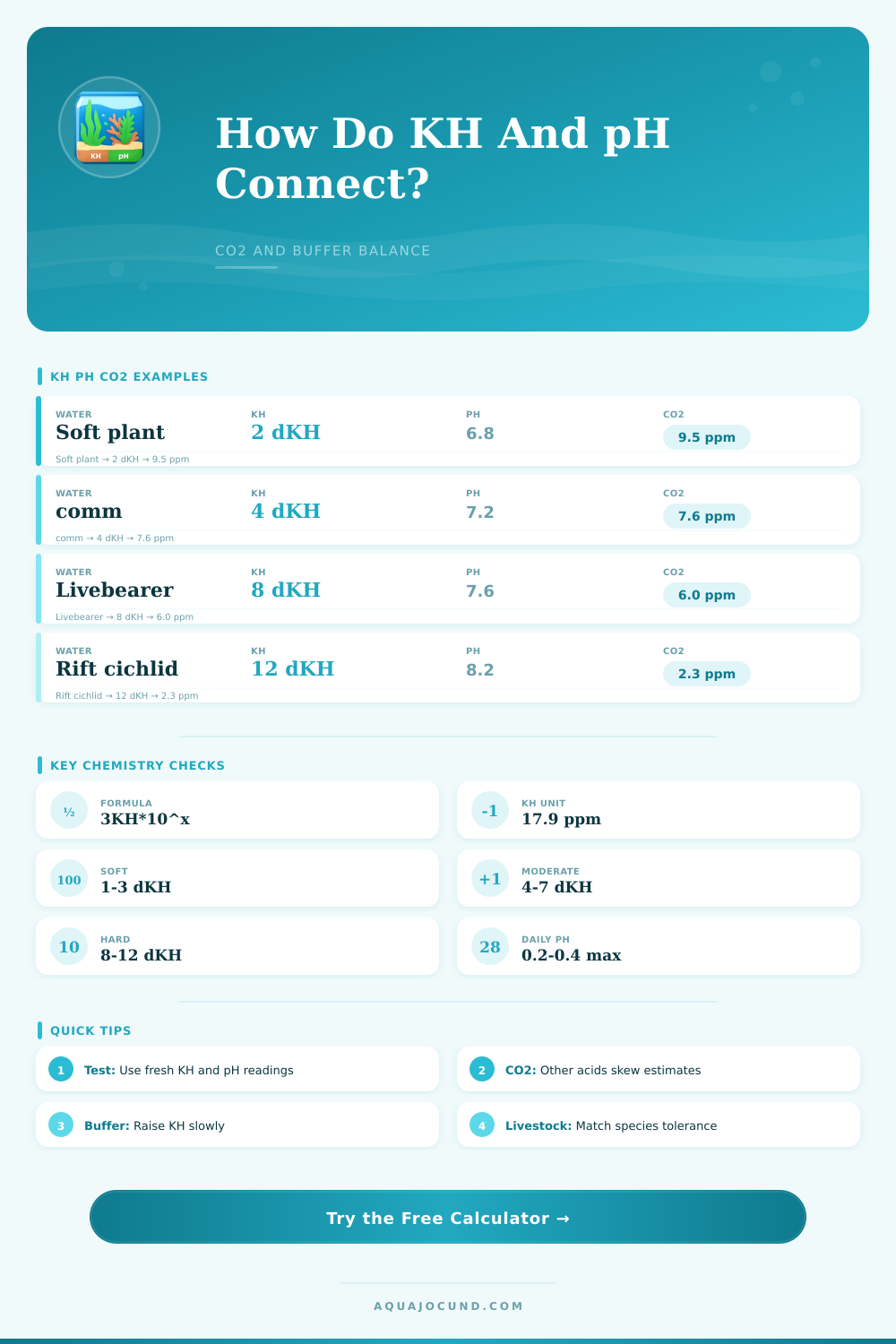
| Soft planted | 1-4 dKH | 6.2-7.2 | CO₂ injection can move pH daily while KH stays stable. |
| Community freshwater | 3-7 dKH | 6.8-7.6 | Good buffer range for many captive-bred community species. |
| Livebearer / hardwater | 7-12 dKH | 7.4-8.2 | KH helps maintain alkaline water and limits pH dips. |
| Rift lake cichlid | 10-18 dKH | 7.8-8.6 | High buffer and mineral content are usually expected. |
| Reef aquarium | 7-11 dKH | 7.8-8.4 | pH is strongly affected by room CO₂ and gas exchange. |
| CO₂ Grid | pH 6.6 | pH 7.0 | pH 7.4 | pH 7.8 |
|---|---|---|---|---|
| 1 dKH | 7.5 ppm | 3.0 ppm | 1.2 ppm | 0.5 ppm |
| 3 dKH | 22.6 ppm | 9.0 ppm | 3.6 ppm | 1.4 ppm |
| 6 dKH | 45.2 ppm | 18.0 ppm | 7.2 ppm | 2.9 ppm |
| 10 dKH | 75.4 ppm | 30.0 ppm | 11.9 ppm | 4.8 ppm |
| Tank Example | Volume | Common KH Goal | 1 dKH Buffer Equivalent |
|---|---|---|---|
| Nano shrimp | 10 gal / 38 L | 0.5-3 dKH | About 1.1 g sodium bicarbonate |
| Community tank | 29 gal / 110 L | 3-7 dKH | About 3.3 g sodium bicarbonate |
| Planted display | 55 gal / 208 L | 2-6 dKH | About 6.3 g sodium bicarbonate |
| Reef system | 75 gal / 284 L | 7-11 dKH | Use reef alkalinity supplement label |
| Rift cichlid tank | 125 gal / 473 L | 10-18 dKH | About 14.2 g sodium bicarbonate |
| Adjustment Type | Primary Effect | Best Use | Caution |
|---|---|---|---|
| Bicarbonate buffer | Raises KH, often nudges pH upward | Freshwater KH increase | Split large changes across days. |
| Carbonate buffer | Raises KH and pH more strongly | Hard alkaline systems | Avoid overshooting soft-water tanks. |
| RO dilution | Lowers KH by mixing lower-alkalinity water | Softening hard tap water | Re-mineralize for livestock needs. |
| CO₂ adjustment | Lowers pH while KH stays nearly unchanged | Planted tanks | Watch fish respiration and surface exchange. |
| Tannins / organic acids | Can lower pH without matching CO₂ math | Blackwater style tanks | CO₂ estimate becomes less reliable. |
Most of us got into keeping fish for peace of mind we get from having a glass box full of fish. We didn’t sign up for doing high school chemistry on our bathroom counter. But there you are staring at some test strips asking yourself “What happened?” How did my carbonate hardness stay constant and my pH drop overnight? Data saves the day where intuition fails.
KH and pH aren’t just numbers, they also determine if an ecosystem stays stable or turns into a fish hospital. Acidic buffering is provided by carbonate hardness (KH). The higher the KH, the harder water will be able to resist changes in acidity (pH). Soft water has lower KH which, while being more easily affected by biological processes and waste products, are also much less stable.
Why Water Stability Matters for Fish Health
The calculator does all that complicated math stuff using things like exponents and logarithms, you simply have to know the meaning of the inputs to your livestock. A common error among many hobbyists: they fixate on reaching a particular pH value but fail to consider the KH. In soft water, the pH will quickly crash if you decrease it once bio loads start generating waste products. That’s where folks go astray. They think of pH as something unchanging when it is actualy a changing state dependent upon buffering capacity.
What does the tool do? You input your present values and it tells you how much CO2 would be dissolved in that given set of chemicals. It provides a look at what’s happening with bio load and gas exchange at a point in time. Each of these presets is there because various natural regions has different balance requirements. For example, a Rift Valley cichlid aquarium has very different chemistry requirements than a planted soft water tank that houses Caridina shrimp. The first requires high alkalinity/mineral content and strong alkalinity to support a pH squarely in the alkaline range. The second seeks low buffering (often supplemented via peat moss or driftwood) to keep the tank acidic. Attempting to apply one regimen to the other typically results in unhappy fish.
The reference tables that come packaged with the calculator illustrate these common parameters so you’ll know where your water falls compared to what is considered normal. Another concept that tends to be forgotten about till it’s too late is the idea of safety margins. Depending on the species, as well as whether they’re wild caught vs. Captive bred, livestock tolerance levels can vary significantly. With this in mind, the tool lets you select a safety percentage, essentially adding a margin of error to your calculations. That is, it takes into account small mistakes using testing kits and/or natural variations on tap water.
Aquarium chemistry is very much an art guided by science rather than pure engineering. Sure, you want stability more than you want perfection, but you also want stability. While a pH of 7.2 and KH of 5 dKH may sound boring on paper, it won’t fluctuate wildly from day to night, keeping fish alive and thriving.
When you know what’s going into the tank, you can begin to diagnose problems when they’re not crises. For example, if your CO2 estimate is higher than your aeration level, then maybe you need better surface agitation or perhaps there is too much plant respiration. Or maybe your KH strangely dropped and some component of your filter media needs to replaced. That’s all diagnostic information that’s buried inside the numbers. It just takes observation to put it into context. The numbers give you the baseline; the observation gives you the context.
How fast the water chemistry changes is important, always do it slowly! A rapid change will stress fish. It can also throw off their salt and water balance systems. The numbers listed under the breakdown section are reminders to go slow. Adding buffers or acid may bring you to the desired pH number rapidly, but that’s never advisable. Go slow. Allow the system to adjust. Observe behavior. Modify flow or lighting as necessary. You’re looking for harmony, not simply reaching a number on a spreadsheet.
Even if your water was set up perfectly initially, it’s never constant, it changes by the day/night cycle of respiration/photosynthesis. During the day when plants are consuming CO2, your pH will increase. At night when plants release CO2, your pH decrease. Having a strong KH buffer cushions these fluctuations throughout the day. Otherwise, you have a chemical pendulum that swings every 12-hours from one extreme to another. That’s why even though soft water may seem easier on the surface, it can actualy be harder to manage.
To summarize, there is a living system here that needs balance. The tools are there to help you see that balance but it’s patience that gets the job done. Make yourself familiar with what each parameter means in your setup. Allow the data to guide your choices rather than enforce dogma. Observe your fish, believe what you’re seeing, and allow the chemistry to do its thing in the background where it belongs. Regardless if your tank’s pH is 6.5 or 7.8, a stable tank is a happy tank.