💧 Aquarium Half-Filled Volume Calculator
Estimate actual partial-fill water volume, half-fill volume, displacement from substrate and rock, target waterline mark, and the water to add or remove.
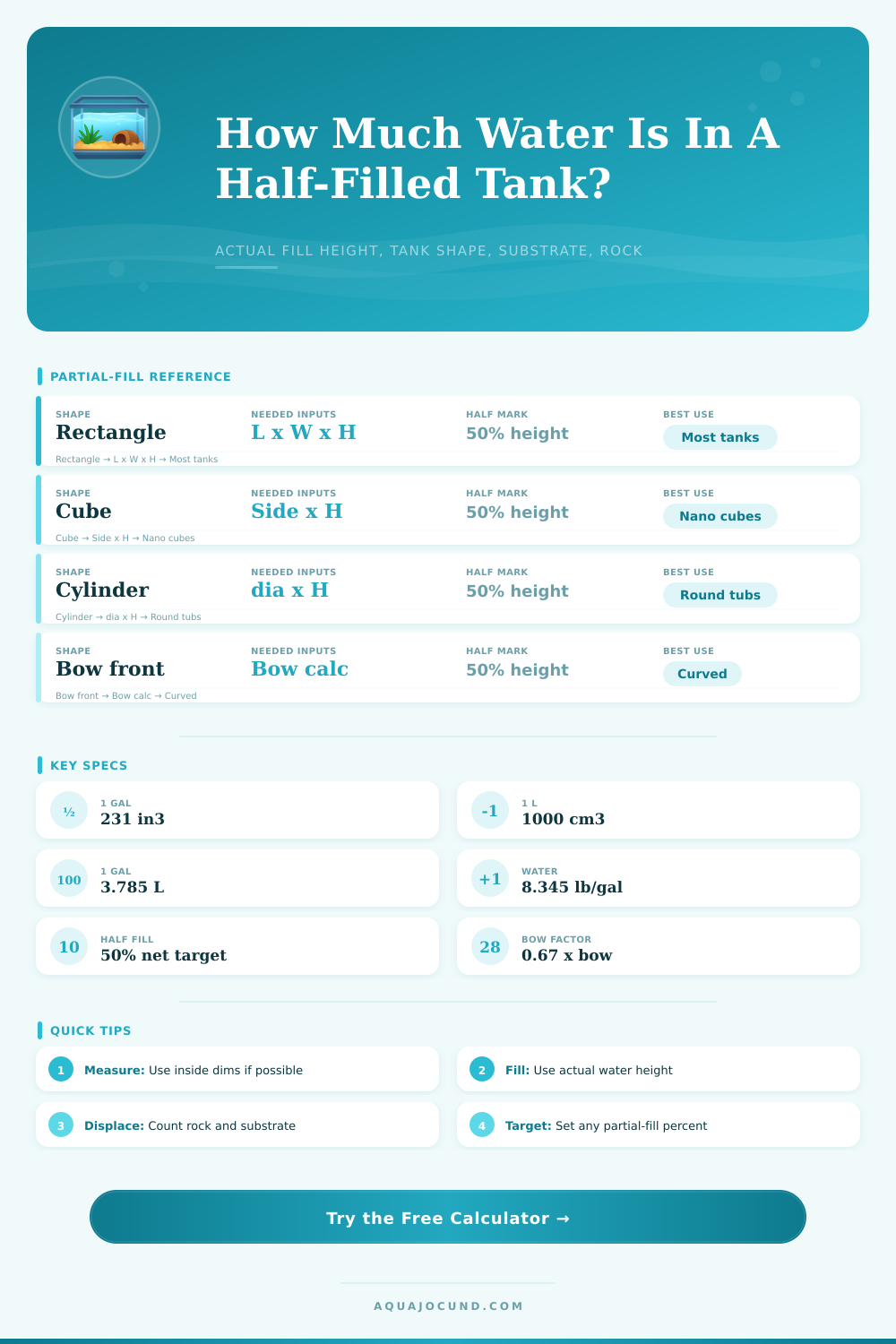
| Tank shape | Gross volume formula | Waterline behavior | Notes |
|---|---|---|---|
| Rectangle | L x W x water height / 231 | Linear with height | Best when inside dimensions are measured. |
| Cube | Side x side x water height / 231 | Linear with height | Useful for cube aquariums with equal front and side lengths. |
| Cylinder | pi x radius2 x water height / 231 | Linear with height | Use inside diameter for round tubs and display cylinders. |
| Bow front | (L x W x h + 0.67 x L x bow x h) / 231 | Linear estimate | Bow depth is the extra front curve depth at the center. |
| Custom footprint | Known footprint area x water height / 231 | Linear estimate | For straight-sided sumps, vats, and odd rectangles. |
| Common tank | Inside dimension example | Clear half volume | With 2 in sand + light rock |
|---|---|---|---|
| 10 gallon | 20 x 10 x 12 in / 51 x 25 x 30 cm | 5.2 gal / 19.7 L | About 3.8-4.5 gal net |
| 20 long | 30 x 12 x 12 in / 76 x 30 x 30 cm | 9.4 gal / 35.7 L | About 7.0-8.2 gal net |
| 40 breeder | 36 x 18 x 16 in / 91 x 46 x 41 cm | 22.4 gal / 84.8 L | About 17-20 gal net |
| 75 gallon | 48 x 18 x 21 in / 122 x 46 x 53 cm | 39.3 gal / 149 L | About 31-35 gal net |
| 125 gallon | 72 x 18 x 22 in / 183 x 46 x 56 cm | 61.7 gal / 234 L | About 50-56 gal net |
| Substrate or rock | Reference data | Displacement treatment | Common half-fill issue |
|---|---|---|---|
| Fine sand | 90 lb/ft3 bulk, SG 2.65 | About 54% of bed volume displaces water | Deep beds remove more net water than expected. |
| Aquarium gravel | 95 lb/ft3 bulk, SG 2.65 | About 58% of bed volume displaces water | Large gaps still fill with water, so use solid fraction. |
| Aragonite sand | 85 lb/ft3 bulk, SG 2.93 | About 47% of bed volume displaces water | Reef sand can be lighter per bed volume than silica sand. |
| Live reef rock | 9.5 lb/gal, 28% water-filled porosity | Weight divided by density, then pore water credited | Porous rock displaces less net water than dense stone. |
| Granite or river rock | 22.4 lb/gal, 2% porosity | Nearly solid displacement from entered weight | Dense rock can strongly reduce half-fill net volume. |
| Target fraction | Typical waterline | Use case | Watch point |
|---|---|---|---|
| 25% | Low quarter mark after displacement | Short leak test stage or shallow holding | Heaters and filters may not stay submerged. |
| 33% | One-third net volume | Drain planning and moving prep | Rock can remain exposed above the waterline. |
| 50% | True half-filled net volume | Half-fill reference, dosing, refill tracking | Waterline may be above the visual halfway mark. |
| 75% | Three-quarter net volume | Quarantine, acclimation, and staged refills | Check overflow teeth and return pump intake height. |
Sometimes it’s a sinking feeling, your aquarium tank weigh more than you’d expect. Most commonly, this occurs when you’re trying to measure amount of water you have available (e.g., water changes) or during a move. It is common to be fooled by how much an aquarium looks like it hold when you are visually estimating its volume. The thick glass distorts things; that curved bow front messes with perception; and the heavy hardscape interior make it difficult to see forest for the trees. What you think is twenty gallons worth of water ready for a change may actualy be hiding another five or six right before your eyes…
This removes the guesswork. Use the calculator (above). How? It break down net volume vs gross volume. Gross volume is space inside the glass. Net volume is the space inside minus all other things. This is where most hobbyists goes astray. Your input includes your actual water height and the inside dimensions.
Why Use an Aquarium Calculator
It also take into account the displacement of rock/substrate. Then you enter density and weight of your hardscape. It then calculates how much that stone displace compared to how much water it hold in its pores. Then there is substrate behavior. Gravel isn’t solid. Sand is not either. It has spaces between grains that fill with water. Some gravels has more space than others (coarser) and some sands has less space than others (finer). In fact, it is so clear that it are laid out in a table on the page called “reference table.” This table show how the solid fraction of material displaces various amounts of water.
Live rock has much lower porosity then that, but that means the rock itself absorbs water which diminishe its displacement effect somewhat. Dense rock such as granite will push water away almost completey. Also consider dimensions of your tank. Straightforward rectangles aside, cylinders and bow fronts behaves differently. Bow fronts include a curved volume that can’t be accounted for with simple width x length calculations. The calculator includes it in total via a standard factor to account for the curvature.
Knowing precisely where water line will be for a particular percentage is important if you’re setting up a quarantine system or simply want to hold off on adding a certain amount of medication until you get there. Perhaps you need to keep equipment submerged and want to minimize the amount of water you’ll have to treat with medication. The application that makes the most sense for me are for moving tanks. If you’re removing water from a display tank, there will always be some water held between rock and substrate. Unless you take them apart, you’ll never get it all drained off. The amount of water still there allow you to prepare for buckets and lift capacity.
And if you’re leak testing? This give you a better idea of how much water is being lost (if any) and whether it’s a small hole or possibly evaporating because the water level is dropping slowly. It’s a bit boring entering those variables (porosity and density), but it makes all the difference. Some rocks displaces more weight in a gallon than others. A dense, solid rock like dragon stone displaces more weight per gallon than a porous, light rock like lava. Those numbers becomes the basis off the displacement calculation so that what comes out is accurate… not just an average.
From there it provide the exact amount of water you have. It tells you how much more or less you need to reach your desired fraction of water. It also shows you where to mark your glass. As it turns out, however, “half full” doesn’t equal “seeing half full”. Every time you add curved glass, sand and stone to a tank the equation shifts. Replacing intuition with arithmetic will allow you to measure the actual water column and take into account the solid mass below it. This help with proper dosing and stops you from overfilling, which means there is far less stress on move day. Knowing the weight of your hobby means you should of not have to guess.