📏 Aquarium Glass Weight Load On Floor Calculator
Estimate glass pane weight, loaded aquarium mass, stand footprint load, point load, joist span effect, and planning safety margin.
| Scenario | Reference Load | Best Placement | Point Load Risk | Calculator Use |
|---|---|---|---|---|
| Upstairs wood floor | 50 psf planning reference | Near bearing wall, crossing joists | High | Use conservative safety factor |
| Ground wood floor | 70 psf planning reference | Against wall over short span | Medium | Check joist span and distribution |
| Known engineered joists | 80 psf planning reference | Confirm joist design and span | Medium | Use actual framing data if available |
| Older unknown floor | 40 psf planning reference | Lowest level or slab preferred | High | Use as a prompt for professional review |
| Concrete slab | 220-250 psf planning reference | Flat, sound slab | Low | Stand leveling still matters |
| Glass | Metric | lb / ft² | kg / m² | Common Aquarium Use |
|---|---|---|---|---|
| 3/16 in | 5 mm | 2.39 | 11.7 | Nano tanks, lids, baffles |
| 1/4 in | 6 mm | 3.19 | 15.6 | 10-40 gallon rimmed tanks |
| 5/16 in | 8 mm | 3.98 | 19.5 | Medium custom tanks |
| 3/8 in | 10 mm | 4.78 | 23.4 | 55-90 gallon aquariums |
| 1/2 in | 12 mm | 6.38 | 31.2 | Rimless and 120+ gallon builds |
| 5/8 in | 15 mm | 7.97 | 38.9 | Deep display panels |
| 3/4 in | 19 mm | 9.56 | 46.7 | Extra-large custom displays |
| Tank | Dimensions | Volume | Typical Loaded System | Floor Note |
|---|---|---|---|---|
| 20 long | 30 x 12 x 12 in / 76 x 30 x 30 cm | 20 gal / 76 L | 230-320 lb | Usually light if spread by cabinet |
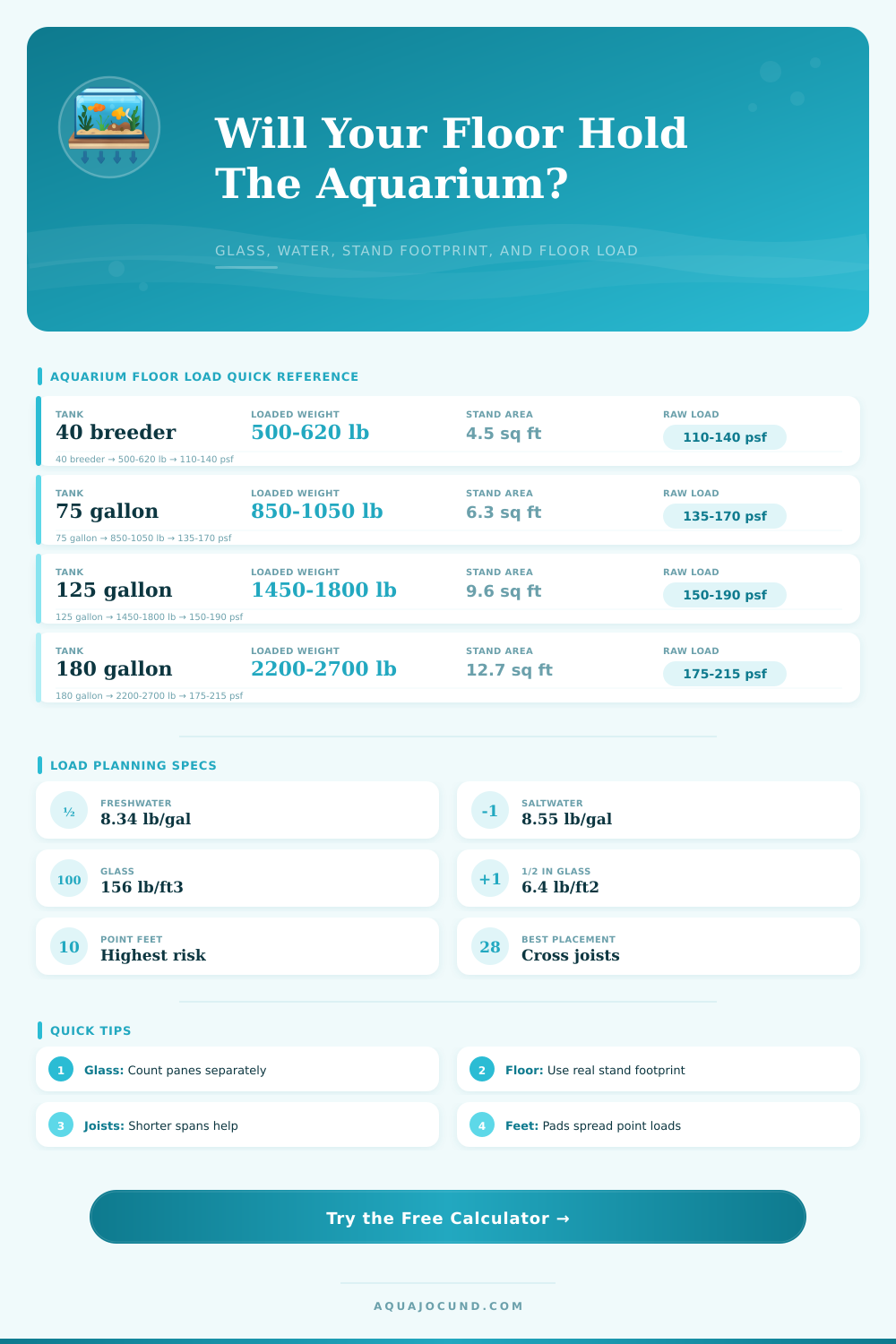
| 40 breeder | 36 x 18 x 16 in / 91 x 46 x 41 cm | 40 gal / 151 L | 500-620 lb | Good footprint for its volume |
| 55 gallon | 48 x 13 x 21 in / 122 x 33 x 53 cm | 55 gal / 208 L | 650-780 lb | Narrow footprint raises psf |
| 75 gallon | 48 x 18 x 21 in / 122 x 46 x 53 cm | 75 gal / 284 L | 850-1050 lb | Cross joists if on wood floor |
| 90 gallon | 48 x 18 x 24 in / 122 x 46 x 61 cm | 90 gal / 341 L | 1000-1250 lb | Tall glass and rock matter |
| 120 gallon | 48 x 24 x 24 in / 122 x 61 x 61 cm | 120 gal / 454 L | 1400-1750 lb | Wide footprint helps distribution |
| 125 gallon | 72 x 18 x 22 in / 183 x 46 x 56 cm | 125 gal / 473 L | 1450-1800 lb | Long tanks should cross several joists |
| 180 gallon | 72 x 24 x 24 in / 183 x 61 x 61 cm | 180 gal / 681 L | 2200-2700 lb | Slab or structural review preferred |
| Stand Type | Distributed Area Used | Point Load Behavior | Best Input Choice |
|---|---|---|---|
| Full cabinet base | Most of footprint | Lower point pressure | Use full stand length and depth |
| Perimeter frame | Rail contact area | Edges carry more load | Use actual rail footprint |
| Plywood load pad | Wider than stand base | Improves distribution | Enter pad size as footprint |
| Metal rack rails | Two narrow bearing lines | Moderate point load | Increase pad area if feet are small |
| Small feet or legs | Very limited contact | Highest local pressure | Enter real foot pad square inches |
Glass weight is only the dry shell. Water usually dominates the total, but rock, substrate, sump water, canopy weight, and thick rimless glass can move a setup from ordinary to heavy very quickly.
Distributed load and point load are different checks. A wide cabinet can lower average psf, while tiny feet can still create high local pressure on tile, subfloor, or joist bays.
Stand on a scale beside your seventy-five gallon tank. Then try to convince yourself its not actualy as heavy than a car! Yeah, I know…that sounds like an exaggeration, but go ahead and check. Freshwater tanks weighs about eight and a third pounds per gallon. For saltwater tanks…it’s a little bit more.
Factor in the weight of the water, some thick glass, some dense substrate, some rockwork, and a cabinet. You are then up into the thousands of pound. The math for safety is less about the tank itself and more about how the floor react to the load. Aquarium keepers worry about supporting their tanks with a stand. While that’s 1/2 of the equation, it’s not where the danger lies.
Why Your Floor Might Break Under a Fish Tank
What happens to all that weight as it moves down through the stand legs to the joist and subfloor beneath? A large heavy cabinet distribute the weight well, reducing the pressure in pounds per square foot. Conversely, narrow metal feet spreads that same weight across very small areas of contact. They increase the pressure on specific spots on the floor boards. Understanding the difference between a point load and a distributed load make all the difference when planning out your setup.
After you enter the dimensions of your tank(s) and stand type, the calculator do all of the math for you. It breaks down the weight into what’s on top (water + contents) and the glass shell, and it even provides the total loaded weight. Why? Adding three inches of sand or heavy gravel can make a huge difference in overall weight. Setting up some dense limestone rock work will have that same impact, but it won’t increase the footprint. If you’re close to max load capacity for your floor type, you want to know how much more it weigh.
Every house has different floor framing. A concrete slab in your basement will be far less restrictive than an upstairs room with traditional wooden joists spanning ten feet. Eventually, too much weight causes the wood floor to sag…or worse, fail structurally. To determine how much weight the floor can handle, the tool accounts for joist orientation, spacing, and span length.
It is always safer to run your long tanks at a right angle to the joists rather than in line with them. By doing this, you spread the weight out over more joist which lowers the stress on one specific area. That’s no mere bureaucratic padding; it’s a safety margin. Home inspectors don’t check fastener strength or confirm actual subfloor condition. Workmanship can vary, and there may be unseen damage or old age in the wood. This creates a need for a conservative reserve factor to allow for what you can’t see from your own livig room carpet.
Eliminating that cushion only creates problems later as the house constanty settles with accumulated stresses. A common error hobbyists make is that they believe all floors are alike. Older houses may have been built with smaller (narrower) floor joists at larger spans than today’s building code allows. If your house is pre-nineteen seventies, there’s a good chance that this is true and the entire floor system are working up to the limits it was designed for. I don’t recommend adding a huge tank into the middle of a space like that.
Ideally, place it towards an interior wall that is not load bearing or on an exterior wall. These locations reduce any bending moment on the joists and reduce deflection as much as possible. Surprisingly, the water makes up most of the load. Even heavy low-iron or borosilicate glass is quite light for its size. Hardscape plus liquid make up most of the weight.
Knowing that helps you prioritize where to save weight if your calculations come back tight. Lightening the load with less substrate depth or using lighter decorative rock can have a big impact. This doesn’t detract from the aesthetics of the aquascape. An aquarium is also a structural decision masquerading as a decoration. You’re adding a massive dead load into your house’s structure.
By spending the time to check the overall weight, distribution across stands, and span between joists, you can make sure your investment stays level and stable over time. It changes what could of been a disaster into something you’ll have forever that only adds value to your space. It transforms a potential disaster into a permanent feature that enhances your space without compromising the integrity of the house around it.
Water weighs a lot. Smart planning gets water under control.