📐 Aquarium Glass Safety Factor Calculator
Estimate hydrostatic pressure, panel bending stress, and the calculated safety factor for aquarium glass panels.
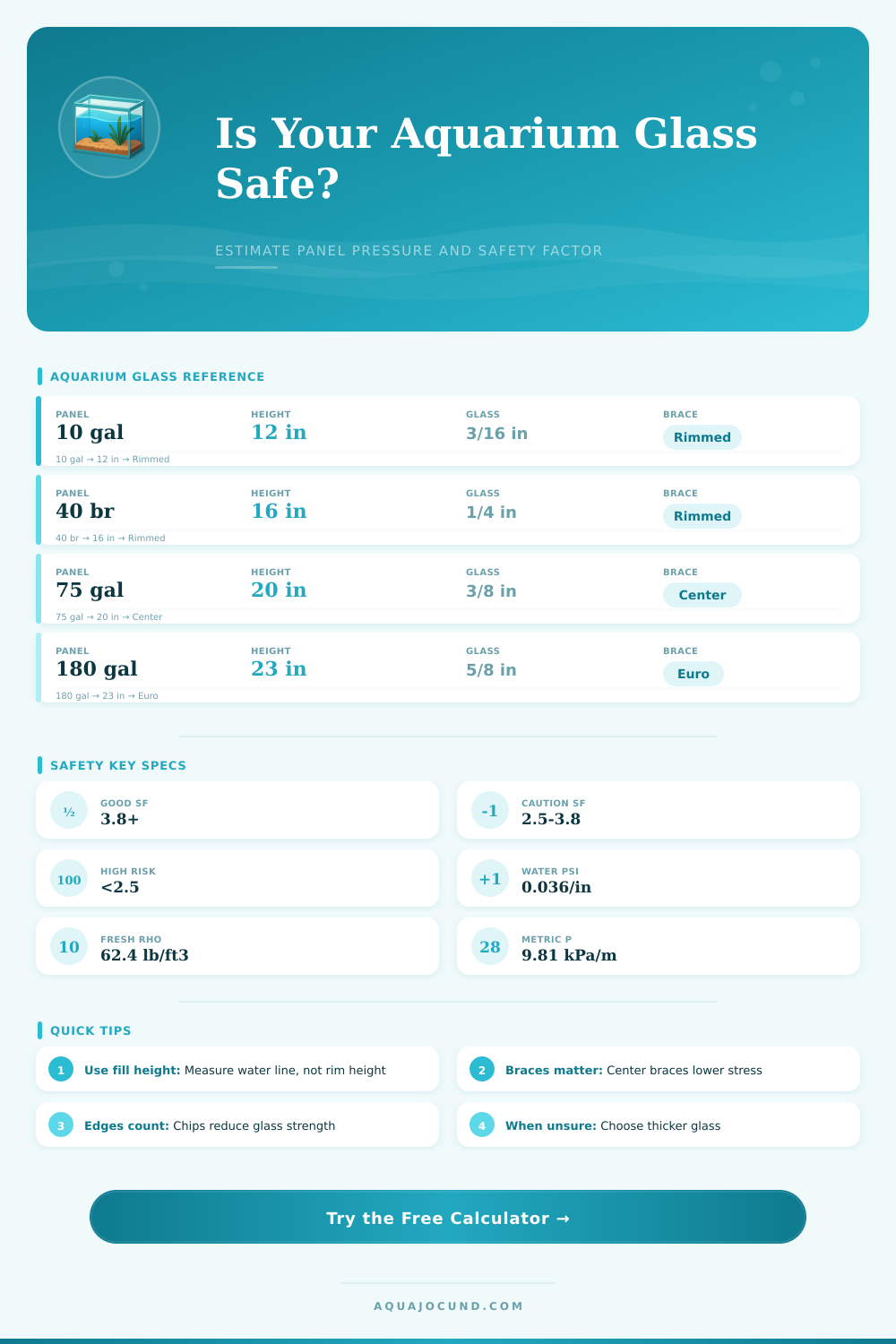
| Safety Factor | Rating | Recommendation | Typical Action |
|---|---|---|---|
| 4.0 and higher | Good | Comfortable estimate for normal aquarium use. | Confirm seams, stand support, and no glass damage. |
| 3.8 to 4.0 | Target | Near a common hobby design target. | Suitable when workmanship and support are sound. |
| 2.5 to 3.8 | Caution | Margins are reduced for chips, uneven stands, or poor bracing. | Use thicker glass, lower water height, or add bracing. |
| Under 2.5 | High Risk | Not recommended from this simplified estimate. | Redesign the panel before filling the aquarium. |
| Glass Type | Design Strength Used | Best Use | Notes |
|---|---|---|---|
| Annealed float glass | 2,800 psi / 19.3 MPa | Most standard aquariums | Can be cut and drilled before assembly. |
| Low-iron aquarium glass | 2,600 psi / 17.9 MPa | Display front panels | Clearer viewing, slightly conservative strength value. |
| Laminated annealed glass | 2,200 psi / 15.2 MPa | Special builds | Interlayer behavior depends on construction and edge seal. |
| Tempered glass | 9,000 psi / 62.1 MPa | Factory-made panels | Cannot be drilled or cut after tempering. |
| Tank | Front Panel | Water Height | Common Glass | Brace Mode |
|---|---|---|---|---|
| 10 gallon | 20 x 12 in | 11 in | 3/16 in | Rimmed |
| 20 long | 30 x 12 in | 11.5 in | 1/4 in | Rimmed |
| 40 breeder | 36 x 17 in | 16 in | 1/4 in | Rimmed |
| 55 gallon | 48 x 21 in | 20 in | 3/8 in | Rimmed |
| 75 gallon | 48 x 21 in | 20 in | 3/8 in | Center brace |
| 90 gallon | 48 x 24 in | 23 in | 1/2 in | Center brace |
| 125 gallon | 72 x 22 in | 21 in | 1/2 in | Center brace |
| 180 gallon | 72 x 24 in | 23 in | 5/8 in | Euro brace |
| Item | Formula Used | Imperial Output | Metric Output |
|---|---|---|---|
| Bottom pressure | Density x gravity x water height | psi | kPa |
| Average pressure | Bottom pressure / 2 | psi | kPa |
| Panel stress | Plate coefficient x pressure x height2 / thickness2 | psi | MPa |
| Safety factor | Adjusted glass strength / estimated stress | ratio | ratio |
- Panel length and height matter: Longer, taller panels bend more, so large front panels often need bracing even when the volume seems modest.
- Water height drives pressure: A shallow frag tank can use a long panel with less pressure than a narrow tall display tank.
- Brace mode changes stress: Center braces and euro braces shorten the effective span and reduce glass deflection in this estimate.
- This is a screening calculator: It is not a structural engineering certificate, warranty, or approval to build a pressure vessel.
- Inspect the real tank: Chipped edges, old silicone, uneven stands, drilled holes, and impact damage can lower the true margin.
- When close, go thicker: If the result lands near a caution threshold, increase thickness or improve bracing before filling the aquarium.
Aquarium glass dont usually fail in a dramatic way. Instead, the aquarium glass usually fails slow at a specific edge or a specific seam in the aquarium. The specific seam that might fail could be the seam where there is a chip in the aquarium glass, where there is an old silicone joint, or where one of the stand’s edge isnt even with the aquarium.
Aquarium water pressure exist from the moment that you fill the aquarium with water. The water pressure builds up against the glass over time. That is why you must use a safety factor calculation to determine whether the aquarium glass is experiencing the water pressure with a large margin or if its close to the limit of the glass.
How to check if your aquarium glass is strong and safe
The aquarium glass calculator will mathematically calculate the strength of the glass after you enter several specific measurements for your aquarium. You must enter the panel length and the panel height of the aquarium into the aquarium glass calculator because the length and height of the glass panels will determine how much the glass will bend. You must enter the water height into the calculator because the water height will determine the pressure that builds up at the bottom of the aquarium.
Use the water fill line rather than the rim of the aquarium. The thickness of the aquarium glass panels must be entered into the aquarium glass calculator. Additionally, you must select the type of bracing that will be used for the aquarium.
A center brace or a euro brace will change the results of the calculation. Lastly, you must select the type of glass that will be used for the aquarium and the condition of the edges of the glass panels. The strength of the glass will change with the type of glass and the edge condition of the aquarium panels.
The result of the aquarium glass calculator will show you the ratio of the strength of the aquarium glass to the stress that the glass panels will experience. A high number indicate that the aquarium glass will be able to handle the stress with a large margin of safety. A low ratio indicates that the aquarium glass will experience more stress than it should be able to.
A low ratio is inherently risky for the aquarium because there are many real-world variable that could impact the strength of the glass. These variables can include the manufacturing of the aquarium stand, the swings in the water temperature of the aquarium, or the way that the silicone slowly creeps over time. While the glass calculator cannot account for these variables, it can warn you of the thin starting margin of safety of the aquarium glass.
Although the total volume of your aquarium is important, the ratio of the thickness of the aquarium glass to the volume of the aquarium is more important. Instead of the total volume, calculate the proportions of the aquarium. For instance, a long and shallow aquarium will require different thickness of aquarium glass than a tall and narrow aquarium.
This is due to the fact that the tall aquarium will have more water pressure on the glass due to the height of the aquarium. Another variable to consider is the width of the front glass panel of a rimless aquarium. Because the panel is so wide, it requires either thicker glass or bracing to support the aquarium.
These variables can all be tested in the aquarium glass calculator to decide on the thickness and bracing of the aquarium before you order the aquarium glass or cut it to size for your aquarium. Some people make the mistake of thinking that all aquarium glass is the same. However, different type of glass have different properties.
For instance, annealed float glass is a common choice for aquariums because you can cut and drill it when installing the aquarium. Tempered glass is another type of glass that is available and is more resistant to breakage; however, it cannot be resized once it is tempered. Finally, laminated panels are one of the weakest forms of aquarium glass because while one of the layers may break, the other layer will remain intact.
However, its strength properties are lower than the strength of plain glass. These different types of aquarium glass will alter the safety factor, and the calculator will allow you to determine whether the increased cost of the aquarium glass is worth the change in the safety factor of the aquarium glass. Aquarium stands may settle over time.
The glass will not move in the same way that the aquarium stands may shift over time. These shifts in the stand may develop stress at the bottom corners of the aquarium glass. If the result of the aquarium glass calculator is close to the caution range for the strength of the glass, then the glass is at risk of breaking.
In these instances, you should of increased the thickness of the glass or improve the bracing of the aquarium stand. Although this aquarium glass calculator is not an exact science, it will provide you with an idea of the safety of the glass. Additionally, it can help you compare the strength of different types of aquarium glass.
However, after you recieve your calculated result, you must inspect the aquarium glass. Make sure that the edges of the aquarium glass do not have chips. Ensure that the seams of the aquarium are even and supported by the aquarium stand.
Finally, ensure that the aquarium stand is level and even with the floor. These measures will ensure that the gap between the calculation of the strength of the aquarium glass and the actual aquarium that is built will be as small as possible.