🐟 Aquarium Glass Panel Cut Calculator
Convert finished outer tank dimensions into front, back, side, bottom, and brace panel cut sizes.
| Profile | Thickness | Approx. In | Typical Use |
|---|---|---|---|
| Picture glass | 3 mm | 0.118 in | Very small lids or baffles, not tall tanks |
| Small aquarium | 5 mm | 0.197 in | Nano and short small tanks |
| Standard aquarium | 6 mm | 0.236 in | 20 long, 29 gal, and similar footprints |
| Mid-size aquarium | 8 mm | 0.315 in | 40 breeder and taller medium tanks |
| Heavy aquarium | 10 mm | 0.394 in | Common for 55 to 75 gal builds |
| Large aquarium | 12 mm | 0.472 in | Large display tanks with bracing |
| Extra heavy | 15 mm | 0.591 in | Deep or long custom builds |
| Build Style | Front / Back | Sides | Bottom Panel |
|---|---|---|---|
| Bottom inside, sides between | Full finished length and height | Width minus two glass panels and gaps | Fits inside all walls, minus inset and gaps |
| Bottom under, sides between | Full length, height minus bottom thickness | Between front/back, height minus bottom thickness | Finished footprint, minus any inset |
| Bottom under, front/back between | Between side panels, height minus bottom thickness | Full width, height minus bottom thickness | Finished footprint, minus any inset |
| Euro brace, bottom inside | Full finished length and height | Between front/back panels | Inside bottom with long and cross braces |
| Tank | Finished Dimensions | Volume | Typical Glass | Brace Note |
|---|---|---|---|---|
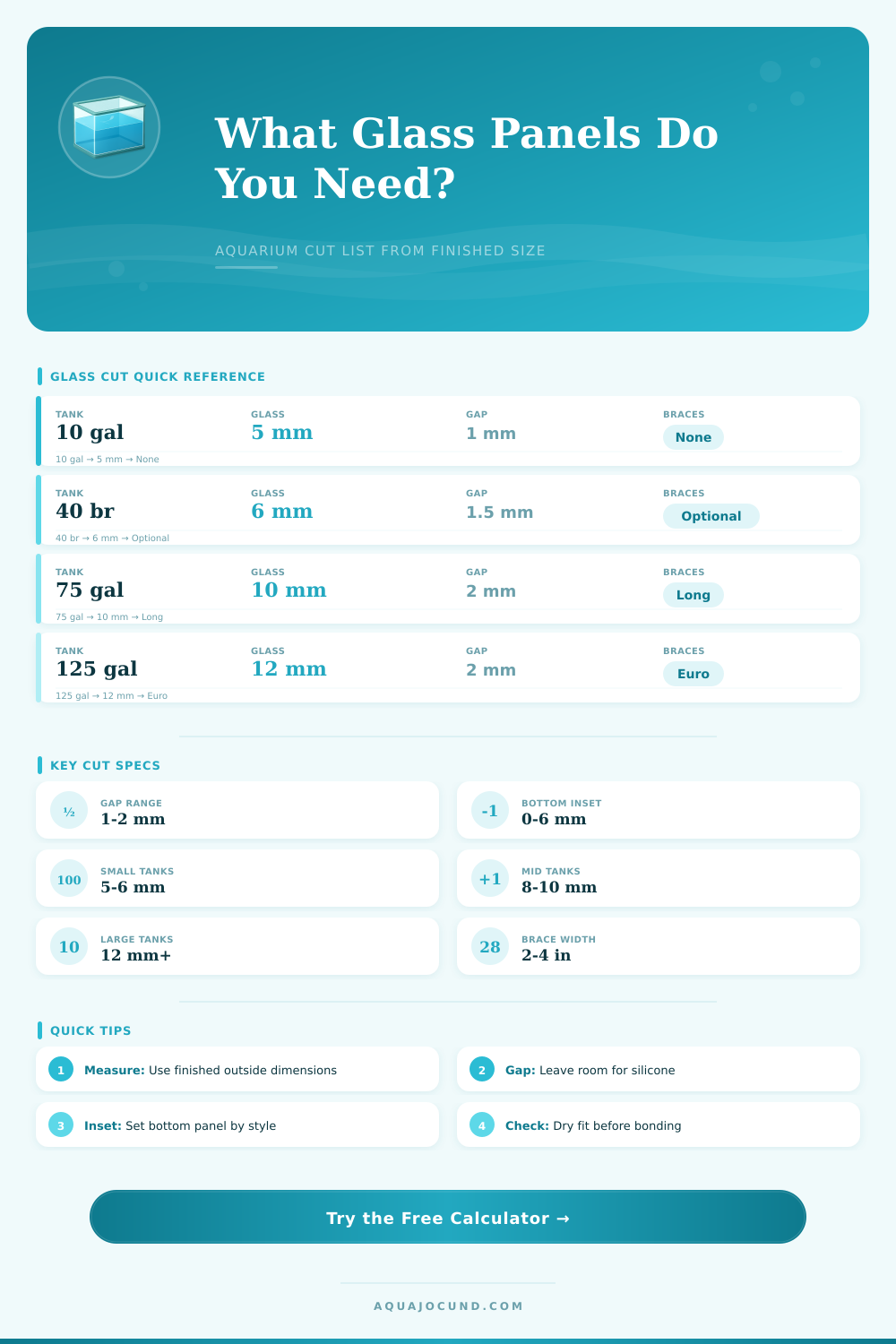
| 5 gal | 16 × 8 × 10 in / 41 × 20 × 25 cm | 5.5 gal / 21 L | 5 mm | Usually none |
| 10 gal | 20 × 10 × 12 in / 51 × 25 × 30 cm | 10.4 gal / 39 L | 5 mm | Usually none |
| 20 long | 30 × 12 × 12 in / 76 × 30 × 30 cm | 18.7 gal / 71 L | 6 mm | Optional center strip |
| 40 breeder | 36 × 18 × 16 in / 91 × 46 × 41 cm | 44.9 gal / 170 L | 8 mm | Optional long braces |
| 75 gal | 48 × 18 × 21 in / 122 × 46 × 53 cm | 78.5 gal / 297 L | 10 mm | Long braces common |
| 125 gal | 72 × 18 × 21 in / 183 × 46 × 53 cm | 117.8 gal / 446 L | 12 mm | Euro bracing common |
| Brace Type | Cut Count | Length Formula | Best Use |
|---|---|---|---|
| Long front/back brace | 2 panels | Inner length minus gaps | Long rimless-style builds |
| Single cross brace | 1 panel | Inner width minus brace overlap | Medium tanks needing center support |
| Double cross brace | 2 panels | Same as cross brace | Long tanks with two openings |
| Euro perimeter | 2 long plus cross braces | Calculated from inner opening | Large glass aquariums |
To build a glass aquarium, you must determine the dimension of each of the glass panels. The dimensions of the finished aquarium will determine the dimensions of each of the glass panels. If the length or the width of a glass panel is miscalculated, the panel will either not fit within the aquarium, or the panels will create gap within the aquarium that the silicone cant fill.
Each aquarium will have different dimension for the front, back, side, and bottom glass panels. These different dimension are required to ensure that the aquarium will not leak, and that the aquarium will not flex against the pressure of the water within the tank. The thickness of the glass panels is another of the primary variable to consider in building the aquarium.
Plan and Measure Glass Panels for an Aquarium
The thickness of the glass panels will determine the amount of pressure that the glass can withstand. Thin glass panels are best utilized in the creation of small aquariums that have small dimensions in relation to they’re height. Aquariums of a longer height, or those that are longer in relation to their width will require thicker glass panels to provide even support to the aquarium.
The thickness of the glass will impact the weight of the aquarium when it is empty of any water or life, as well as the volume of water that the tank can contain. The thickness of the glass should of be selected such that it can handle the height of the aquarium, as well as thick enough to prevent the panels from bowing out of the tank. Similarly, the depth of the tanks and whether or not the bottom panel of the aquarium will be incorporated into the vertical walls will impact the dimensions of the panels.
The depth of the aquarium is best determined by providing a gap between the panels of silicone that will allow for the panels to be bond together. If no gap is provided, the panels may not allow for incorporation of the silicone adhesive. Whether or not the bottom panel of the aquarium will incorporate into the vertical walls will impact the dimensions of either the vertical walls panels or the bottom panel.
The build style for the aquarium will impact the calculation of the aquarium’s dimensions. For instance, if the aquarium is constructed in a way such that the bottom panel of the aquarium is incorporated into the vertical walls, the dimensions of the side panels must be shortened to account for the thickness of the vertical walls. Additionally, if the bottom panel is constructed such that it is placed underneath the vertical panels, the vertical panels will have to be shortened to account for the thickness of the bottom panel.
Additionally, it is also possible to incorporate Euro bracing along the aquarium, which create a rim along the top of the aquarium that increases its stability. The calculator allows for these different build style to be selected, allowing for each build style to be viewed. Bracing is one of the component that is necessary in the construction of any aquarium.
Aquariums that are very long may appear stable when they are empty of water. However, the long aquarium may flex when it is filled with water. To account for this, cross brace can be incorporated into the aquarium that run across the opening at the top of the aquarium.
The number of cross braces that are incorporated will relate to the length of the aquarium. The width of the cross braces will also relate to the length of the aquarium. Cross braces may not be required for small aquariums, but will be required for long aquariums to avoid flexing within the tank.
The reference table contain the dimensions of the sizes of the aquariums that are commonly built. For instance, aquariums that are 48 inches in length, 18 inches in width, and 21 inches in height are some of the most common aquarium size. As such, there are standard thicknesses of glass and bracing for aquariums of these dimensions.
While these standards do not have to be followed, they provide an example of the dimensions that can be utilized for aquarium construction. Additionally, the calculator will automate the process of converting these different unit and dimensions to allow for the user to evaluate the different potential thickness of the glass panels for the aquarium and different build styles. When the dimensions of the aquarium and each of the panels has been calculated, the aquarium must be prepared for assembly.
It may be necessary to order the panels from the glass shop with polished edge. Additionally, if the glass shop will grind the edges of the panels, there will be an extra amount of glass that will be needed for the panels. It is also a good idea to dry fit the aquarium prior to assembling the panels with silicone.
A dry fit will allow individuals to ensure that the aquarium will remain square when assembled. Additionally, assembling the aquarium allows for individuals to ensure that the panels will fit together correctly prior to the incorporation of silicone adhesive. These step will ensure that the aquarium that is built will have the appropriate size for the space in which it will be placed, the type of life that will be included in the tank, and that each of the panels will appropriately fit together.