💧 Aquarium GH KH Adjustment Calculator
Plan hardness, alkalinity, CaCO3 equivalents, dose splitting, and water change drift in one pass.
| Additive | Use | CaCO3 Equivalent | Best Note |
|---|---|---|---|
| Balanced Ca/Mg GH salt | GH only | About 52% | Most useful for RO remineralizing when calcium and magnesium both need support. |
| Calcium sulfate dihydrate | GH only | 58.1% | Adds calcium hardness without raising KH; dissolves more slowly than chloride salts. |
| Magnesium sulfate heptahydrate | GH only | 40.6% | Adds magnesium hardness; use with calcium when a balanced Ca:Mg ratio matters. |
| Sodium bicarbonate | KH buffer | 59.6% | Common alkalinity buffer; it raises KH and tends to nudge pH upward. |
| Potassium bicarbonate | KH buffer | 50.0% | Useful in planted tanks when potassium addition is acceptable. |
| Carbonate salts | KH buffer | 72.4-94.4% | Stronger pH effect; split carefully and retest after each dose. |
| Livestock Profile | Typical GH | Typical KH | Adjustment Style |
|---|---|---|---|
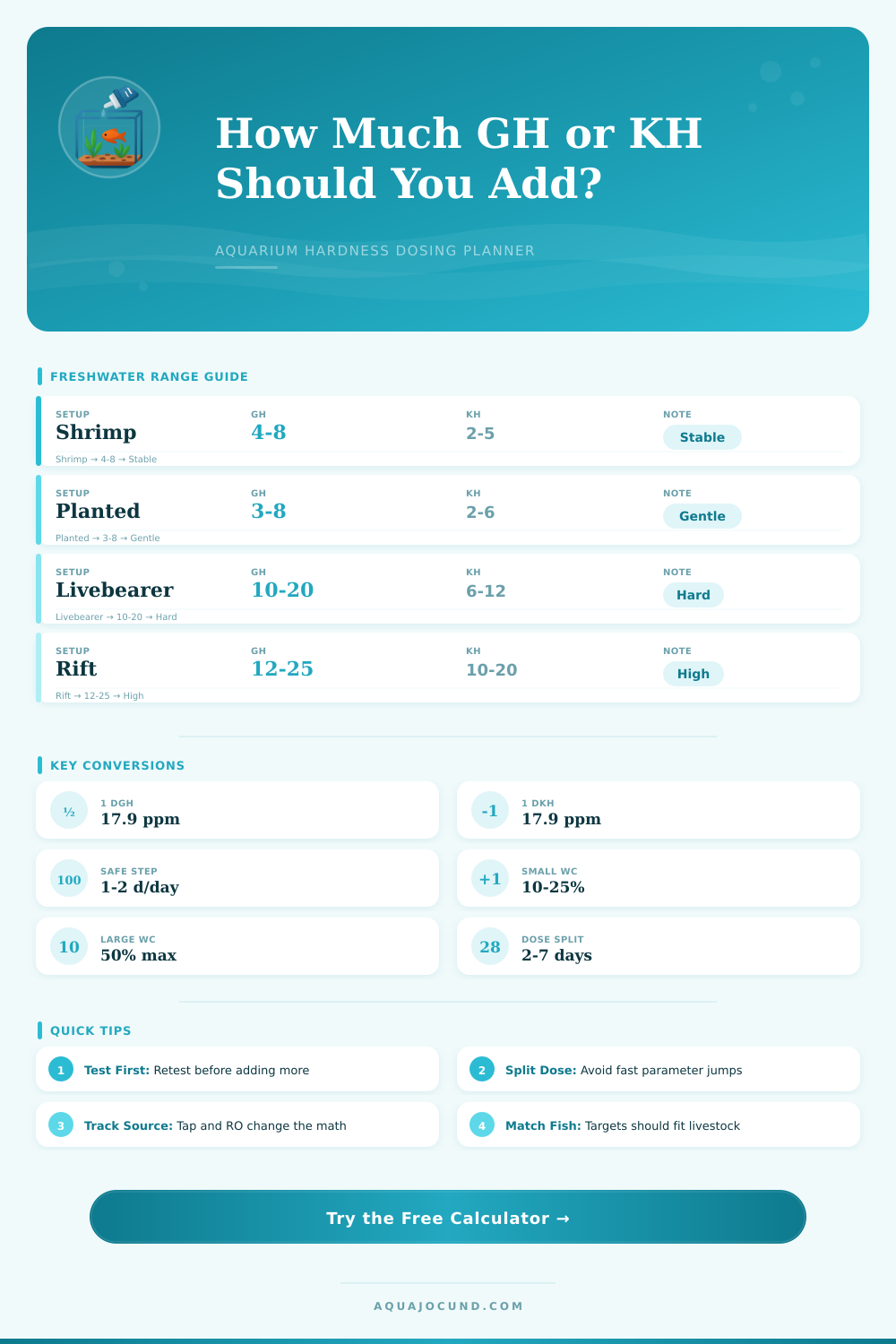
| Caridina shrimp | 3-6 dGH | 0-2 dKH | Soft Use remineralized RO and avoid KH creep. |
| Discus / softwater | 1-6 dGH | 0-3 dKH | Soft Small shifts are safer than chasing exact numbers. |
| Planted community | 3-8 dGH | 2-6 dKH | Moderate Balance plant needs with livestock tolerance. |
| Neocaridina shrimp | 6-10 dGH | 3-8 dKH | Stable Stability usually matters more than a perfect target. |
| Goldfish | 8-18 dGH | 4-12 dKH | Hard Moderate KH helps resist pH swings. |
| Livebearers | 10-20 dGH | 6-12 dKH | Hard Guppies, mollies, and platies prefer mineral-rich water. |
| Rift lake cichlids | 12-25 dGH | 10-20 dKH | High Raise GH and KH together, then keep water changes consistent. |
| Scenario | Formula | Impact | Use Case |
|---|---|---|---|
| 25% RO change | Tank x 0.75 + RO x 0.25 | Dilutes GH and KH | Lowering hardness slowly without chemical reducers. |
| 25% hard tap change | Tank x 0.75 + tap x 0.25 | Raises GH/KH drift | Hard source water can undo softwater targets. |
| 50% emergency change | Tank x 0.50 + source x 0.50 | Large swing risk | Match temperature and minerals before big changes. |
| Remineralized RO | Source set to target | Stable repeat | Best method for shrimp, softwater, and precise setups. |
Aquarium water chemistry involve monitoring specific number. There are several different parameter involved in aquarium water chemistry. The most common test for aquarium water chemistry is the test for pH.
Aquarium chemistry require that the pH of the water be tested because the pH affect the behavior of the fish in the tank. However, the other two most important parameter for most aquariums are general hardness (GH) and carbonate hardness (KH). The GH and KH parameters ensures that the chemistry of the water in the aquarium is stable.
How to Measure and Adjust GH and KH in Your Aquarium
If the GH and KH of the water drift away from the requirement of the fish in the aquarium, then the chemistry of the aquarium water becomes difficult to manage. In order to manage the aquarium’s chemistry, it is important to understand how many to change the GH and KH level in the tank. Additionally, it is important to understand how quick to change the GH and KH levels.
If the GH and KH levels in the tank are raised too quick, the shrimp and other delicate fish in the tank may experience stress. Additionally, if the KH is raised without raising the GH, the resulting water chemistry can cause the pH of the water in the aquarium to rise to a level higher than that which is desired. Lowering the GH or KH in the aquarium is a more difficult task because the only surefire way to lower these parameter is to perform a series of water change using softer water.
Because lowering the GH and KH levels in the tank is difficult, aquarium keeper often instead choose to raise the levels of GH and KH. Water changes can be used to dilute the aquarium water, which help to manage the GH and KH levels. To calculate the amount of additives that should be used to raise or lower the GH or KH in the aquarium water, a mathematical process can be used.
However, the math behind calculating the amount of additive can become difficult. The variable that must be accounted for include the volume of the aquarium, the current GH and KH levels of the tanks water, the desired GH and KH level, and the strength of the additives that are to be use. The calculator that is provided can help to make the calculation for GH and KH changes.
The calculator ask for the dimensions of the aquarium or the volume of water that the aquarium contain. Based off the tank dimensions and the volume of the tank, the calculator can account for the water change that is to be perform. The calculator asks for the current GH and KH levels of the aquarium’s water, the desired GH and KH levels of the tank water, and the type of additive that is to be used.
Each type of additive contains a different amount of calcium carbonate than other type of additives. Additionally, a balance remineralizing salt contains a different amount of mineral than other chemicals, such as pure calcium chloride or sodium bicarbonate. Therefore, the amount of each type of additive vary.
The calculator can calculate the total amount of additive that is required for the tank, and can spread the total amount of additive over a number of day. Each tank owner can determine the rate at which the GH or KH parameters is to rise by the tank’s livestock; the calculator will follow this rise parameter. Using a dosing schedule makes it possible for the GH and KH parameters to remain within the comfort zone of the fish in the aquarium.
Each species of livestock has its own preference for the GH and KH levels of the water in the tank. Shrimp that come from soft and acidic habitat may have issues with high levels of KH. Thus, shrimp require low levels of KH in their water.
Rift lake cichlids come from regions where the water contain high levels of GH and KH. Thus, rift lake cichlids require water with high levels of both of these parameter. One way of choosing the proper GH and KH level in the tank is to use the species selection menu that is provided by the calculator.
Each species will have a typical range for its requirement of GH and KH parameters. These parameter remove the guesswork as to what level of GH and KH to use in the aquarium. However, the owner can override the GH and KH parameters should they have information about the requirement of the species in their aquarium.
The target GH and KH level should reflect the requirement of the livestock that are cared for in the aquarium. Another factor that can complicate the dosing schedule of the aquarium is the changes in water caused by water change. Water changes will reset the chemistry in the aquarium.
For example, if 25% of the water is changed with soft water, the GH and KH level in the tank will drop. The calculator takes into account the percentage of water change and the hardness of the water that is to be use to change the water in the aquarium. Additionally, the calculator can estimate the effect that future water change will have on the parameter.
The calculator also consider the effect of water changes with the dosing schedule. The substrate, hardscape, and air gap in the aquarium will impact the volume of water in the aquarium. For example, a tank that measure 48 inches in width, 18 inches in height, and 20 inches in depth does not necessarily contain the same volume of water as a tank of those dimension; the rocks, sand, and other equipment placed in the aquarium will displace some of the water.
The net volume adjustment field in the calculator allow for the water volume in the aquarium to be reduced by a percentage to reflect this. If the working volume of the aquarium is reduced, the total amount of grams of additive that must be dose will not be too high. High levels of the additive may overwhelm the aquarium’s water.
The calculator allow for the tank owner to add the parameter of GH and KH. However, it is still important to test the aquarium water after each partial dose of the additive. The calculator provide a start to the parameter that the tank owner must adjust to achieve the best result for the livestock in the aquarium.
The calculator cannot replace the need for testing the aquarium water. Additionally, stability in the aquarium is more important than perfect level of GH or KH parameter. Stability of the water parameter is more important once the livestock has established itself in the aquarium.
Having small fluctuation in the levels of the parameter is better for the livestock than large change. Large change to the parameter will cause the parameter to move in the opposite direction of the change after each water change. Thus, it is helpful for the tank owner to use the calculator to make the first change to the water parameter; the calculator makes chemistry become measurable amount to manage the tanks chemistry rather than using estimated amount of chemical.