📏 Floor Load Aquarium Weight Calculator
Estimate loaded aquarium weight, stand footprint, floor load, joist spread, and planning margin.
| Scenario | Planning PSF | Best Placement | Calculator Meaning |
|---|---|---|---|
| Concrete slab on grade | 250+ | Flat, dry slab | Usually highest aquarium margin |
| Basement concrete slab | 220+ | Over intact concrete | Strong support when moisture is controlled |
| Ground floor wood | 70 | Near load-bearing wall, crossing joists | Often workable for medium tanks with good spread |
| Upstairs wood-framed room | 50 | Against bearing wall, across several joists | Needs conservative review for large aquariums |
| Older or unknown framing | 40 | Verify joists, span, and subfloor first | Lowest planning allowance in this calculator |
| Input | Better Case | Weaker Case | Why It Matters |
|---|---|---|---|
| Joist orientation | Tank length crosses joists | Tank length runs with joists | Crossing joists shares load across more framing members |
| Stand footprint | Full cabinet or pad | Small feet or narrow rails | Continuous contact lowers localized pressure |
| Wall placement | Near bearing wall | Middle of a long span | Joists deflect less near a support |
| Subfloor condition | Flat, dry, fastened | Soft, cut, damaged, uneven | Point loads can become the limiting issue |
| Tank Size | Dimensions in (cm) | Footprint | Typical Loaded Weight | Typical Stand PSF |
|---|---|---|---|---|
| 20 long | 30 x 12 x 12 (76 x 30 x 30) | 2.5 sq ft | 240-300 lb | 95-120 psf |
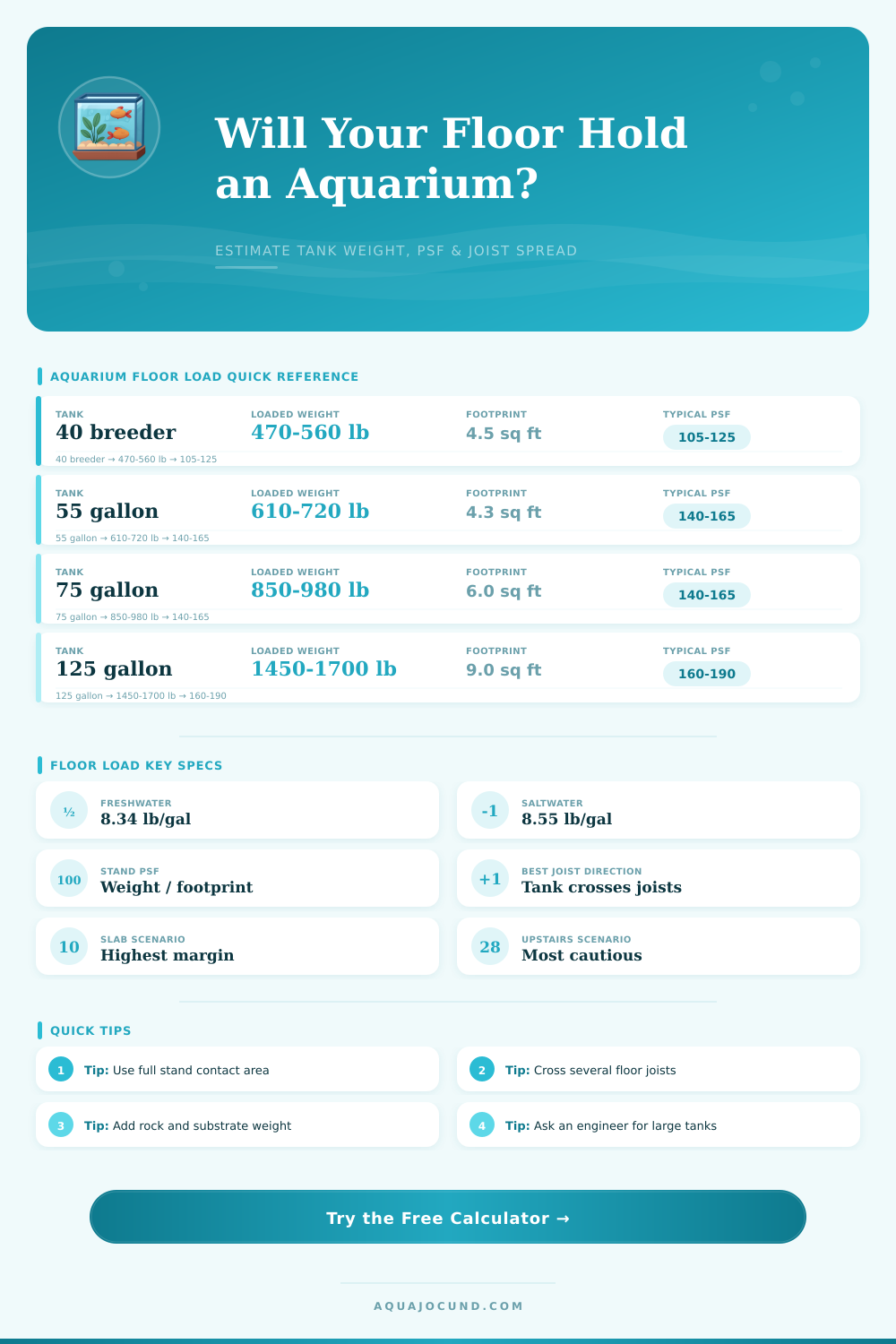
| 40 breeder | 36 x 18 x 16 (91 x 46 x 41) | 4.5 sq ft | 470-560 lb | 105-125 psf |
| 55 gallon | 48 x 13 x 21 (122 x 33 x 53) | 4.3 sq ft | 610-720 lb | 140-165 psf |
| 75 gallon | 48 x 18 x 21 (122 x 46 x 53) | 6.0 sq ft | 850-980 lb | 140-165 psf |
| 125 gallon | 72 x 18 x 22 (183 x 46 x 56) | 9.0 sq ft | 1450-1700 lb | 160-190 psf |
| 180 gallon | 72 x 24 x 24 (183 x 61 x 61) | 12.0 sq ft | 2100-2450 lb | 175-205 psf |
| Material | Approx Density | 1 in Over 6 sq ft | Use In Calculator |
|---|---|---|---|
| Fine sand | 90 lb/ft³ | 45 lb | Dense freshwater or reef sand beds |
| Aquarium gravel | 100 lb/ft³ | 50 lb | Heavier coarse substrate |
| Crushed coral | 80 lb/ft³ | 40 lb | Marine or hard-water substrate |
| Aquasoil | 55 lb/ft³ | 28 lb | Lighter planted tanks |
| Planted soil/cap | 75 lb/ft³ | 38 lb | Mixed soil and cap estimates |
| Bare bottom | 0 lb/ft³ | 0 lb | Quarantine, breeder, or minimalist setups |
When you place a large aquarium in a home, you must first determine if the floor can support the weight of that aquarium. The weight of the aquarium includes the weight of the glass of the tank, the weight of the water in the tank, the weight of the substrate in the tank, the weight of any rocks placed in the tank, and the weight of the aquarium stand upon which the aquarium will sit. While the dimensions of the aquarium or the appearance of the aquarium are critical factors in choosing the best aquarium for your home, you must also consider the weight of the aquarium.
A calculation of the load that the aquarium will place upon the floor will help to ensure that your floor will remain intact with the addition of the aquarium. To calculate the load of the aquarium that will be placed upon the floor, there are several different factors that must be entered into the calculator. The shape and dimensions of the aquarium will determine the volume of water that the aquarium will contain.
Make sure your floor can hold a big aquarium
The type of water that will fill the tank (freshwater or saltwater) will impact the weight of the aquarium, as saltwater is heavier than freshwater. The type of construction of the aquarium will impact the weight of the aquarium when empty; an aquarium made of thick glass that does not include a rim will weigh more than an aquarium constructed in a standard manner with a rim. The substrate that you are to place within the tank will impact the weight; a substrate like sand will weigh more than a substrate like aquasoil.
Additionally, you will place the weight of any rocks, a sump, and any aquarium equipment into the calculation. Finally, you will enter the weight of the aquarium stand and the footprint of the aquarium stand into the calculator; a full cabinet aquarium stand will distribute the weight of the aquarium differently than a stand that has four small feet. Beyond entering the information related to the aquarium itself, you must also enter information related to the floor scenario.
The type of floor scenario (concrete slab on grade versus wood-framed floor) will impact the load that that floor can support. Additionally, the orientation of the joists that make up the floor will impact the distribution of the weight of the aquarium; joists that are crossing the aquarium versus those that are running parallel to the aquarium will distribute the weight of the aquarium differently. By entering each of these variables into the load calculator, you can determine the load of the aquarium.
In addition to determining the load that will be placed upon the floor (the raw stand-footprint load and distributed load), the calculator will also compare that load to the reference value of that scenario to determine a safety margin for the floor. The calculator will output to the user raw information about the aquarium and the load that it will place upon the floor; the raw load in pounds per square foot that will be placed upon the floor, the distributed value of the load (distributed by the aquarium stand and the joists), and the safety margin that exists before the floor reaches its limit. A low percentage margin indicates that there is little safety in using that floor for the aquarium; while the floor may not fail with such a margin, it is recommended that you perform a professional review of the floor in such a situation.
In addition to the information that is collected and entered into the calculator, there are some complications to consider regarding the actual house in which the aquarium will be placed. For instance, the joists may be of an older construction and may have holes in them from wires or plumbing. The subfloors may be uneven.
The floor may flex under the aquarium; it may bend due to long spans between joists. Vibration from other appliances in the house may also impact the safety of the floor. In these cases, you should always use extra caution in placing the aquarium upon an upstairs floor if the tank and its contents weigh more than 900 lbs.
While it may seem that placing the aquarium on the ground floor will always be safe, this isnt true if you are to place the aquarium in the middle of a wide span of floor. While it may seem that placing the aquarium on an upstairs floor will always be unsafe, this is not true if the aquarium is small in size. Each scenario is different and depends off the construction of the floor scenario in which the aquarium will be placed.
The reference tables will show the weight (in lbs/ft^2) of different sizes of aquariums when they are loaded. Within these tables is information about the weight of the different substrates that can be used within the aquarium. These reference tables can be used to help you set expectations for your aquarium and its load upon the floor.
It is common for individuals to ignore the raw pounds per square foot value and to only consider the distributed load. The raw load can be high yet acceptable if the aquarium stand distributes it to the joists. However, a low raw pounds per square foot value may be problematic if the stand for the aquarium has narrow feet or the joists is running parallel to the aquarium.
It is important to consider both of these loads when making your decision. Additionally, it is also possible to ignore the weight of any rocks that are placed within the tank, the substrate, and the equipment that is placed within the aquarium. For instance, an aquarium that contains reefs will have live rock and a sump that can weigh several hundred pounds.
In these situations, be sure to consider the weight of the rocks, substrate, and equipment within the aquarium. It is also important to ensure that you fill the aquarium to the appropriate percentage of its total volume; if the aquarium is to be filled to a percentage that is less than 100%, be sure to adjust the fill percentage within the calculator. By using this calculator prior to the purchase of your aquarium or its placement within your home, you can save time.
By placing the aquarium of different sizes and using different footprints for the aquarium stand, you can understand how the safety margin of the floor will change with each scenario. For instance, if you find that the narrowest aquarium stand creates a low safety margin upon the upstairs floor, you can make a decision to purchase a different aquarium or to place the aquarium in a different location. Overall, the goal of the aquarium floor load calculator is to provide you with information regarding the behavior of the weight of the aquarium under the conditions of your floor.
You should of checked the floor first. Most people dont realize how heavy water is, and they’re weight estimates can be wrong. If you want to avoid a disaster, youll need to use the calculator to be sure.
A luxurios aquarium looks great, but its a lot of weight. A single adult-sized sofa isnt as heavy as a full tank of water. Most people thinks the floor is strong enough, but they arent always right.
Dont make the same mistake as them. It is actualy easier to check teh floor now then later. When the water leaks, it will be a big problem.
You should of planned ahead.