Aquarium Filter Media Replacement Cost Calculator
Estimate cartridge, floss, carbon, GFO, and biomedia replacement cost from media volume, intervals, rinse reuse cycles, tank load, pack pricing, and safety stock.
📏Tank volume and filtration load
🧪Media schedule and pack costs
Use the filled basket, reactor, bag, or tray volume changed at one service.
Applies mainly to mechanical pads, sponge blocks, and coarse prefilters.
Use extra allowance for cut-to-fit pads, messy reactor refills, and media discarded during cleaning.
Cost Breakdown
🧰Media type comparison grid
📊Reference tables
| Media type | Typical interval | Rinse reuse | Cost driver |
|---|---|---|---|
| Poly floss or fine pad | 3 to 14 days | Low | Frequency and cut waste |
| Disposable cartridge pad | 2 to 4 weeks | Low to moderate | Cartridges per service |
| Coarse sponge block | Rinse monthly, replace slowly | High | Annual wear and collapse |
| Activated carbon | 2 to 4 weeks | Very low | Pack volume and tint load |
| GFO or phosphate media | 4 to 8 weeks | Very low | Phosphate uptake demand |
| Ceramic biomedia | Replace 10 to 20% yearly | High | Breakage, clogging, upgrades |
| Ion exchange resin | Exhaustion based | Very low | Water chemistry and color change |
| Filtration preset | Real use case | Common media mix | Planning interval |
|---|---|---|---|
| 5 gal sponge | Betta or shrimp nano | Sponge, tiny polishing pad | Rinse 14 to 30 days |
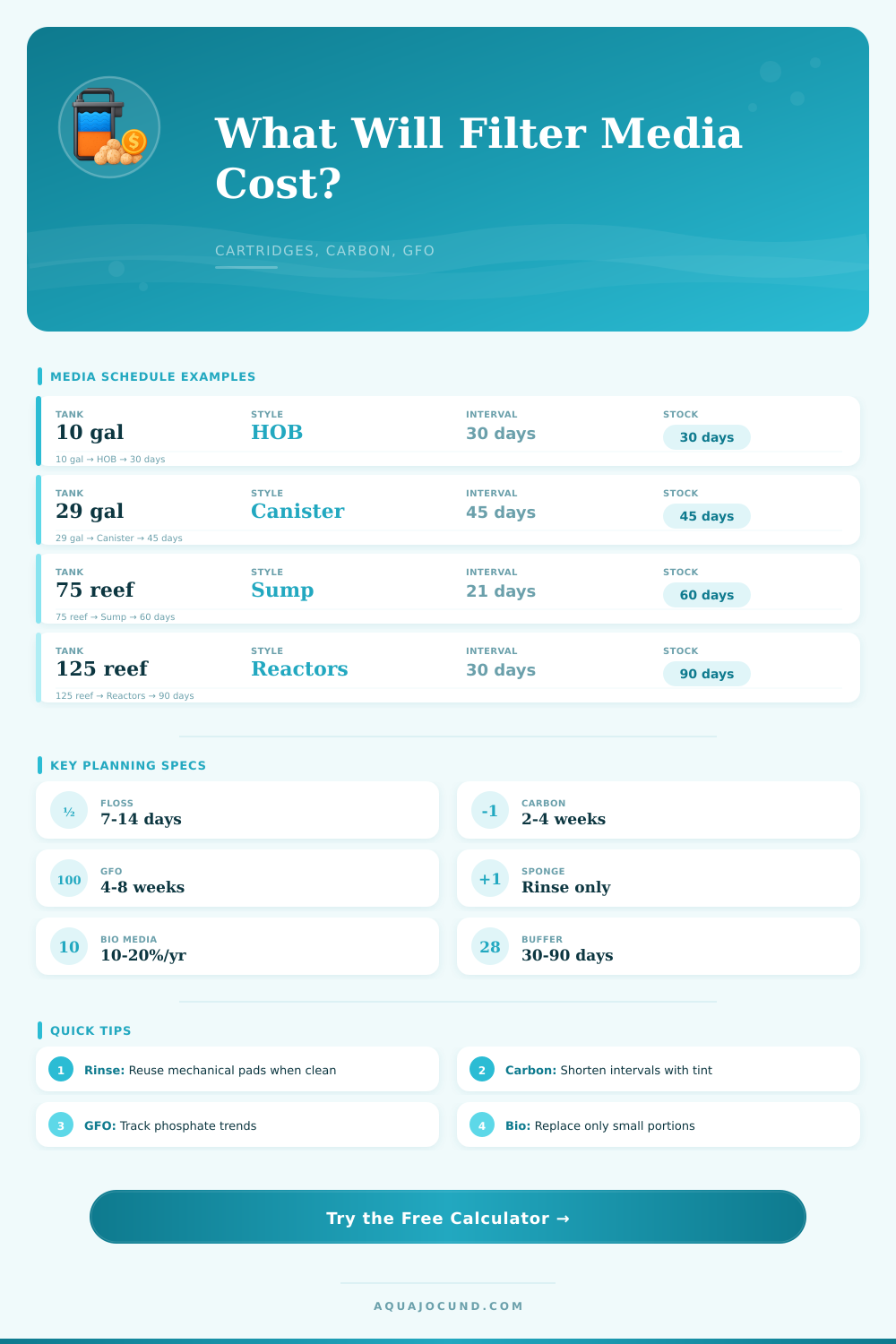
| 10 gal HOB | Nano community | 1 cartridge, small carbon pouch | 21 to 30 days |
| 20 long pads | Community or fry grow-out | Floss, sponge, light carbon | 14 to 30 days |
| 29 planted | Canister with prefilter | Sponge, biomedia, optional carbon | 30 to 45 days |
| 55 cichlid | Messy high-feed tank | Coarse pads and biomedia | 14 to 21 days |
| 75 reef sump | Filter cup plus media bags | Floss, carbon, GFO, biomedia | 7 to 30 days |
| 125 reef reactors | Large reef with reactors | Carbon, GFO, socks or cups | 21 to 45 days |
| Tank size | Dimensions | Typical loose media | Cartridges or pads |
|---|---|---|---|
| 10 gallon | 20 x 10 x 12 in / 51 x 25 x 30 cm | 0.5 to 1.5 cups / 0.12 to 0.35 L | 1 small pad |
| 20 long | 30 x 12 x 12 in / 76 x 30 x 30 cm | 1 to 2 cups / 0.24 to 0.47 L | 1 to 2 pads |
| 40 breeder | 36 x 18 x 16 in / 91 x 46 x 41 cm | 2 to 4 cups / 0.47 to 0.95 L | 2 pads or tray layers |
| 75 gallon | 48 x 18 x 21 in / 122 x 46 x 53 cm | 4 to 8 cups / 0.95 to 1.89 L | 2 to 4 pads or cups |
| 125 gallon | 72 x 18 x 21 in / 183 x 46 x 53 cm | 8 to 16 cups / 1.89 to 3.79 L | 4+ pads, socks, or trays |
| Cost item | Calculator treatment | Why it matters | Adjustment clue |
|---|---|---|---|
| Mechanical media | Pad cost plus loose mechanical volume | Often the most frequent discard | Raise rinse cycles if pads stay intact |
| Activated carbon | Carbon share x pack price per volume | Usually replaced on a fixed clock | Shorten if water yellows quickly |
| GFO | GFO share x pack price per volume | Higher unit cost, longer interval | Base on phosphate trend |
| Biomedia | Small yearly attrition cost | Not normally changed at each service | Replace only clogged or crumbling portions |
| Safety stock | Daily average cost x reserve days | Keeps one or more services on hand | Increase for reef or remote supply |
💡Media replacement cost tips
Likely you purchased your aquarium filter as a single unit. You know what it’s like; you buy a car without ever considering the monthly gas expense. Similarly, biological waste converts to dissolved organic matter and becomes visible debris which require removal/breakdown each and every month to maintain clear water. Rather than planning, most hobbyists guess, remembering the last time they were out of filter pads/carbon. That strategy result in the “oh crap” moment in the pet store aisle where you realize that your special cartridge size is three bucks higher then the off brand variety.
The dynamic shifts once you begin planning ahead, because you now consider annual cost, not individual transactions. To calculate what a given volume tank costs for specific media types, just select each option in the dropdowns below, plug in your numbers, and let the calculator do the rest. It will automatically distinguish between chemical (i.e., activated carbon) vs. It distinguishes between chemical and mechanical media, such as poly floss, and shows you what to expect on your wallet every month. Because chemical media doesn’t fail in the same way or at the same time as mechanical media, it keeps things simple yet accurate.
How to Save Money on Aquarium Filter Supplies
Activated carbon (AC) removes dissolved odors and tints well, but its capacity decrease with use. Even if it appears pristine, it should of been changed every few weeks. Fine pads/poly floss, Physical particles rapidly clog this type of media, making it require service within a couple of weeks. Granular ferric oxide is a specialty media used in phosphate removal by reef keepers; this stuff is expensive but lasts longer then other options. Once you grasp these differences, you won’t treat all your media as disposable, one-time-use garbage bags that “magically” dissapears when exhausted.
You can rinse and reuse these, but people overlook this step to much. Pre-filter pads and sponge blocks is coarse media. When used as a prefilter they don’t need to be replaced with each water change. Rather, you simply rinse them out in dechlorinated water which will remove any sludge but leave all those good bacteria still alive within their pores. Each time you can rinse rather than replace a piece of mechanical media, you’re extending its life and reducing your average daily cost. The tool has you input how often you’ll reuse a pad before ultimately throwing it out. This simple behavior change add up to big savings over the course of a year.
Regeneration, Chemical media such as GFO and carbon cannot be regenerated at home without harsh chemicals or high heat. They simply fill up over time and then sit there taking up space inside your canister or sump. To calculate this expense, the calculator assume a certain number of packs per month (based off how much media you have) and the cost per pack. The more organic loading from things like messy fish such as goldfish and cichlids, the quicker you’ll deplete your carbon. You can adjust the tank load setting to account for this fact. This prevents you from budgeting for an ideal nano tank scenario when you are actualy feeding five big tangs twice daily.
Another idea worth taking seriously is safety stock. Out-of-stock filter media means you have to make an inconvenient call or click online at an inconvenient time and pay extra for something available now. Having a supply of GFO, carbon bags, and cartridges on hand allow you to maintain the system when it truly requires maintenance instead of in some emergency situation when you’re least prepared for it. This buffer stock has a projected cost as well so you can estimate your cost for coverage. Think of it as insurance against those cloudy emergencies and brown water episodes that occur precisely when you’d least like them to!
Unlike other types of media, biomedia isn’t meant to be mechanical; it’s there to serve a biological purpose. It’s typically made from ceramic rings, sintered glass (both of which offer surface area for bacteria to colonize), and if you’re lucky, it lasts longer than the time required to replace all the media. Generally speaking, replacing at least a portion of the biomass once per year help ensure bacterial diversity without crashing the nitrogen cycle. Most experts suggest removing roughly ten to twenty percent of the biomedia each year. This accounts for attrition, so it’s a reasonable cost when treating bio media as an annual expense (which is how responsible husbandry works). Many hobbyists treat bio media as a monthly expense; a waste of both your money and water stability.
Filtration budgeting isn’t perfect (nothing ever is). But it’s consistently better. It doesn’t need to be exact; you may never precisely know how much time remains before your carbon fails. However, you’ll get pretty close so you can know for sure when to restock. And this calculator helps make the vague worry of when to change things into something precise: a dollar amount. You can measure it like electricity, food, and more. With that amount in mind, stocking up is no longer a last-minute scramble; it’s a strategic purchase. Money doesn’t buy happiness, but clear water does. Knowing exactly what that cost is lets you pursue that happiness guilt-free without running into unexpected expenses when you change your filter.