Aquarium Fill Time Calculator
Estimate how long a tank, water change, RO/DI barrel, or mixing station refill will take after head height, method losses, shutoff buffer, and pause checks.
Use the actual water being added, not always the full display rating.
Set 0 for an empty tank, or enter the current fill level.
Measure with a bucket test when possible.
Typical membranes are rated at ideal pressure and temperature.
Vertical lift from source water level to tank rim.
Leaves room for hands, rock, equipment, or final adjustment.
For bucket, barrel, brute can, or saltwater mixing station cycles.
Use for dechlorinator contact time, salt mixing delay, or temperature matching.
Tap Hose or Python
Fast for freshwater fills and large water changes when temperature and conditioner are controlled.
Typical rate: 2 to 5 GPMBucket Batches
Best for nanos, quarantine tanks, and small controlled changes where pauses are part of the workflow.
Typical rate: 1 to 2.5 GPMRO/DI Direct
Very slow but precise for reef systems, auto top-off reservoirs, and saltwater mixing containers.
Typical rate: 35 to 150 GPDMixing Station Pump
Fast and repeatable when water is already heated, mixed, and stored near the aquarium.
Typical rate: 3 to 8 GPMGravity Siphon
Quiet and simple from a raised container, but head height and tubing diameter strongly affect flow.
Typical rate: 0.5 to 3 GPMDrip Line
Useful for sensitive shrimp, fry, and acclimation moves where stability matters more than speed.
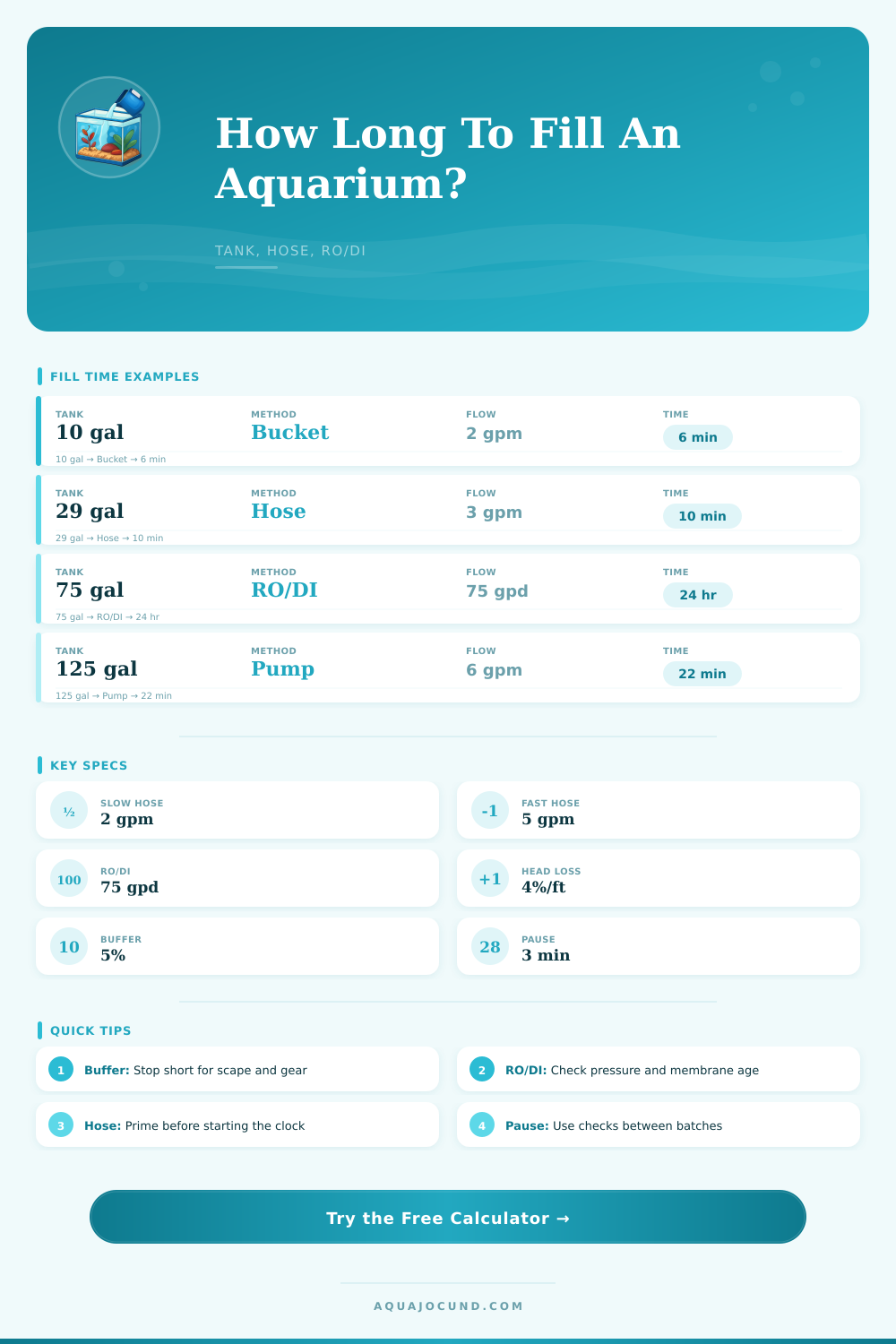
Typical rate: 0.02 to 0.3 GPM| Tank or Change | Water Added | At 2 GPM | At 5 GPM | 75 GPD RO/DI |
|---|---|---|---|---|
| 5 gallon nano fill | 5 gal / 19 L | 2.5 min | 1 min | 1.6 hr |
| 10 gallon full fill | 10 gal / 38 L | 5 min | 2 min | 3.2 hr |
| 20 long half change | 10 gal / 38 L | 5 min | 2 min | 3.2 hr |
| 29 gallon full fill | 29 gal / 110 L | 14.5 min | 5.8 min | 9.3 hr |
| 55 gallon full fill | 55 gal / 208 L | 27.5 min | 11 min | 17.6 hr |
| 75 gallon reef batch | 30 gal / 114 L | 15 min | 6 min | 9.6 hr |
| 125 gallon display fill | 118 gal / 447 L | 59 min | 23.6 min | 37.8 hr |
| Rated Membrane | Gallons Per Hour | 10 Gallons | 30 Gallons | Best Use |
|---|---|---|---|---|
| 35 GPD | 1.46 GPH | 6.9 hr | 20.6 hr | Nano top-off |
| 50 GPD | 2.08 GPH | 4.8 hr | 14.4 hr | Small tanks |
| 75 GPD | 3.13 GPH | 3.2 hr | 9.6 hr | Most reefs |
| 100 GPD | 4.17 GPH | 2.4 hr | 7.2 hr | Large changes |
| 150 GPD | 6.25 GPH | 1.6 hr | 4.8 hr | Storage barrels |
| Reservoir Size | Useful Batch | 30 Gal Change | 55 Gal Fill | Typical Container |
|---|---|---|---|---|
| 2.5 gal / 9.5 L | 2.3 gal | 14 cycles | 25 cycles | Small bucket |
| 5 gal / 19 L | 4.8 gal | 7 cycles | 12 cycles | Standard bucket |
| 10 gal / 38 L | 9.5 gal | 4 cycles | 6 cycles | Mixing tote |
| 20 gal / 76 L | 19 gal | 2 cycles | 3 cycles | Brute can |
| 32 gal / 121 L | 30.4 gal | 1 cycle | 2 cycles | Large barrel |
| Method | Calculator Base | Loss Factor | Best Accuracy Check | Watch Point |
|---|---|---|---|---|
| Tap hose | Hose GPM | Head height | 5 gallon bucket test | Temperature swing |
| Bucket | Pour rate | Cycle pauses | Timed batch pour | Spillage and fatigue |
| RO/DI direct | GPD / 1440 | 15% real-world loss | One hour output cup | Forgetting shutoff |
| Mixing pump | Pump GPM | Head height | Marked barrel drop | Running pump dry |
| Gravity | Siphon GPM | Head height | Timed gallon fill | Siphon break |
| Drip | Drip GPM | Small line loss | Graduated cup test | Clogged valve |
Don’t Panic, If you know what you are doing, then you’ll be able to fill your seventy-five gallon reef tank without worry. Most of us estimates how fast this takes and end up waiting too long or spilling some. The rate that water flows depends on its height and pressure. For example, if you have a hose rated to flow five gallons per minute at ground level, then when it has to lift the water twenty feet into a stand it’ll slow down to three gallons per minute. So remember elevation, because every foot of vertical distance reduces the effective pressure pushing the water forward.
You don’t have to do any math in your head with a bucket in hand because the calculator takes all this into account. The flow rate will change depending on how far above or below your faucet the tank sits. So if you have a high tank and a faucet on the floor, the calculator lets you know that the fill will be slower then expected.
How to Fill Your Tank Without Panic
It even accounts for a buffer of time when you shut things off. When you close the tap, water still flows through pipes for a period of time. Closing it right at edge often means it will overflow. The five percent margin ensures that water stay in the tank.
Depending on what kind of gear you have, select an appropriate filling method. For freshwater tanks, a simple hose fill is sufficient. Reef tanks usually use some sort of reverse osmosis system which will generate water at a slow rate (approximately three gallons per hour for most membranes). If you’re trying to fill up a big barrel, that will take almost a full day!
Pre-filling them help prevent having to run that output right back into the display when setting everything up. It also provides you with time to add salt, condition, etc. Do this before exposing water to your livestock. In many ways, preparation time is the invisible killer of efficiency. Salt has to fully dissolve. Dechlorinator need to do its thing (which might take twenty minutes).
Using the tool, you can add pause buffers to your plan. It turns a straight volume math equation into a more practical project timeline. Without accounting for those pauses, you risk rushing things and stressing your fish out. A ten gallon water change that only takes five minutes when you’re pouring will take half-an-hour with heating and mixing time included.
While the water will rise quicker in narrower tanks and slow down in wider tanks, total water volume is the best measure for timing. Narrower nano tanks has less water volume per inch compared to wider breeder tanks, which fill up quicker near the top. Do you want to get out of the room or be next to the faucet? Because the calculator focuses on total time, you’ll be able to plan your day around it.
Secondly, be sure to consider substrate and equipment displacement. For example, a 50-gallon tank might actualy hold only 42 gallons of water once you add the gravel and the sump return. The buffer input doesn’t get you all the way to the theoretical max. It’s a reminder that this is a marketing number, not a hydrodynamic limit. Knowing the distinction between usable volume and nominal capacity help avoid any unpleasent surprises.
The process becomes not chaotic, but controlled by planning the fill. Instead of making you react, drips are scheduled into your daily routine. When you need to do maintenance on Saturday you know how long to let the reverse osmosis system run overnight. You should of planned ahead.
As the lift goes up, the flow from the hose slows down. If you honor the physics of the set-up, the water will move predictably and that first panic fades with a timeline. Filling a tank is simply one more step in keeping it alive.