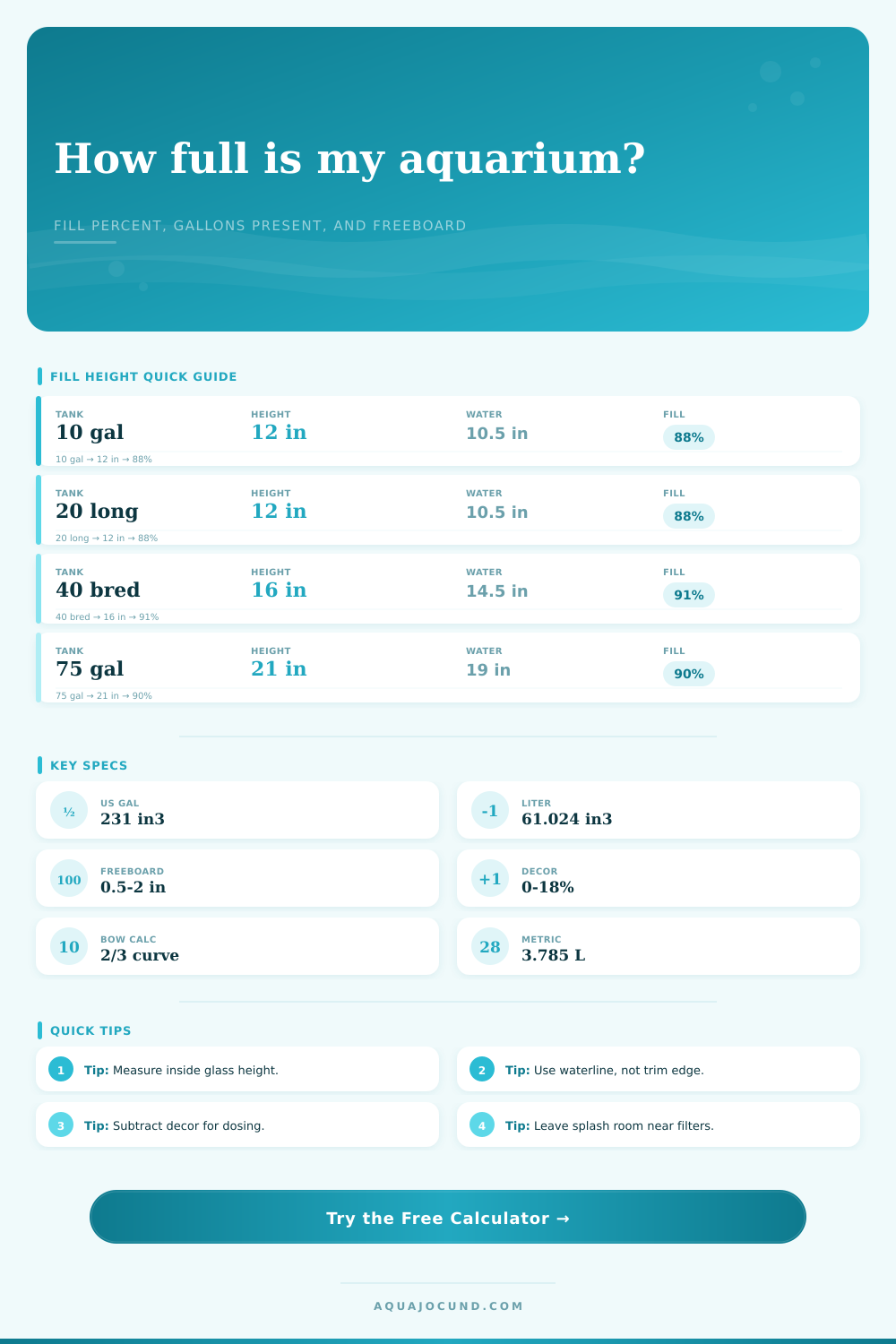
Aquarium Fill Percentage Calculator
Calculate full tank volume, current water volume, fill percentage, gallons to full, and freeboard from your measured water height.
Calculation breakdown
| Shape mode | Full volume formula | Present volume formula | Best use |
|---|---|---|---|
| Rectangle | L × W × H / 231 | L × W × water height / 231 | Most glass aquariums |
| Cube | Side × side × H / 231 | Side × side × water height / 231 | Nano and rimless cubes |
| Cylinder | Pi × radius squared × H / 231 | Pi × radius squared × water height / 231 | Column tanks and jars |
| Bow Front | (L × W + 2/3 bow area) × H / 231 | Same footprint × water height / 231 | Curved front tanks |
| Custom | Known full volume | Full volume × water height / H | Odd shapes or rated volume |
| Tank size | Inside dimensions | Full volume | At 1 inch freeboard |
|---|---|---|---|
| 5.5 gal | 16 in × 8 in × 10 in / 41 cm × 20 cm × 25 cm | 5.5 gal / 20.8 L | 4.99 gal / 18.9 L |
| 10 gal | 20 in × 10 in × 12 in / 51 cm × 25 cm × 30 cm | 10.4 gal / 39.4 L | 9.52 gal / 36.0 L |
| 20 long | 30 in × 12 in × 12 in / 76 cm × 30 cm × 30 cm | 18.7 gal / 70.8 L | 17.1 gal / 64.4 L |
| 29 gal | 30 in × 12 in × 18 in / 76 cm × 30 cm × 46 cm | 28.1 gal / 106 L | 26.5 gal / 100 L |
| 40 breeder | 36 in × 18 in × 16 in / 91 cm × 46 cm × 41 cm | 44.9 gal / 170 L | 42.1 gal / 159 L |
| 75 gal | 48 in × 18 in × 21 in / 122 cm × 46 cm × 53 cm | 78.5 gal / 297 L | 74.8 gal / 283 L |
| Setup mode | Default displacement | Default freeboard | Calculation note |
|---|---|---|---|
| Bare bottom / quarantine | 0% | 1.0 in / 2.5 cm | Closest to geometric volume |
| Light decor freshwater | 5% | 1.0 in / 2.5 cm | Small decor and equipment |
| Planted substrate and wood | 10% | 1.25 in / 3.2 cm | Substrate, roots, and hardscape |
| Rocky cichlid aquascape | 14% | 1.5 in / 3.8 cm | Stone stacks displace more water |
| Reef rock and sand | 18% | 1.25 in / 3.2 cm | Live rock often reduces net water |
| Rimless display | 7% | 1.5 in / 3.8 cm | Extra splash room near the top |
| Fill percent | Freeboard on 12 in tank | Freeboard on 18 in tank | Typical meaning |
|---|---|---|---|
| 75% | 3.0 in / 7.6 cm | 4.5 in / 11.4 cm | Low fill, acclimation, or storage |
| 85% | 1.8 in / 4.6 cm | 2.7 in / 6.9 cm | Conservative splash margin |
| 90% | 1.2 in / 3.0 cm | 1.8 in / 4.6 cm | Common rimmed tank waterline |
| 95% | 0.6 in / 1.5 cm | 0.9 in / 2.3 cm | High fill, check filter splash |
There you are standing in front of your tank, a jug of treated water in one hand, looking down at the space between the tank rim and the water level. Time to top it off again, you think. How much water is that though? An inch doesn’t sound like much, but does it equal a full quart or just a half-gallon? That difference may be important depending on the amount, whether you are calculating an exact volume for a water change or dosing with medications.
If you’re like most hobbyists, you use the size of your tank as listed by the manufacturer. While this number is a useful reference point, it remains nothing more than a rough estimate. What the label describes is what the manufacturer *hoped* would fit inside your tank; what you’re really left with is what fits inside yours.
Why You Should Measure Your Tank Water Correctly
The volume you have inside the glass will depend on several factors: the shape and interior dimensions of your tank and whatever you’ve put in substrate. You can enter your own numbers into the calculator above (which does all the math for you). You won’t have to guess about unit conversions or fumble around wondering what the displacement coefficient is.
All it requires is that you measure correctly, know how to get the true inside height. And that’s where it begins: know that the measurement should of been taken from the bottom glass to the practical full line on the inside. Don’t use the outside edge of the rim as your point of reference.
Why? If you do, you’re calculating a volume that will overflow the tank. This can happen the moment a ripple occurs from the filter output or when a fish jumps. You want some freeboard, which is the air space between the water surface and the top of the glass. Freeboard ranges from a half inch to two inches. It keeps splash-out to a minimum while also allowing you to toss stuff in there without flooding the tank.
Then there’s the existing contents of the tank. Most people make a mistake when calculating volume here as well. Sure, a tank will hold the most water when it is a bare bottom tank. But who maintains a tank with nothing on the bottom? Unless it’s temporary, nobody does. As soon as you place some substrate, rocks, wood, live rock, etc., you displace water.
The calculator takes that into account using a displacement percentage. Depending on how you set up your tank, that can vary from 10% to 18% (or even more) displacement. A deeply planted tank with lots of wood may have ten percent displacement. An aquarium full of live rock used in a reef tank could have eighteen percent or more displacement. That ain’t nothing!
For example, if you’re dosing based off a fifty gallon tank volume and you only have forty-one gallons of actual water in there, guess what? You’re overdosing your fish. If you’re doing water changes based on fifty gallons, then you might stress your livestock because you’re taking out too much water all at once.
Geometry (Tank shapes alter things as well). Rectangular is pretty straightforward math. Bow front or cylinder add curves and alter the footprint area. Not a problem because the tool can handle it, and you don’t have to derive a formula for a partial cylinder in your head. Just enter the additional bow depth or if it’s a cylinder, the diameter.
For really small tanks where every milliliter matters (e.g., betta set ups or shrimp nano tank), this precision comes into play. If you are off by a half gallon on a volume that size, that’s a ten percent change in total environment. To keep it stable, knowing exactly what percentage of your tank is filled allows you to keep everything in check.
For example, when you do a water change, you’re going to replace X amount of water. You don’t want to just arbitrarily replace a certain number of gallons (unless you want to). What if you have eight gallons instead of ten? That’s what happens when you use decor. Eventually, all that gathered error adds up and causes fluctuations in parameters.
Next thing you know, you’re constantly tweaking things like hardness or pH because you dosed according to a hypothetical amount instead of the real amount. Why not get the baseline correct initially?
First is the part where you measure the water correctly. Lay a measuring tape up against the inside of the glass (or use a ruler) and write down how tall the water is right now, and then how tall the inside of the tank is when it’s full. Add that data plus your tank type. Then hit “go” and see what happens.
It tells you how many gallons are currently in the tank, and how many more gallon need to be added to get to whatever freeboard you want. It makes something that was previously a “guesstimate” solid. You will no longer wonder if you filled it too high or left too much empty space.
Just knowing. Your fish live happily ever after in a stable environment, measured accurately. The water does not go anywhere it shouldn’t, and your fish are happy livig in an accurately measured world.