🌿 Aquarium Fertilizer Dilution Calculator
Calculate dry salt stock solutions, liquid fertilizer dilution, target ppm, tank volume, and measured dose volume.
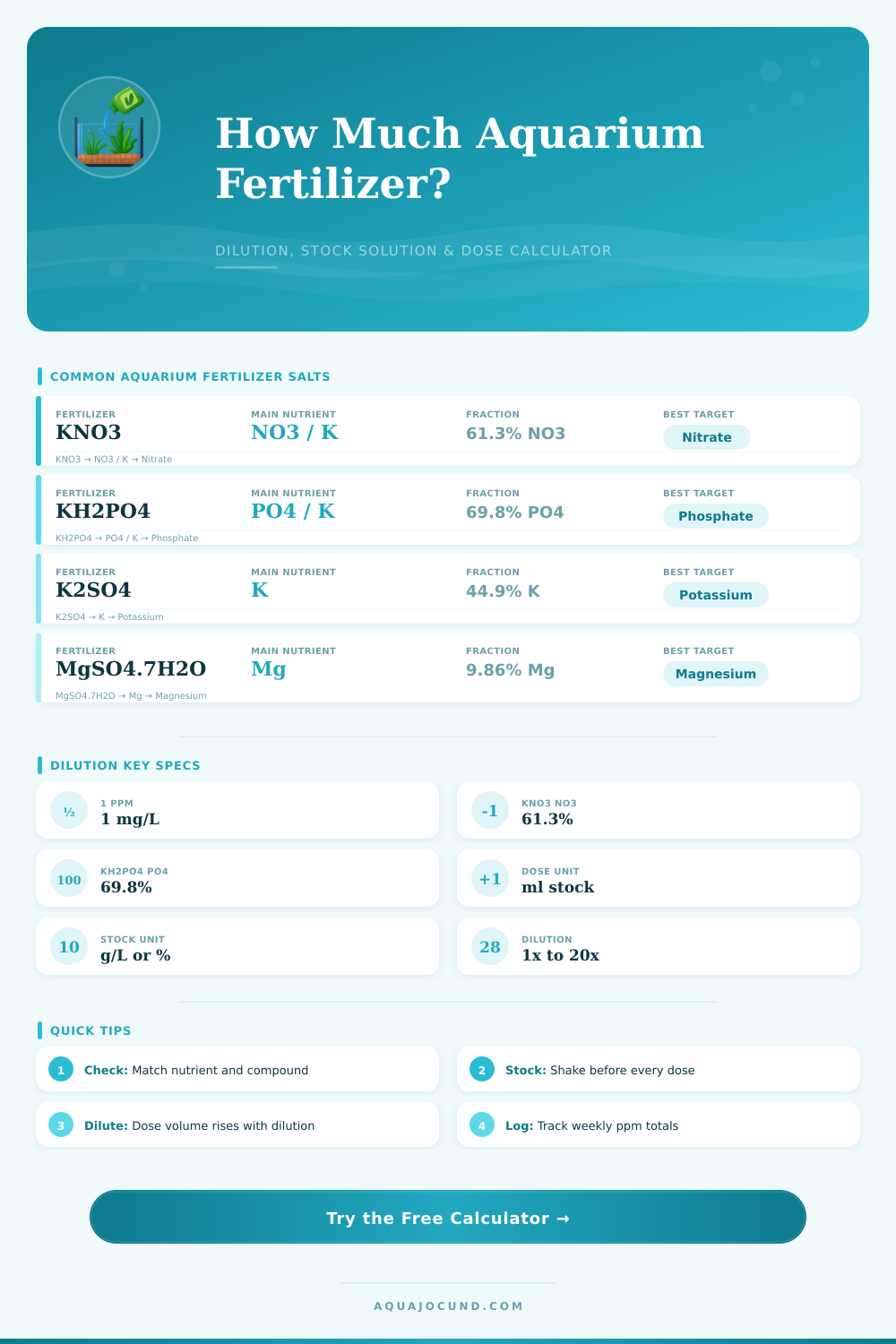
| Compound | Useful Nutrients | Main Fraction | Stock Example | Notes |
|---|---|---|---|---|
| Potassium nitrate | NO3, N, K | 61.3% NO3 | 60 g/L | Common nitrate and potassium source |
| Monopotassium phosphate | PO4, P, K | 69.8% PO4 | 6 g/L | Strong phosphate source; small doses matter |
| Potassium sulfate | K | 44.9% K | 80 g/L | Potassium without nitrate or phosphate |
| Magnesium sulfate heptahydrate | Mg | 9.86% Mg | 100 g/L | Raises magnesium and general hardness |
| Calcium nitrate tetrahydrate | Ca, NO3, N | 17.0% Ca | 120 g/L | Adds both calcium and nitrate |
| Iron DTPA | Fe | 11.0% Fe | 10 g/L | Use for measured iron additions |
| Tank | Dimensions | Volume | Example Target | Typical Stock Dose |
|---|---|---|---|---|
| 10 gal nano | 20 x 10 x 12 in | 38 L | 2 ppm NO3 | 1.2 ml of 100 g/L KNO3 |
| 20 long | 30 x 12 x 12 in | 76 L | 7.5 ppm NO3 | 9.3 ml of 100 g/L KNO3 |
| 29 gal | 30 x 12 x 18 in | 110 L | 1.0 ppm PO4 | 1.6 ml of 100 g/L KH2PO4 |
| 40 breeder | 36 x 18 x 16 in | 151 L | 10 ppm K | 33.6 ml of 100 g/L K2SO4 |
| 55 gal | 48 x 13 x 21 in | 208 L | 5 ppm Mg | 105.5 ml of 100 g/L MgSO4.7H2O |
| 75 gal | 48 x 18 x 21 in | 284 L | 0.1 ppm Fe | 2.6 ml of 100 g/L Fe DTPA 11% |
| 90 gal | 48 x 18 x 24 in | 341 L | 10 ppm NO3 | 55.6 ml of 100 g/L KNO3 |
| 125 gal | 72 x 18 x 22 in | 473 L | 2 ppm PO4 | 13.6 ml of 100 g/L KH2PO4 |
| Dilution | Mixing Ratio | Strength Remaining | Dose Volume Effect |
|---|---|---|---|
| 1x | Undiluted stock | 100% | Baseline dose |
| 2x | 1 part stock + 1 part water | 50% | Dose volume doubles |
| 4x | 1 part stock + 3 parts water | 25% | Dose volume is 4 times baseline |
| 10x | 1 part stock + 9 parts water | 10% | Good for nano tanks and iron traces |
In order to correctly manage a planted aquarium, one must have a thorough understanding of how to add specific amount of nutrients to the aquarium water. Many people struggle with keeping the nutrients of there plant optimal for growth, simply because many people guess the amount of nutrients they are adding. If you guess the amount of nutrients that you are adding to your plant, you will not be able to achieve the correct concentration of that nutrient in the aquarium water.
However, if you accurately measure the amount of nutrients you add, you can treat the process of adding fertilizer to your plant as an arithmetic process. For the best growth, aquatic plants needs to have a certain amount of each nutrient in every milliliter of fertilizer that is added to the aquarium. Various common fertilizers for aquariums have specific amounts of these nutrients.
How to Measure and Dose Nutrients for Aquarium Plants
One common choice for these fertilizers are dry salts, which are inexpensive and stable. However, dry salts is only useful as fertilizers once you dissolve the dry salts into a liquid solution. The strength of this liquid solution of dry salts varies, depending upon how many grams of salt you add to a liter of water, as well as what percentage of the nutrient is contained within that salt.
For example, potassium nitrate is approximately sixty-one percent nitrate by weight, so you must account for this when figuring out how much nitrate you are adding when you add potassium nitrate. The same is true for monopotassium phosphate and magnesium sulfate, as these dry salts contain a specific percentage of the phosphate and magnesium, respectively. The same principles also apply to liquid fertilizer.
With liquid fertilizers, the concentration of that nutrient is already listed on their label. When the liquid fertilizer is heavier than water, you must account for the density of that liquid fertilizer to accurately convert from the volume of that liquid fertilizer to the same mass of that liquid fertilizer. Essentially, the goal with creating aquarium fertilizers is to be able to move a measured mass of that nutrient from the fertilizer bottle into the aquarium water.
There is no difference between using liquid fertilizers and dry salts except that the percentages on liquid fertilizers make it easier to figure out the concentration of nutrients in your fish tank because you dont have to convert the amount of grams of the fertilizer you added to your fish tank. One concept many beginners dont understand when adding dry salts or liquid fertilizers is the idea of dilution. When you add an appropriate amount of water to a nutrient stock solution, the total amount of nutrient still stays the same as it was in the original solution.
However, when you divide the original volume of that solution by adding more water, you do change the concentration of the stock solution. If you dilute a stock solution by a factor of ten, then each milliliter of that diluted stock solution only has one-tenth the amount of nutrient as each milliliter of that original stock solution had. In these cases, if you dilute a stock solution by a factor of ten, you need to dose ten times as much of the diluted stock solution in order to achieve the same concentration change in your aquarium as your undiluted stock solution would of afforded you.
Thus, dilution is a concept that needs to be understood. Dilution is helpful, though, if you want to measure small amounts of nutrients such as iron, which typically has desired concentrations of less than two hundred parts per billion. The volume of an aquarium is also a concept that many beginners do not fully understand.
Often, the stated volume of an aquarium is far higher than the actual volume of water that can be filled inside that tank. Tanks often have substrate and hardscape materials inside them, such as rocks and wood, which take up some volume inside that tank and prevents that volume portion from filling with water. Additionally, most aquariums have curved corners, which reduces the actual volume compared to what is stated for tanks that have square corners.
By multiplying the stated volume by an adjustment factor of somewhere between eighty-five and ninety-five percent, aquarists will find that this number more closely matches with that actual volume of their aquarium. If you dont apply this adjustment factor to the calculations and dosages of your plants nutrient requirements, you run the risk of under-dosing your plant with these critical nutrients. If under-dosed with these nutrients, your plants will not exhibit optimal health.
In short, adding nutrients to an aquarium is not a complicated task. However, proper dosing requires knowledge and care. While adding the correct amount of nutrients to an aquatic plant at a given time is important, it is more important to add the plants cumulative required amount of those nutrients during a week.
Studies show that adding plants three small doses of nutrients during a week will promote more growth than adding one large dose once every week. The dosing calculator can be used to determine these cumulative weekly additions for all nutrients required for your aquatic plants. Common mistakes made when attempting to dose aquatic plants with necessary nutrients include mistakes in using the wrong units when calculating dry salt doses or forgetting that the dry salt contains only some percentage of the desired nutrient.
Other mistakes include treating desired parts per million as total concentration already present instead of amount increase that you want to add. When you can properly calculate the mass of nutrients that your aquatic plants need to achieve their desired growth level, then you can determine how much that nutrient needs to be present in the aqueous solution that you put in your aquarium. If you know how much mass of nutrient you need, then you know how much volume of aqueous solution needs to be properly diluted and dosed into each liter of your tanks water.
Once you know this value, adding agricultural fertilizers to your aquatic plants becomes a repeatable task that ensures your plants always get the nutrients they need to survive and grow.