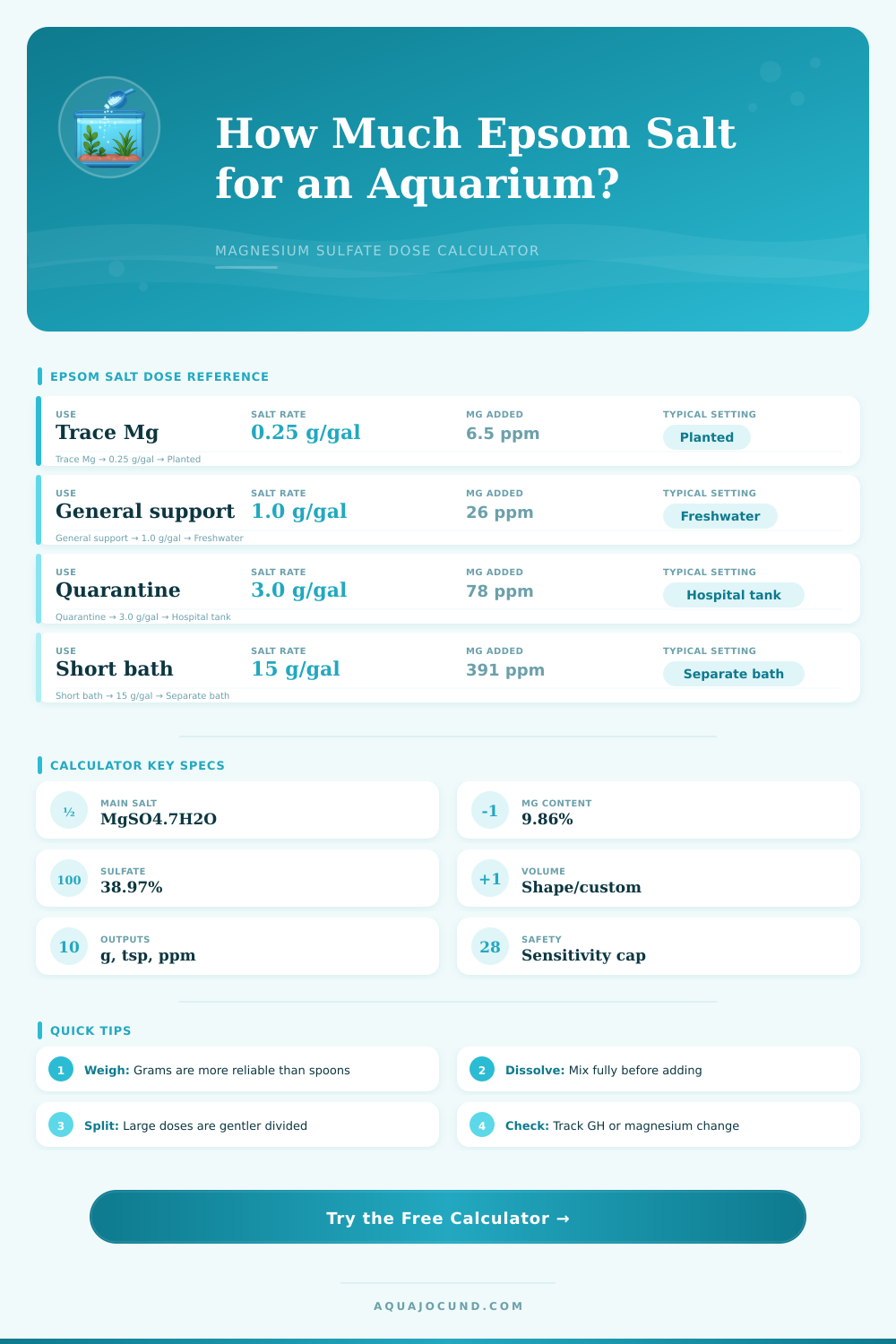
Epsom Salt Aquarium Dosing Calculator
Estimate magnesium sulfate dose from true water volume, salt composition, target use, portion size, and livestock sensitivity.
| Salt Form | Formula Basis | Mg by Weight | Sulfate by Weight |
|---|---|---|---|
| USP Epsom salt | MgSO4.7H2O | 9.86% | 38.97% |
| Aquarium magnesium sulfate | MgSO4.7H2O | 9.86% | 38.97% |
| Lab heptahydrate | MgSO4.7H2O | 9.86% | 38.97% |
| Magnesium sulfate monohydrate | MgSO4.H2O | 17.56% | 69.42% |
| Anhydrous magnesium sulfate | MgSO4 | 20.19% | 79.81% |
| Use Case | Calculator Basis | Heptahydrate Mg Added | Guardrail |
|---|---|---|---|
| Trace magnesium correction | 0.25 g/gal | 6.5 mg/L | Small planted adjustment |
| Planted tank magnesium boost | 0.50 g/gal | 13.0 mg/L | Split if livestock are sensitive |
| Freshwater general support | 1.00 g/gal | 26.1 mg/L | Whole-tank conservative ceiling |
| Quarantine constipation support | 3.00 g/gal | 78.2 mg/L | Hospital or quarantine use |
| Hospital osmotic support | 5.00 g/gal | 130 mg/L | Short monitored treatment |
| Separate short bath | 15.00 g/gal | 391 mg/L | Separate container only |
| Selection | Dose Factor | Salt Cap | Calculator Meaning |
|---|---|---|---|
| Hardy adult freshwater fish | x1.00 | Normal cap | Cichlids, goldfish, robust community fish |
| Normal community fish | x0.85 | Moderate cap | Tetras, rasboras, livebearers, gouramis |
| Sensitive or scaleless fish | x0.60 | Lower cap | Corydoras, loaches, weak fish |
| Dwarf shrimp and snails | x0.50 | Low cap | Small invertebrate systems |
| Eggs, fry, or weak livestock | x0.40 | Lowest cap | Use small trial doses |
| Corals and reef invertebrates | x0.75 | 50 ppm Mg per dose | Avoid large sulfate-only corrections |
| No livestock in treatment water | x1.15 | Expanded cap | Empty quarantine or equipment bath |
| Tank | Dimensions | True Water | 1 g/gal Dose |
|---|---|---|---|
| 5.5 gal | 16 x 8 x 10 in / 41 x 20 x 25 cm | 4.8 gal / 18 L | 4.8 g, about 1.0 tsp |
| 10 gal | 20 x 10 x 12 in / 51 x 25 x 30 cm | 8.7 gal / 33 L | 8.7 g, about 1.7 tsp |
| 20 long | 30 x 12 x 12 in / 76 x 30 x 30 cm | 18.7 gal / 71 L | 18.7 g, about 3.7 tsp |
| 29 gal | 30 x 12 x 18 in / 76 x 30 x 46 cm | 28.0 gal / 106 L | 28.0 g, about 5.6 tsp |
| 40 breeder | 36 x 18 x 16 in / 91 x 46 x 41 cm | 39.5 gal / 149 L | 39.5 g, about 7.9 tsp |
| 75 gal | 48 x 18 x 21 in / 122 x 46 x 53 cm | 69.0 gal / 261 L | 69.0 g, about 13.8 tsp |
| Formula | Value | Used For | Output |
|---|---|---|---|
| US gallons to liters | gal x 3.78541 | Concentration math | Liters |
| Heptahydrate Mg fraction | 24.305 / 246.47 | Epsom salt Mg | 9.86% |
| Mg increase | grams x Mg fraction x 1000 / liters | Elemental magnesium | mg/L or ppm |
| Sulfate increase | grams x sulfate fraction x 1000 / liters | SO4 contribution | mg/L |
| Target Mg grams | target ppm x liters / Mg mg per gram | Reef or custom target | grams of salt |
Maintaining the levels of magnesium in the aquarium is a necessary task due to the potential for the levels of magnesium to become too low for the health of the inhabitant of the aquarium. If the levels of magnesium in the aquarium are too low, the fish may become sluggishly and the plants may develop yellow tips on there leaves. One way of increasing the magnesium levels in the aquarium is to use magnesium sulfate, also known as Epsom salt.
Magnesium sulfate provide the aquarium’s inhabitants with magnesium and sulfate ions, but does not add sodium chloride to the aquarium water. In order to reestablish magnesium levels in the aquarium to those that are beneficial for the inhabitants, it is important to determine the correct amount of magnesium sulfate that should be added. If too little are added, the deficiencies in the water will not be remedy.
How to Use Epsom Salt to Add Magnesium to Your Aquarium
If too much is added, the high levels of magnesium sulfate may stress out the livestock in the aquarium. Various factors should be considered in determining the amount of magnesium sulfate that should be added to the aquarium. One factor to consider is the volume of the water in the aquarium.
The volume of water that must be accounted for is not the same than the total size of the aquarium. Rocks and substrate within the aquarium can displace some of the water in the aquarium. Another factor to consider is the sensitivity of the fish in the aquarium.
For instance, shrimp is more sensitive to water chemistry changes than fish without scales. Additionally, the total volume in the aquarium has different effect depending upon the type of magnesium sulfate that is to be used in the tank. For example, different form of magnesium sulfate contain different amounts of elemental magnesium.
The calculator described in this document allows the user to enter each of these different variable into the calculator to determine the amount of magnesium sulfate that should be added to return the magnesium levels to those that are beneficial for the aquarium’s inhabitants. The calculator allows the user to enter the dimension of the aquarium to determine how many liters of water are in the aquarium. The calculator can account for the displacement of water due to rocks and substrate.
Another factor that can be entered into the calculator is the type of livestock in the aquarium. Because different species have different sensitivities to water chemistry, the calculator allows for this factor to be entered to ensure that the parameters of the aquarium are properly adjust. This calculator will provide the user with the number of grams of magnesium sulfate that is require.
Furthermore, it is also useful in providing the amount of magnesium (in gram) and the amount of sulfate (in grams) that will be added to the aquarium water. Many aquarium keeper use magnesium sulfate for three specific reasons. First, it is often used in planted tanks to aid in the growth of the plants by ensuring that they have sufficient amount of the elements required for the plants’ function.
Second, it is often used in community tanks containing soft water to adjust the chemistry of the water to the preferred range of the fish in those communities. Third, it is often used in the hospital tank in cases of sickness in fish to aid the recovery of those fish. Each of these reason requires a different concentration of magnesium sulfate in the aquarium water.
It is best to avoid adding a large amount of magnesium sulfate to the aquarium at once. Instead, utilize the split dose setting on the calculator. This will allow for the amount of magnesium sulfate to be divided into smaller portion that can be added to the aquarium over a period of several hour or one day.
This allows for the inhabitants of the aquarium to become accustomed to the addition of the magnesium sulfate prior to adding the remaining portion of the calculated amount. Another factor to consider is the weight of a teaspoon of magnesium sulfate. The weight may differ depending upon the texture of the crystal.
Fine crystals will often weigh less than coarse crystals. For this reason, it is best to remove the uncertainty regarding the weight of the magnesium sulfate by weighing it out on a scale. The weight of the magnesium sulfate can then be entered into the calculator.
Reef systems require a different management of the magnesium level than freshwater systems do. Therefore, care should be taken when using this calculator in the management of a reef aquarium system. Reef systems often use chloride based supplements to manage their magnesium levels instead of the sulfate found in Epsom salt.
Excessive amounts of sulfate can disrupt the ionic balance of the reef aquarium water. For this reason, the calculator will alert the user if they attempt to use the calculator to manage a reef aquarium system. The calculation of the amount of magnesium sulfate required to adjust the magnesium levels in the water can be determined through the equation: (grams of salt * fraction of magnesium in salt) / number of liters in aquarium.
The same equation can be used to determine the amount of sulfate that will be added to the aquarium. It is necessary to fully dissolve the magnesium sulfate in a portion of the aquarium water prior to adding the magnesium sulfate to the aquarium. After adding the magnesium sulfate to the aquarium, it is important to retest the aquarium water to ensure that the levels are returning to those that are beneficial for the aquarium’s inhabitants.
The purpose of using this calculator is to maintain the parameters of the aquarium to allow the livestock and plants to behave and grow normal, respectively.