Aquarium Drip System Flow Rate Calculator
Size a drip water-change or acclimation system from tank volume, exchange target, emitters, lines, lift, restriction, reservoir capacity, and daily run time.
| Hardware profile | Typical rated flow | Best use | Planning note |
|---|---|---|---|
| Airline pinch valve | 0.05-0.50 gph | Acclimation and nano top-up | Very sensitive to small adjustments |
| Needle valve airline | 0.10-1.00 gph | Controlled gravity drip | Good repeatability after priming |
| 0.5 gph button emitter | 0.5 gph / 1.9 lph | Small tanks and slow exchange | Needs enough pressure to stay consistent |
| 1.0 gph button emitter | 1.0 gph / 3.8 lph | Medium tanks | Common irrigation dripper size |
| 2.0 gph button emitter | 2.0 gph / 7.6 lph | Large tanks and racks | Often too fast for nano tanks |
| Dosing pump channel | 0.01-1.50 gph | Precise automatic exchange | Use timed calibration, not label rating |
| Daily exchange | Common purpose | Equivalent weekly exchange | Flow behavior to watch |
|---|---|---|---|
| 5% | Light continuous refresh | About 35% before overlap effects | Stable salinity and temperature are easier |
| 10% | Nano or planted maintenance | About 70% before overlap effects | Reservoir needs routine attention |
| 15-20% | Heavier feeding or sensitive stock | High continuous turnover | Match drain capacity and replacement chemistry |
| 25-30% | Rack or grow-out exchange | Very high continuous turnover | Use redundant overflow and refill controls |
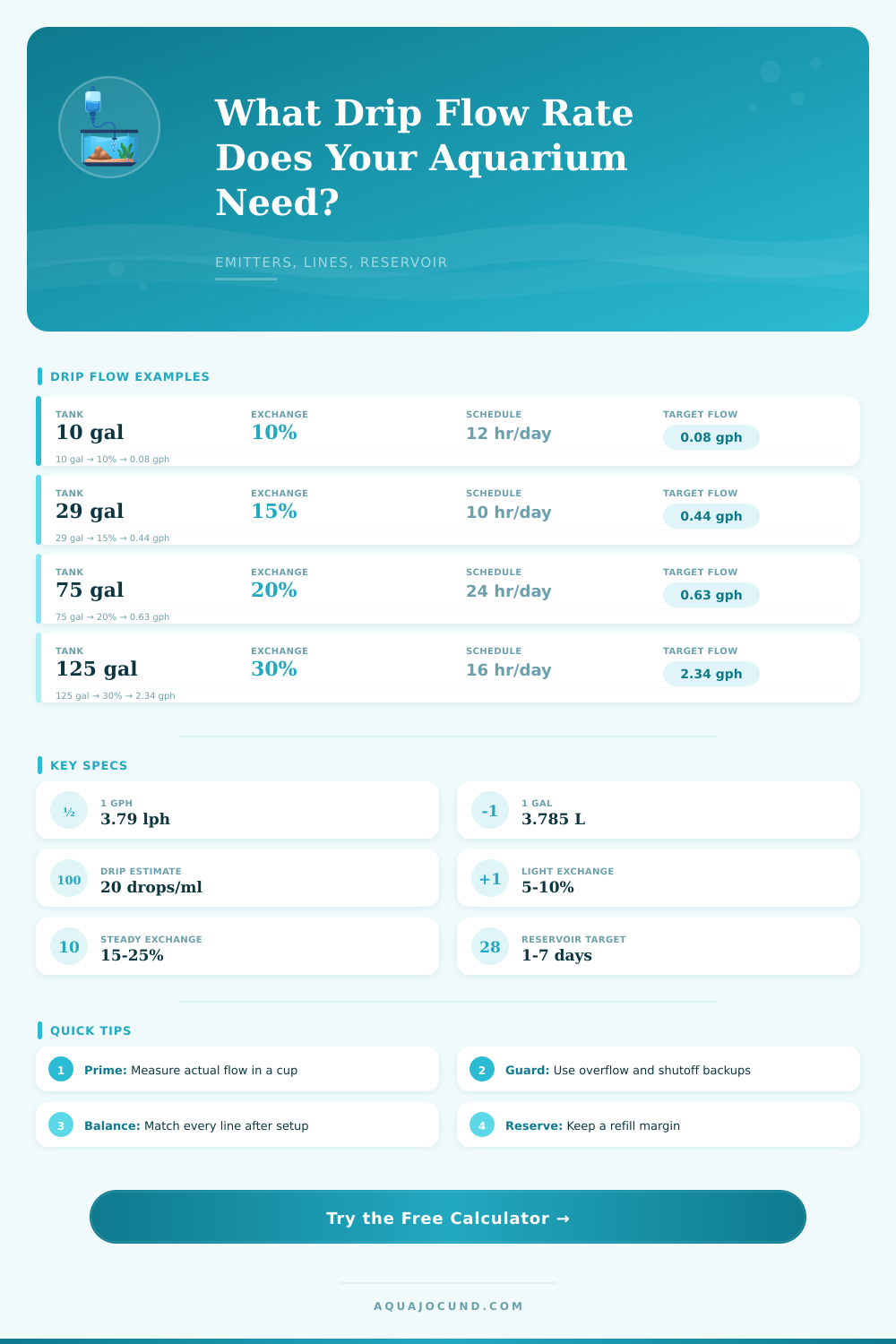
| Tank size | Approx metric volume | 10% per day | 20% per day | Target at 12 hr/day |
|---|---|---|---|---|
| 10 gal nano | 38 L | 1.0 gal/day | 2.0 gal/day | 0.08-0.17 gph |
| 20 gal long | 76 L | 2.0 gal/day | 4.0 gal/day | 0.17-0.33 gph |
| 40 breeder | 151 L | 4.0 gal/day | 8.0 gal/day | 0.33-0.67 gph |
| 75 gal display | 284 L | 7.5 gal/day | 15.0 gal/day | 0.63-1.25 gph |
| 125 gal display | 473 L | 12.5 gal/day | 25.0 gal/day | 1.04-2.08 gph |
| 300 gal system | 1136 L | 30.0 gal/day | 60.0 gal/day | 2.50-5.00 gph |
| Adjustment | Typical effect | Calculator treatment | Field check |
|---|---|---|---|
| Gravity head below 1 ft | Weak and clog-prone | Large flow reduction | Raise reservoir or reduce line splits |
| Gravity head 2-4 ft | Useful pressure range | Moderate flow retention | Measure after reservoir level drops |
| Pump lift above 4 ft | Flow falls with height | Head loss applied per foot | Calibrate at final installed height |
| Restrictor under 30% | Fine drip but sensitive | Flow multiplier is small | Use filters and inspect for clogging |
| Many branches | Uneven flow without balancing | Balance penalty added | Cup-test each line separately |
There’s water dripping from a measuring cup into your aquarium. Steady, right? Unless you know what the flow rate is…you don’t know whether it’s the exact amount required to safely perform a water change or acclimate new fish. Knowing how to deal with pressure makes all the difference between an effective controlled exchange vs. It could be a potential flooding hazard. Watch the drops fall but understand the pressure.
Typically, a hobbyist looks at a 1 gph emitter and assumes it’s going to provide that much. This happens regardless of how long the tubing is or how high reservoir sits. This is where problems start. Water flows down due to gravity, which is consistent. But there are other factors, like how friction inside a small plastic tube can drain some of that power. You cannot rely solely on nameplate ratings to calculate how fast it will drip out; you have to consider what the physical set up is doing.
How to Use This Calculator for Your Aquarium
The calculator above helps close that gap between specs sheet and real world. By accounting for both line length and head height, it factors in those unseen variables. Now think about the height of reservoir. Is it just inches higher than the tank outlet? When the bucket gets down towards empty, the drop in pressure is dramatic. You’re going from a fast start to a trickle drip. You can accurately estimate how much fluid is actually exchanged on a given day by using the tool provided above. Adjusting for the variable is necessary. A larger vertical head give you a steadier pressure. A taller head provides more stable pressure, though it introduces its own challenges if you are trying to keep things quiet. The head lifts water vertically. The calculator accounts for that and shows how much actual water makes it into the tank once gravity has had time to work against resistance.
Next are the concerns about restrictors and tubing length. The longer the airline and number of elbows, the less volume because there’s more friction. You must balance the pressure if you’re running long lines to multiple tanks. Otherwise, the closest emitter will always get fed while the farthest starves. This is why knowing what flow rate you want beforehand when constructing the manifold is important.
How much water do you really need? How many gallons per hour you need to replace X amount of water each day at the rate you want? A couple drops may be all you need for a small nano tank. A large display system require something a little more robust but with control nonetheless. Hardware selection matters, too. For example, button emitters are popular on irrigation systems but tend to clog easy on aquarium systems where they accumulate biofilm or other minerals. Needle valves give more precise control, but must be adjusted properly and checked regularly. The tool comes with reference information on the appropriate hardware for different flows so you aren’t buying restrictors that can’t support the desired pressure or a pump that’s too big for the task.
How often should I replace my water? How often you do this depends a lot on what is in your tank. Slow, frequent water changes are great for shrimp tanks to simulate nature’s water flow. However, they are not as good for other creatures that may be too sensitive to such shock. Large fish can potentially tolerate larger swings if the other parameters is consistent. You can enter the rate and time frame you want to use and it will calculate an hourly volume for you that lets you know exactly how much water needs to pass through per hour. This avoids the mistake of designing a system where the tank fills back up in 3 days instead of the 12 hours you intended.
The other important factor is the size of the reservoir. Of course, if you have only enough water in there to drip for six hours, it’s going to go dry well short of the end of the cycle. But on the flip side, having a big reservoir will cause the water to sit too long and get stale (particularly so if you’re dealing with chlorinated tap water that may fade in an inconsistent manner). One-to-three days worth of water seems like the sweet spot to hit in terms of water quality versus convenience.
To conclude, So overall, automation is only as good as your initial calibration. Yes, use those numbers as a baseline. But verify it physically to know that everything will be safe. Run the system for 15 minutes and measure the output into a container. That will prove whether what was calculated on paper is what’s coming out in real life. It’ll keep you and your fish safe, and it’ll protect your investment. The water will tell you what the math says. Then adjust accordingly. Keep adjusting until it’s right.
Tuned correctly, a drip system hums along quietly. It provides regular benefit but requires little attention. The flow is unnoticeable. It supports the life within the tank without calling attention to itself. That quiet consistency makes a complicated plumbing project an easy maintenance routine.