Aquarium Drain Time Calculator
Estimate water-change drain time from volume, hose inside diameter, siphon drop, pump rating, hose length, bends, screen buildup, and the stopping water depth.
💧Water to remove
Enter the water-change amount you want to remove before refilling.
The calculator caps the drain if the target water line is reached first.
🚿Drain path and flow limits
Measure from aquarium water surface to the hose outlet or drain point.
Use 100 for a clean open hose, lower for strainers, mulm, kinked hose, or plant debris.
Use lift above the pump. Enter 0 when draining downhill.
Drain Breakdown
🔧Drain method comparison
📊Reference tables
| Hose inside size | Typical siphon range | Best use | Watch point |
|---|---|---|---|
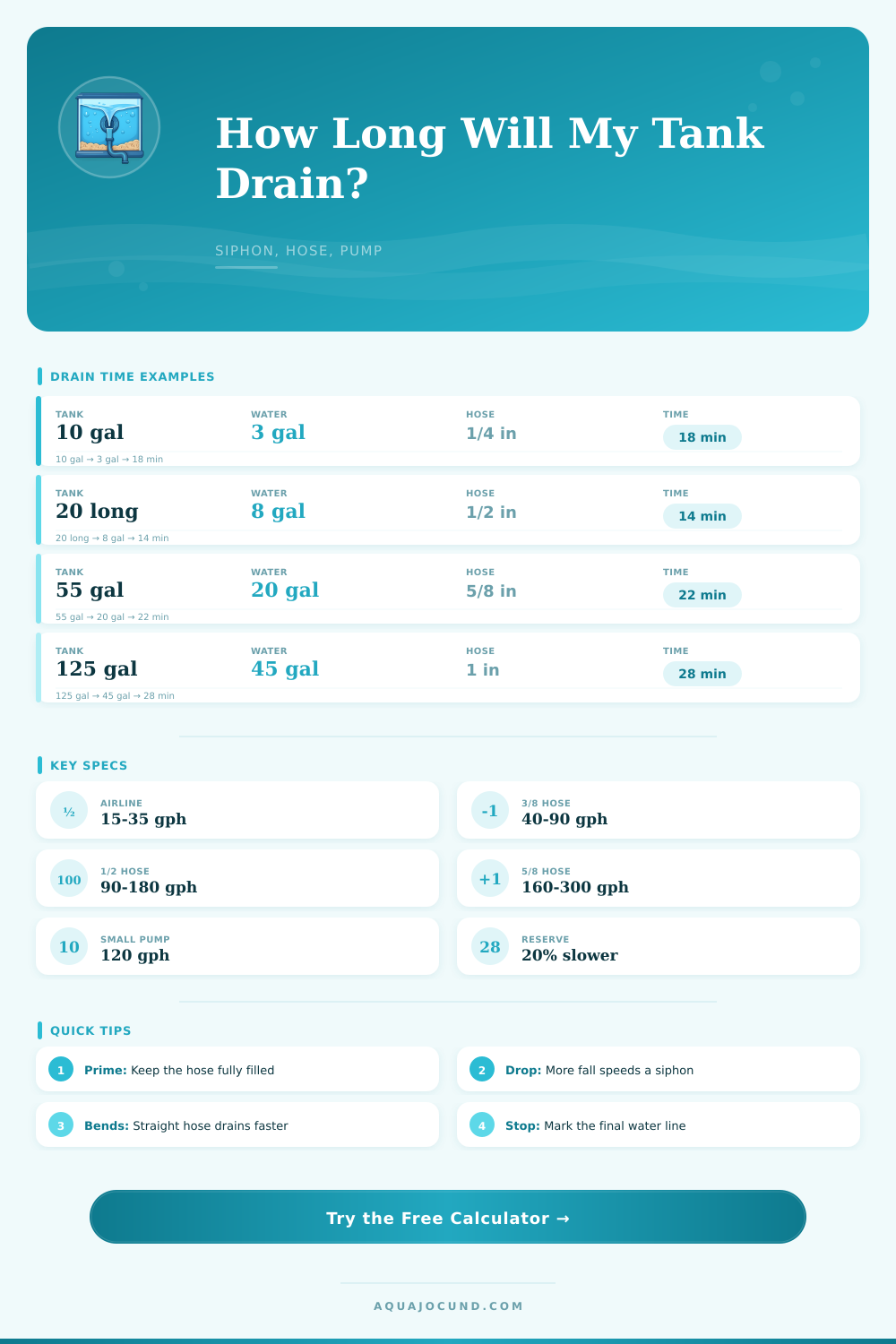
| 3/16 in / 4.5 mm airline | 8 to 25 gph / 30 to 95 L/h | Shrimp, fry, drip changes | Very easy to clog |
| 1/4 in / 6 mm | 15 to 40 gph / 57 to 151 L/h | Betta bowls and nano tanks | Needs a clean intake |
| 3/8 in / 10 mm | 40 to 90 gph / 151 to 341 L/h | Small tanks and careful cleaning | Slow on deep gravel |
| 1/2 in / 13 mm | 90 to 180 gph / 341 to 681 L/h | Most 20 to 40 gallon tanks | Bucket fills quickly |
| 5/8 in / 16 mm | 160 to 300 gph / 606 to 1136 L/h | Python style changers | Needs secure hose routing |
| 3/4 in / 19 mm | 250 to 500 gph / 946 to 1893 L/h | Large display drains | Strong suction at intake |
| 1 in / 25 mm | 450 to 900 gph / 1703 to 3407 L/h | Sump and bulkhead drains | Protect livestock from intake |
| Drain method | Flow behavior | Good for | Limiting factor |
|---|---|---|---|
| Airline drip siphon | Very slow, stable | Shrimp and fry safety | Hose bore and clogs |
| Bucket siphon | Low to medium | Small tanks near a bucket | Bucket height and hose drop |
| Gravel vacuum siphon | Medium, pulsed by cleaning | Substrate cleaning | Gravel tube debris load |
| Faucet assist water changer | Medium to fast | Long hose to sink | Hose length and sink height |
| Utility pump drain | Fast if pump is sized well | Large changes and uphill drains | Pump head curve |
| Return pump to drain | Fast, plumbing dependent | Sump systems with valves | Valve and pipe restriction |
| Bulkhead gravity drain | Fast and steady | Fish rooms and sumps | Standpipe intake height |
| Tank example | Water change | Common drain setup | Typical time |
|---|---|---|---|
| 5 gallon betta | 1.5 gal / 5.7 L | 1/4 in mini siphon | 4 to 8 minutes |
| 10 gallon shrimp | 2 gal / 7.6 L | Airline with sponge guard | 10 to 20 minutes |
| 20 long community | 6 gal / 22.7 L | 1/2 in gravel vac | 6 to 12 minutes |
| 40 breeder reef | 10 gal / 37.9 L | 5/8 in hose to bucket | 7 to 14 minutes |
| 55 gallon goldfish | 20 gal / 75.7 L | Small utility pump | 10 to 25 minutes |
| 75 gallon reef | 15 gal / 56.8 L | Sump pump out | 8 to 18 minutes |
| 125 gallon display | 40 gal / 151 L | 1 in pump hose | 18 to 35 minutes |
| Restriction source | Planning derate | When to use it | Calculator input |
|---|---|---|---|
| Clean open hose | 0 to 5 percent slower | Short clear hose, no strainer | 95 to 100% open |
| Soft prefilter sponge | 10 to 25 percent slower | Shrimp or fry protection | 75 to 90% open |
| Mulm in gravel tube | 15 to 35 percent slower | Deep gravel cleaning | 65 to 85% open |
| Kinked or coiled hose | 20 to 45 percent slower | Long hose to sink or floor drain | 55 to 80% open |
| Lift above aquarium | Use pump head loss | Draining uphill to sink or barrel | Enter pump lift |
💡Drain planning tips
Have you ever stood over your tank with a bucket in hand and felt panicked as the water level dropped faster then expected? Yeah, me too. And then you use the tape to mark where line should be on the glass…but now you see that gravity won’t let you stop where you planned, the suction pulls you past that point. That wet spot on the floor comes from not knowing just how much water flows through hose during those last few minutes before shut-off when changes in the head pressure shift. Use the calculator above and let it do complex math of fluid dynamics so you can plan out the water change with accuracy…not by using your watch and crossing your fingers.
What’s the key to guessing how long it will take? Realize that flow isn’t consistent. Most people assume that if a pump move two hundred gallons an hour, it will move eight gallons in exactly 2.4 minutes. But here’s why that reasoning doesn’t work. Your pipes has friction losses and vertical drops. They also vary in diameter. All of this creates resistance, which changes for each elbow you add to the system and each foot of pipe.
How to Plan Your Water Change Time Accurately
This tool recognizes all these variables and allows you to enter your drain pathway configuration plus hose inside diameter. A one-inch pump discharge line acts very differently than a quarter-inch airline tube. The former will push water aggressively but can also kick up substrate if not handled properly; the latter is highly resistant, susceptible to getting clogged with mulm.
The distinction between rated and actual flow is important. Pumps are rated under ideal conditions; i.e., zero head pressure, meaning no friction or lift. But reality is never ideal. If you’re going with a siphon, you’ll have two options, mechanical force or gravity assistance. With a conventional bucket siphon, gravity acts by virtue of the vertical drop from the tank surface to the drain point. The higher it sits above the drain point, the quicker water will flow. The closer the bucket sit beside the tank, the slower the flow. Lower it all the way to the floor, below height of any sinks, etc., and gravity will come into play big time, making the process much faster. That’s why I included the vertical drop of the siphon in the calculator.
Most hobbyists don’t think this really makes a difference. It does. Six inches makes a huge difference when shaving off minutes from a water change in larger tank.
Using a return pump or a utility pump to drain the tank introduce different considerations. It’s a pump with a curve for head, which is how much pressure it loses for each foot of lift. Because of this, your effective flow rate will drop sharply if you are pumping water uphill, such as to an upstairs bathroom sink drain. This tool allow you to enter the rated capacity of the pump and amount of lift and provides more accurate estimate than an optimistic best case scenario.
In the real world, performance depend heavily on restrictions. With a clean hose there’s little resistance. However, when you add a prefilter sponge or gravel vacuum head full of debris to keep your shrimp safe, that flow will decrease by as much as 30% or more. Realize that real world efficiency isn’t perfect. The clog factor input lets you model that inefficiency. It’s better to plan for a slower drain than to rush and accidently suck up livestock or overflow your bucket.
It’s also good to think about the stopping depth. As the tank empties and water level lowers, the pressure pushing on the siphon diminishes and flow rate slows near the end of the cycle. To prevent over draining the tank, the calculator limits the estimated result at the residual depth you set. That’s especially true if you are using larger tanks where just an inch or two difference in depth equates to several gallons of water.
A good time estimate makes it far easier to plan your maintenance window. If you know what time to run, you know when the tank needs attention. You can then arrange the water change to fit in between other tasks or at least be there to supervise filling the tank. It turns a stressful, rush-job chore into a controlled process.
The reference tables at the bottom of the page will help benchmark where you might fall among common set-ups, matching hose sizes and methods to typical flow rates. Half inch hoses, for instance, tend to be the sweet spot for mid sized community tanks. Fast enough but not so noisy or prone to siphon off livestock. One inch lines or pumps is better suited to larger display tanks where you don’t want to spend all of Sunday waiting for water to drain.
In short, you’re given your control back in the maintenance process by understanding how long it will take to drain your tank. No more guesswork; just precise plans. The next time you’re standing in front of that glass wall holding a hose, you’ll already know exactly how long it should of taken to get there and where the water line needs to be. No more rushing around, no more spills, just consistent, predictable progress towards cleaner water for your fish.