Aquarium Dip Ratio Calculator
Calculate dip container volume, additive amount, ratio strength, timer settings, and tolerance checks for short aquarium baths using measured water volume.
Fast presets
Dip Ratio Plan
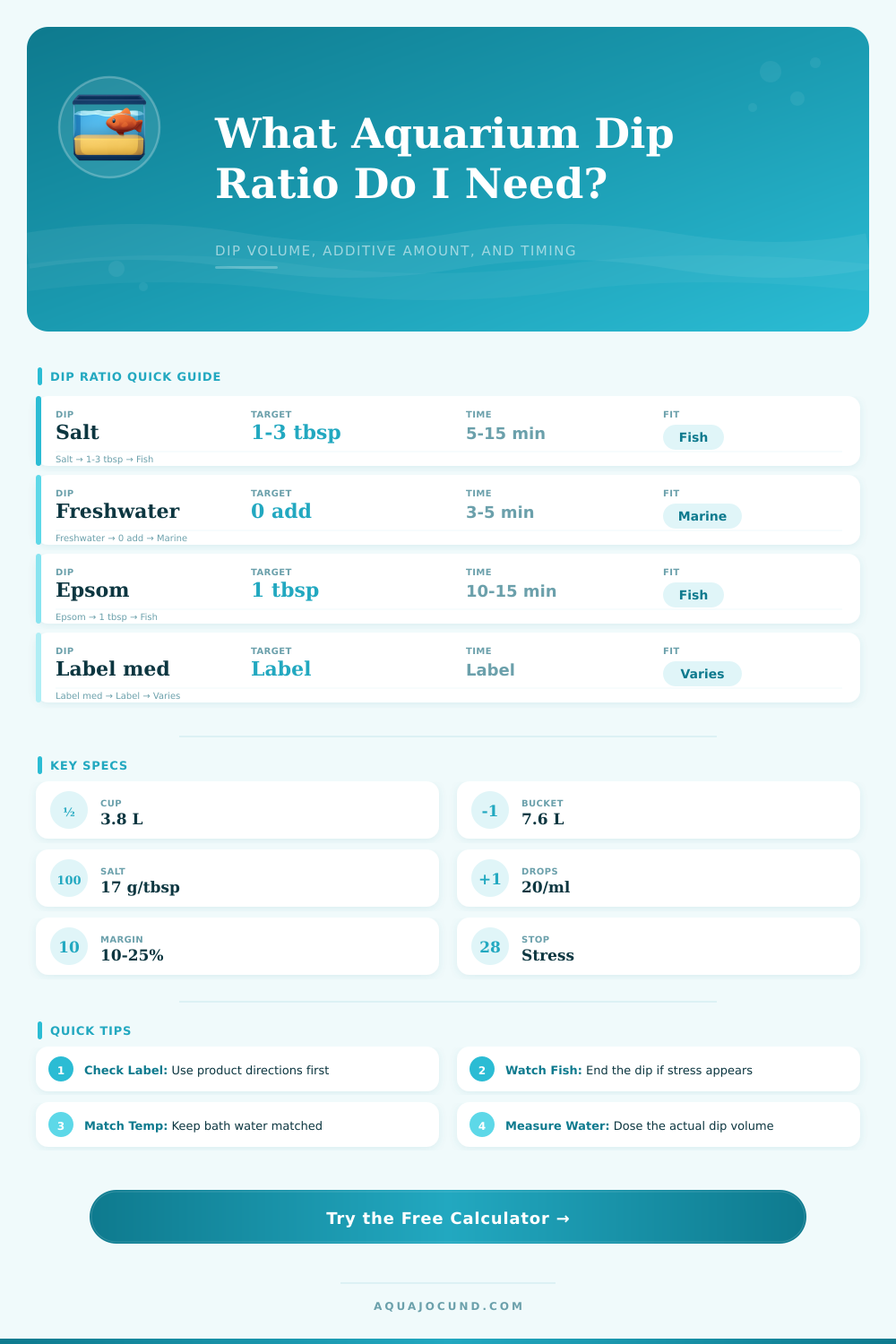
| Dip Solution | Calculator Basis | Typical Window | Best Match |
|---|---|---|---|
| Aquarium salt bath | 1 to 3 tbsp per gallon, converted to grams and tablespoons. | 5 to 15 min | Hardy freshwater fish, goldfish, and short external parasite baths. |
| Epsom salt bath | 1 tbsp per gallon, converted with 15 g per tablespoon. | 10 to 15 min | Short osmotic baths for fish when that method is appropriate. |
| Freshwater dip | Matched temperature and pH, no additive amount. | 3 to 5 min | Marine fish only when a freshwater dip is intentionally chosen. |
| Label medication bath | User-entered label rate in ml, drops, grams, teaspoons, or tablespoons. | Label time | Product baths where the printed label controls the dose. |
| Plant peroxide dip | Dilution math for plant-only dips, never livestock dips. | 1 to 5 min | Hardy aquatic plants removed from livestock water. |
| Iodine coral dip | Label rate by cup, liter, or gallon using custom liquid dosing. | 5 to 10 min | Coral frags in a separate bath with product directions. |
| Group | Salt Tolerance | Dip Time Guide | Calculator Watch Flag |
|---|---|---|---|
| Hardy freshwater fish | Moderate | 5 to 15 min | Reduce if breathing becomes rapid or balance changes. |
| Delicate or scaleless fish | Low | 2 to 5 min | Use a gentler margin and avoid strong salt presets. |
| Goldfish or koi | Moderate high | 5 to 15 min | Still stop early if rolling, jumping, or severe stress appears. |
| Marine fish | Freshwater dip only | 3 to 5 min | Match pH and temperature before the timer starts. |
| Shrimp, snails, crabs | Very low | Avoid unless label says | Calculator warns because many dips are unsuitable. |
| Plants or coral | Separate target | Product specific | Never return dip water to the aquarium. |
| Container | Measured Volume | Salt at 1 tbsp/gal | Use Case |
|---|---|---|---|
| Specimen cup | 0.5 L / 0.13 gal | 0.13 tbsp / 2.2 g | Small fish or coral plug when product directions allow. |
| Small bowl | 1 L / 0.26 gal | 0.26 tbsp / 4.5 g | Betta, small community fish, or plant sample dips. |
| Half bucket | 3.8 L / 1 gal | 1 tbsp / 17 g | Most simple ratio labels are easiest at one gallon. |
| Two gallon bucket | 7.6 L / 2 gal | 2 tbsp / 34 g | Medium fish with enough room to stay upright. |
| Large tub | 18.9 L / 5 gal | 5 tbsp / 85 g | Larger fish or equipment-only rinses. |
| Formula | Metric | Imperial | Where Used |
|---|---|---|---|
| Direct volume | liters entered | gallons x 3.785 | Measured dip water from a jug or bucket mark. |
| Rectangle volume | L x W x H / 1000 | L x W x H / 231 | Storage tote, specimen box, or rectangular bath. |
| Round bucket volume | pi x r² x H / 1000 | pi x r² x H / 231 | Cylindrical bucket filled to a measured depth. |
| Liquid dose | dose per L x liters | dose per gal x gallons | Label-guided product bath or custom liquid dip. |
| Salt dose | grams per L x liters | tbsp per gal x gallons | Aquarium salt or Epsom salt bath conversion. |
When preparing a dip for either a fish or a coral frag, there is several different factor to consider. Each of these factors has the potential to interact with each of the other factors in the process. For instance, you must consider the volumes of the water that you will use in preparing the dip, the tolerance of the animal that you are treating, and the temperature of the water that will be used in the dip.
Should any of these factors (volume, temperature, or animal tolerance) be incorrect set for the dip that you are preparing, the dip may stress the animal instead of providing beneficial treatment to the fish or frag. Each of the calculator provides you with the amount of additive that is to be used, the ratio of the additive to the water that will be treated, and the amount of time during which the animal should be placed in the bath. You should enter the volume of the water that will be used into the calculator, but the volume markings on a bucket or container should not be used to measure the water; the volume of the water line in the container should be used since the ratio of the additive to water is based off the amount of liquid in the container.
How to Prepare a Safe Dip for Fish and Corals
The tolerance of the animal is another of the factors that you must consider prior to treating the animal with the dip. For instance, some fish species has more tolerance for a salt bath than others. Fish that are known to be delicate or to be scaleless have more sensitivity to salt baths than more common fish species.
The calculator considers this factor so that a time for the animal to be treated with the dip is suggested according to the animal species that is to be treated. Additionally, the calculations for the corals and plants are calculated separately from those of the fish. Each of the dip baths for the corals have different chemistry than the baths for the fish.
The chemistry of the dip for the corals must match that of the main tank in which the corals reside. Should the temperature of the bath for the corals or fish differ from that of the main tank, the fish or coral may experience stress as a result of those differing temperatures. The reference tables that are provided for the readers allow for the reader to compare each of the options for the dips that can be performed for the fish or corals.
These tables, however, are not meant to replace the use of the calculator. The tables display the amount of each dip that can be prepared in different volume of water, and tables also display the tolerance of each of the animal groups to the dips. These tables can be used to ensure that the suggestions from the calculator are accurate for your specific animal.
While each of the animals may have different levels of sensitivity to each of these dips, the amount of additive that is used to prepare the dip is the most important number for many fish keepers. However, the duration of the dip is just as important as the amount of additive. The margin field in the calculator allows for the reader to select the type of animal that is to be treated.
Should the reader choose a type of animal that is known to be delicate in this field, the calculator will automatically adjust the amount of additive that is calculated for the animal so that it is given to the animal in amounts that are safe and will not harm the sensitive fish. Other fields within the calculator will display the adjusted amount of the additive that should be used, as well as a risk level for the treatment. Risk levels will indicate whether the risk level for the animal is low, normal, or high.
In addition to the calculations that the calculator performs, there are other factors that may affect the stress level of the animal when it is being treated with the dip. For instance, the aeration of the water and the amount of space within the container in which the animal is to be treated can both affect the stress levels of the animal; the calculator has no way of measuring these factor. Should the risk level for the animal be high, as determined by the calculator, it is important to watch the animal while it is being treated; a high risk level suggests that the animal may become stressed during the treatment, and you should be ready to end that treatment early.
The amount of water that will be used in the treatment should be measured prior to beginning the treatment, and the additive should be mixed in a separate container prior to adding it to the water in which the animal will be placed into the container. Mixing the additive in a separate container prevents the animal from being exposed to any undissolved salt or other liquid that may be prepared in the container. Additionally, the timer should be started only after placing the animal into the treated container.
While the calculator will provide the instructions for the length of time that the animal should be treated, the animal will have to be observed to ensure that its posture or breathing is not changing as a result of the treatment; in the case that the animals breathing or posture is changing, the dip should be stopped early to avoid harming the animal. You should of checked for any signs of stress. Its better to be safe than sorry.
Alot of people forget to monitor the fish properly. Making sure the water is correctely prepared is vital. It isnt easy to manage moddern aquariums.