📐 Aquarium Deflection Calculator
Estimate glass or acrylic panel bow from water height, panel span, thickness, bracing, and safety factor.
| Material | Elastic Modulus | Long-Term Allowable | Bow Limit Used | Best Fit |
|---|---|---|---|---|
| Soda-Lime Glass | 70 GPa / 10.2 Msi | 19 MPa estimate | Span / 500 | Standard framed aquariums |
| Low-Iron Glass | 70 GPa / 10.2 Msi | 18 MPa estimate | Span / 500 | Display tanks with clearer panels |
| Tempered Glass | 70 GPa / 10.2 Msi | 50 MPa estimate | Span / 500 | Panels designed for tempering |
| Laminated Glass | 60 GPa / 8.7 Msi | 15 MPa estimate | Span / 450 | Specialty safety panels |
| Cell-Cast Acrylic | 3.2 GPa / 0.46 Msi | 7 MPa estimate | Span / 360 | Large clear panels and custom tanks |
| Polycarbonate | 2.3 GPa / 0.33 Msi | 6 MPa estimate | Span / 300 | Impact-resistant specialty panels |
| Tank | Dimensions | Water Height | Typical Glass | Panel Checked |
|---|---|---|---|---|
| 10 Gallon | 20 x 10 x 12 in / 51 x 25 x 30 cm | 11 in / 28 cm | 1/8 in / 3 mm | Front panel |
| 20 Long | 30 x 12 x 12 in / 76 x 30 x 30 cm | 11 in / 28 cm | 1/4 in / 6 mm | Long panel |
| 40 Breeder | 36 x 18 x 16 in / 91 x 46 x 41 cm | 15 in / 38 cm | 1/4 in / 6 mm | Long panel |
| 55 Gallon | 48 x 13 x 21 in / 122 x 33 x 53 cm | 20 in / 51 cm | 3/8 in / 10 mm | Front panel |
| 75 Gallon | 48 x 18 x 21 in / 122 x 46 x 53 cm | 20 in / 51 cm | 3/8 in / 10 mm | Front panel |
| 125 Gallon | 72 x 18 x 22 in / 183 x 46 x 56 cm | 21 in / 53 cm | 1/2 in / 12 mm | Long panel |
| 180 Gallon | 72 x 24 x 24 in / 183 x 61 x 61 cm | 23 in / 58 cm | 1/2 in / 12 mm | Long panel |
| 240 Gallon | 96 x 24 x 24 in / 244 x 61 x 61 cm | 23 in / 58 cm | 5/8 in / 16 mm | Long panel |
| Bracing Mode | Deflection Multiplier | Stress Multiplier | Notes |
|---|---|---|---|
| Rimless / Open Top | 1.25 | 1.15 | Highest top-edge movement; use conservative design. |
| Molded Top Frame | 0.82 | 0.88 | Plastic rim limits some top spread but varies by tank. |
| Single Center Brace | 0.58 | 0.72 | Reduces effective long-panel span near the top. |
| Eurobrace Perimeter | 0.68 | 0.78 | Good edge restraint with open center access. |
| Multiple Cross Braces | 0.42 | 0.60 | Strong bow reduction on long custom tanks. |
| Full Top Frame Support | 0.48 | 0.64 | Conservative estimate for full rigid perimeter support. |
| Quantity | Formula Used | Base Units | What It Means |
|---|---|---|---|
| Bottom pressure | rho x g x water height | Pa | Pressure rises linearly with depth. |
| Panel load | 0.5 x pressure x height x span | N | Total triangular water force on the panel. |
| Approx bow | C x pavg x h^4 / (E x t^3) | m | Plate-style bow estimate with bracing modifiers. |
| Bending stress | K x pmax x h^2 / t^2 | Pa | Approximate stress screen for safety factor. |
| Safety factor | allowable stress / estimated stress | ratio | Compares estimated stress with material allowance. |
| Bow ratio | effective span / deflection | ratio | Higher ratios mean less visible panel movement. |
Aquarium tank panel may appear to be solid objects when the aquarium is empty. However, when the aquarium are filled with water, the tank panels experience a significant pressure from the water. The water pressure increase from the bottom of the tank panel to the top of the tank panel.
The tank panel must be able to withstand this pressure so that the panel does not bow under the load of water or place stress upon the seams of the aquarium. One way of ensuring that the aquarium tank panel will not bow too much under the load of the water is to perform a deflection check. A deflection calculator allow an individual to enter certain parameter of the aquarium, such as the dimensions of the aquarium, the height of the aquariums water, the thickness of the tank panel, and the types of bracing that will be used in the aquarium.
How Water Pressure Makes Aquarium Panels Bend
Based off these entries into the calculator, the calculator can provide an individual with an estimate of how much the tank panel will bow when filled with water. The pressure that the water exerts on the tank panels of an aquarium increases with the depth of the aquariums water. Therefore, the water pressure upon the bottom of the aquarium panel will be higher than the water pressure upon the top of that aquarium panel.
It is necessary to enter the actual height of the water into the calculator. For example, shallower water will produce less pressure upon the tank panel then deep water. This is due to the fact that the depth of the water in the aquarium determines the pressure exerted by the water upon the tank panel.
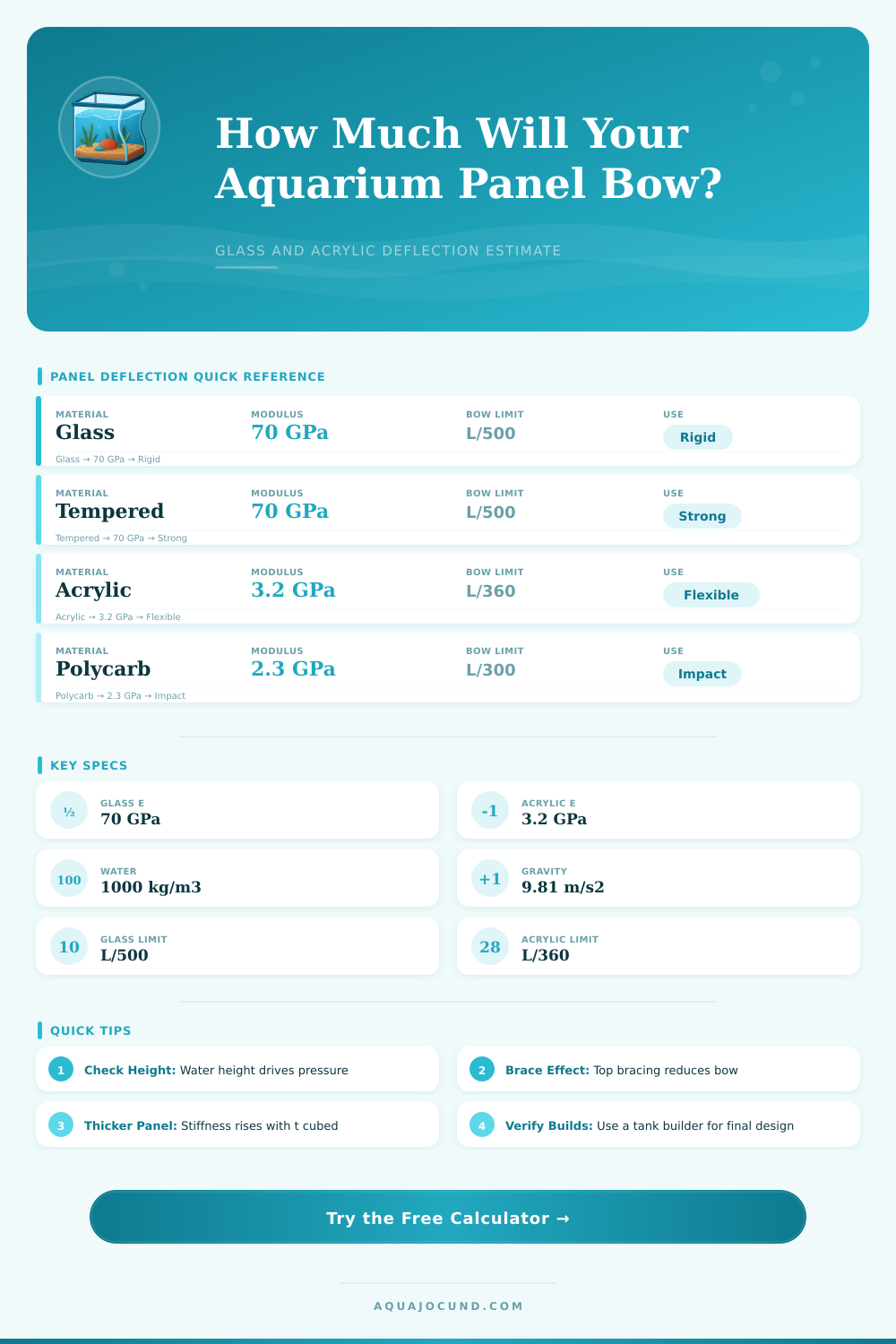
The type of material of which the aquarium tank panel is made is another factor that will impact how much that aquarium panel will bow. For instance, glass panels has a high elastic modulus. High elastic modulus indicates that the material is resistant to bending.
However, glass is also a brittle material, meaning that it is prone to breaking at the seams of the aquarium. Acrylic materials are more easy bent than glass materials. However, acrylic materials tend to exhibit less visible distortion before failing.
Calculators often allow individuals to switch between these two material, and to determine the thickness of the aquarium panel that would result in the panel not bowing too much under the load of the water. The type of bracing that the builder uses in the aquarium will also impact the bowing of the aquarium panel. Aquariums that do not include any bracing on the top of the tank panels will have the panel more likely to bow.
The addition of center or perimeter bracing will reduce the amount of deflection that the aquarium panel will experience. These different type of bracing have different multipliers that can be entered into the deflection calculator. The calculator allows individuals to view the differences in the bracing options, allowing them to decide whether the installation of an additional brace will increase the stability of the aquarium.
A safety factor can be incorporated into the deflection calculator for the aquarium to provide for any issue that may arise in the construction of the aquarium itself. For instance, the safety factor can account for any potential softening of the edges of the aquarium panel. It also ensures that there is some margin for error in the construction of the aquarium.
Aquarium builders often target a safety factor of three or four. The builder can adjust the safety factor in the calculator to accommodate the needs of the individual. If the safety factor is too low, the calculator will display the stress margin and the bow limit of the aquarium panel.
These measures will indicate whether the aquarium panel is too thin or whether it will bow too much. Outside of the parameters that are set up in the deflection calculator, there may be additional factors that may impact the bowing of the aquarium panel. For instance, there may be small chip along the edges of the aquarium panel.
Acrylic materials may also soften over time due to exposure to the higher temperatures in the room in which the aquarium is constructed. These factors can also be accounted for in the calculator. However, again, the calculator is only a screening tool.
More detailed tables provide information about the modulus values and the allowable bow ratio of both glass and acrylic materials. The deflection calculator provides the aquarium builder with a means of making decisions regarding the construction of the aquarium based upon numbers rather than guesswork. For instance, the builder must measure the height of the water in the aquarium, choose the type of material that will be used for the aquarium panel, and experiment with the type of bracing that is to be used in the aquarium prior to ordering the aquarium glass or cutting the acrylic.
The calculator allows the aquarium builder to observe how certain changes to the thickness or the bracing of the aquarium will have a significant impact upon the stiffness of the aquarium panel. Thus, the deflection calculator allows aquarium builders to understand how their tank panel will react to the water pressure prior to beginning to build the aquarium.