🐟 Aquarium Dechlorinator Dosing Calculator
Calculate conditioner dose from water volume, chlorine or chloramine ppm, label strength, water change size, overdose limit, and emergency factor.
| Preset | Label Rate | PPM Capacity | Use Case | Calculation Rate |
|---|---|---|---|---|
| Standard liquid | 1 mL / 10 gal | 1 ppm | Most weekly water changes | 1.0 mL / 10 gal / ppm |
| Concentrated liquid | 0.5 mL / 10 gal | 1 ppm | Small bottles with stronger label rate | 0.5 mL / 10 gal / ppm |
| Ultra concentrated | 0.2 mL / 10 gal | 1 ppm | High strength conditioner | 0.2 mL / 10 gal / ppm |
| Pond strength | 0.1 mL / 10 gal | 1 ppm | Large tanks or storage vats | 0.1 mL / 10 gal / ppm |
| Nano dropper | 0.25 mL / 10 gal | 0.5 ppm | Small tanks where drops are easier | 0.5 mL / 10 gal / ppm |
| Custom label | User entered | User entered | Match your bottle instructions | Dose divided by label ppm |
| Tank | Dimensions | Change | Treated Volume | Standard Dose at 2 ppm |
|---|---|---|---|---|
| 5 gal betta | 16 x 8 x 10 in | 25% | 1.25 gal / 4.7 L | 0.25 mL |
| 10 gal nano | 20 x 10 x 12 in | 30% | 3 gal / 11.4 L | 0.6 mL |
| 20 long | 30 x 12 x 12 in | 40% | 8 gal / 30.3 L | 1.6 mL |
| 29 gal planted | 30 x 12 x 18 in | 35% | 10.2 gal / 38.6 L | 2.0 mL |
| 40 breeder | 36 x 18 x 16 in | 50% | 20 gal / 75.7 L | 4.0 mL |
| 55 gal cichlid | 48 x 13 x 21 in | 50% | 27.5 gal / 104 L | 5.5 mL |
| 75 gal display | 48 x 18 x 21 in | 40% | 30 gal / 114 L | 6.0 mL |
| 125 gal large | 72 x 18 x 22 in | 30% | 37.5 gal / 142 L | 7.5 mL |
| Input | Factor | Why It Matters | Calculator Behavior |
|---|---|---|---|
| Free chlorine | 1.0x | Usually neutralizes directly at label rate | Uses ppm exactly as entered |
| Chloramine | 1.2x | Bound ammonia products often need more reducer | Adds a conservative 20% demand |
| Mixed / unsure | 1.3x | Useful when the utility report is unclear | Uses a higher planning factor |
| Routine margin | 1.0-1.5x | Compensates for measuring and ppm uncertainty | Applies before overdose cap |
| Safety cap | 1-5x | Keeps dose within the chosen label multiple | Limits routine and emergency dose |
| Emergency dose | 1.5-3x | For accidental untreated refill or high reading | Multiplies routine dose, then caps |
Removing the chlorine and chloramine from tap water prior to adding it to an aquarium is a necessary task due to the potential damages that the chlorine and chloramine can do to both the fish and the aquariums beneficial bacteria. For those who must determine how much water conditioner to add to the new water, the amount of water conditioner that is necessary to be added can depend upon the volume of water to be treated, the sanitizer reading of the tap water to be treated, and the strength of the water conditioner that will be used. Each of these variables can be accounted for in the dosing calculator that can be used to determine the amount of water conditioner that should be added to the new water prior to adding that water to the aquarium.
The dosing calculator will first require the user to enter the volume of the water that will be treated with the water conditioner. While many may believe that the total volume of the aquarium is the volume of water that should be treated, the amount of water that should be treated is only that portion of water that will be added to the aquarium. For instance, if the aquarium is to receive a 50% water change in a 55-gallon aquarium, the amount of water that should be entered into the dosing calculator would be the 27 gallons of water that will be added to the tank.
How to Use a Water Conditioner Calculator
Following the entry of the volume of water that will be treated, the user will enter the sanitizer reading of the water into the dosing calculator. Chloramine contains bound ammonia, and the presence of ammonia requires more water conditioner to neutralize the ammonia than the chlorine in the water. As such, the dosing calculator accounts for the chloramine in the water and ensures that the calculated amount of water conditioner will be enough to neutralize the chloramine in the water.
The strength of the water conditioner can also be entered into the dosing calculator. Water conditioners come in both concentrated and non-concentrated varieties. The label on the bottle of water conditioner will indicate the number of ppm of sanitizer that the stated dose of water conditioner can neutralize.
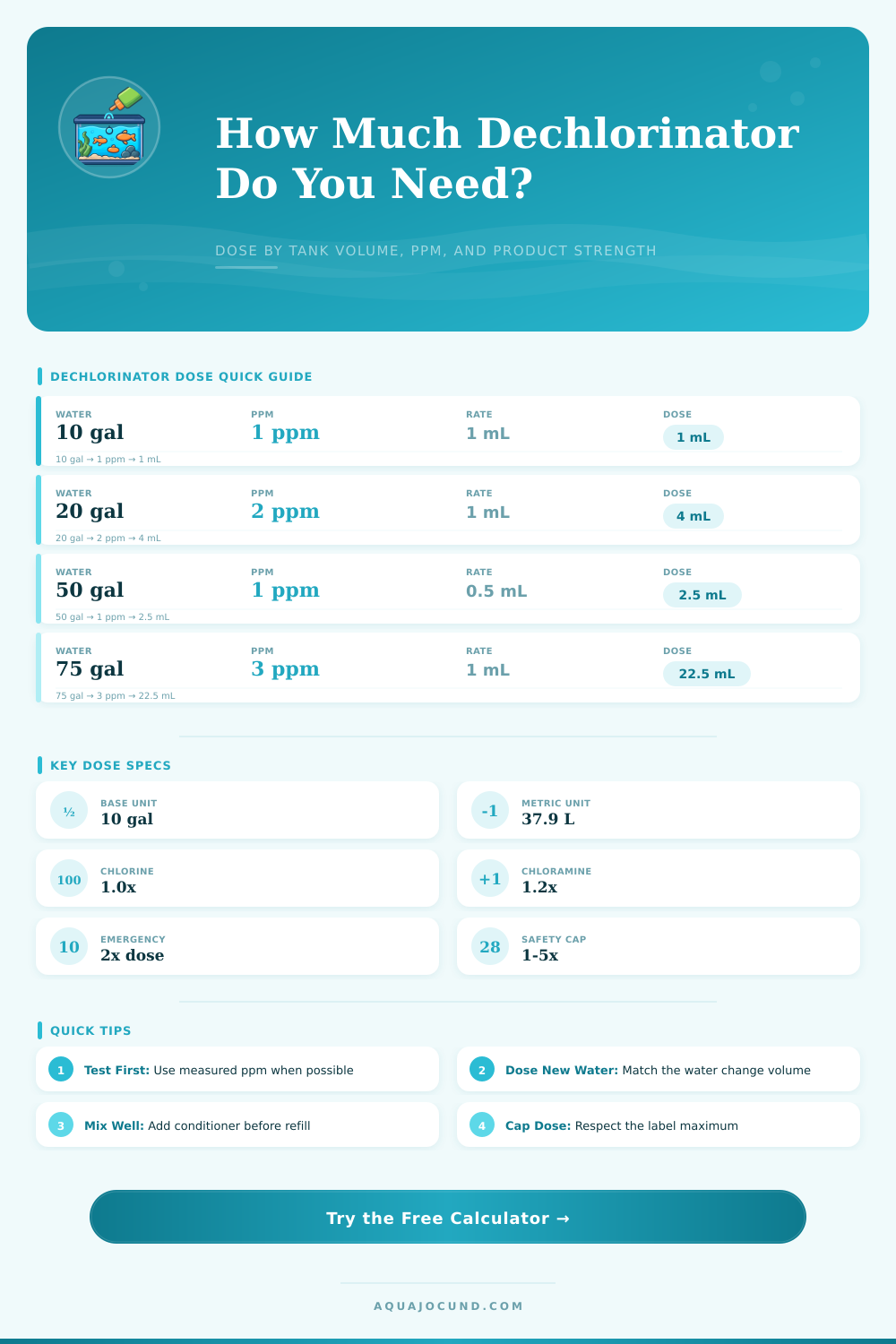
Based off the ppm of the water and the strength of the water conditioner, the dosing calculator can calculate the amount of water conditioner that should be added to the water to be treated for the water to be safe for the aquariums inhabitants. In addition, it is possible to add a safety margin to this dose, should the user wish to account for errors in measuring the water conditioner, or if the sanitizer levels in the tap water may be more high than expected. The dosing calculator also includes a safety cap that limits the amount of water conditioner that can be added to ensure that there is no overdose of the water conditioner.
The amount of water conditioner that should be added is between one times the label dose of water conditioner and five times the label dose of the water conditioner. This safety cap prevents the user from adding too much water conditioner to the water that will be added to the aquarium. Should the dosing calculator set the water conditioner dose to five times the label dose, the user will know that the concentration of water conditioner is one that can be added to the aquarium; should the water tests contain higher levels of sanitizer, the user will be able to recognize that the current dose of water conditioner is insufficient.
It is a good habit to treat the water in a separate container prior to adding that water to the aquarium. Treating the water in a separate container allows the water conditioner to perform its tasks prior to adding the water to the aquarium. Additionally, treating the water in a separate container ensures that any error in the addition of the water conditioner occur outside of the aquarium.
If the user is to add the water conditioner directly to the aquarium, it should be added near a powerhead or filter intake in the aquarium to ensure that the water conditioner quickly mixes with the water in the aquarium. Because chloramine takes longer to react with the water conditioner than chlorine, it is also a good habit to wait at least a few minutes before testing the water. In general, water conditioner will work more slow in cold water.
Therefore, if the water that is to be added to the aquarium is very cold, the water conditioner may not be able to neutralize all of the chlorine in the water. To avoid this scenario, it is helpful to warm the water to a higher temperature prior to adding the water conditioner to the water. In addition, it is never a good idea to add the same water conditioner to the water twice.
However, if the water conditioner is to be added directly to the aquarium water, it is helpful to use a dedicated cup or syringe for the water conditioner to avoid adding it twice to the tank. Beneath each of the dosing calculator is a series of reference tables. These reference tables indicate the amount of water in various sized aquariums that will be replaced at various percentage values.
These tables also indicate the label rates for various types of water conditioners. These tables provide context for the water conditioner that is to be used in the aquarium, but the dosing calculator will provide the specific measurements for the amount of water conditioner that will be needed. The label rate and the ppm of the sanitizer in the water should be matched.
The ppm of the sanitizer in the tap water may change over time. For these reasons, it is important to use the current ppm rate of the water rather than an old average of the ppm of the water. Additionally, if the ppm of the tap water is unusually high, the emergency factor on the dosing calculator can be used to increase the amount of water conditioner that is to be added to the tank.
As with any task, it is important to avoid adding too much water conditioner to the aquarium. Water conditioner can be purchased in quantities that may be costly to the aquarium owner to replace in the event that too much water conditioner is added to the water. Additionally, too much water conditioner may create a film on the surface of the water that the fish may dislike.
The dosing calculator indicates the factor that contribute to the amount of water conditioner that the calculator calculated. By understanding the reason for the calculated amount of water conditioner, the users will feel more confidently in the use of that water conditioner. By using the dosing calculator correctly and understanding the reason for each value in the aquarium water, the fish will remain comfortable within the aquarium, and the beneficial bacteria that maintains the balance of the water within the aquarium will remain intact.