🐟 General Cure Dosing Calculator
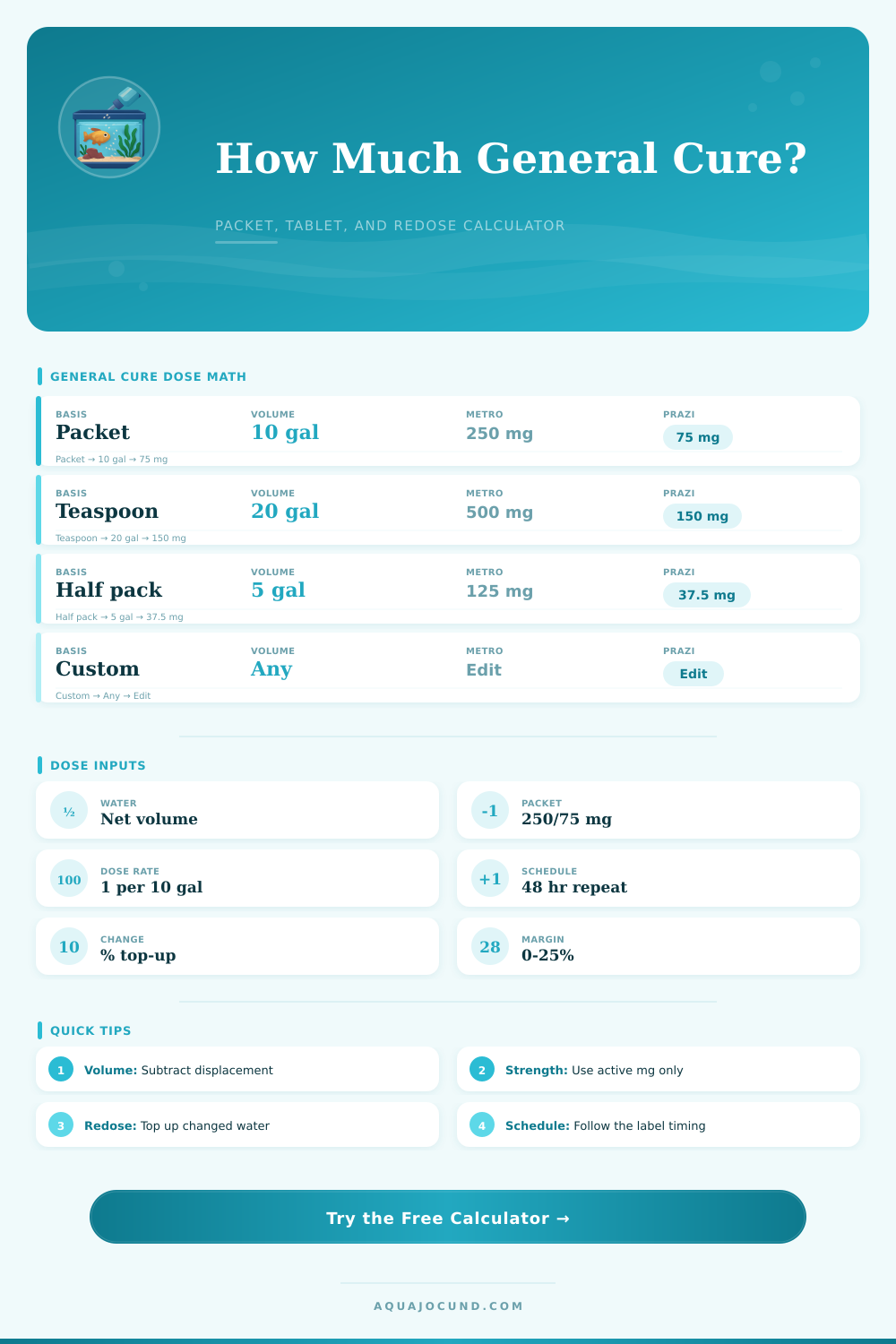
Calculate combined metronidazole and praziquantel amounts from real water volume, editable packet or tablet strength, displacement, dose schedule, water changes, and safety margin.
✅ Dose Calculation Results
| Measurement type | Metronidazole | Praziquantel | Equivalent label basis | Calculator use |
|---|---|---|---|---|
| Standard powder packet | 250 mg | 75 mg | 1 packet per 10 US gal | Default packet calculation |
| Half packet portion | 125 mg | 37.5 mg | 0.5 packet per 5 US gal | Small quarantine tanks |
| Bulk teaspoon example | 500 mg | 150 mg | About 2 packet equivalents | Editable bulk powder basis |
| Tablet or capsule | Editable mg | Editable mg | Depends on label | Tablet split or custom unit |
| Custom measured unit | User entered | User entered | User entered | Scale, scoop, or premix math |
| Tank size | Typical dimensions | Gross volume | Net at 10% displacement | Packets at 1 per 10 gal |
|---|---|---|---|---|
| 5.5 gallon | 16 x 8 x 10 in / 41 x 20 x 25 cm | 5.5 gal / 20.8 L | 5.0 gal / 18.7 L | 0.50 packet |
| 10 gallon | 20 x 10 x 12 in / 51 x 25 x 30 cm | 10 gal / 37.9 L | 9.0 gal / 34.1 L | 0.90 packet |
| 20 long | 30 x 12 x 12 in / 76 x 30 x 30 cm | 20 gal / 75.7 L | 18 gal / 68.1 L | 1.80 packets |
| 29 gallon | 30 x 12 x 18 in / 76 x 30 x 46 cm | 29 gal / 109.8 L | 26.1 gal / 98.8 L | 2.61 packets |
| 40 breeder | 36 x 18 x 16 in / 91 x 46 x 41 cm | 40 gal / 151 L | 36 gal / 136 L | 3.60 packets |
| 55 gallon | 48 x 13 x 21 in / 122 x 33 x 53 cm | 55 gal / 208 L | 49.5 gal / 187 L | 4.95 packets |
| 75 gallon | 48 x 18 x 21 in / 122 x 46 x 53 cm | 75 gal / 284 L | 67.5 gal / 255 L | 6.75 packets |
| 125 gallon | 72 x 18 x 22 in / 183 x 46 x 56 cm | 125 gal / 473 L | 112.5 gal / 426 L | 11.25 packets |
| Scenario | Input used | Calculator operation | Output meaning |
|---|---|---|---|
| Initial dose | Net water volume | Volume divided by label rate | Product units for one full dose |
| Repeat dose | Rounds and interval | Per-dose units multiplied by rounds | Total planned product amount |
| Water-change top-up | Change percent | Per-dose active amount multiplied by change percent | Units to replace changed water |
| Component target | Metro or prazi mg/L | Target mg/L multiplied by net liters | Companion ingredient follows product ratio |
| Original full dose | Water change | Top-up units | Metro replaced | Prazi replaced |
|---|---|---|---|---|
| 1 packet | 25% | 0.25 packet | 62.5 mg | 18.75 mg |
| 2 packets | 30% | 0.60 packet | 150 mg | 45 mg |
| 4 packets | 50% | 2.00 packets | 500 mg | 150 mg |
| 6 packets | 20% | 1.20 packets | 300 mg | 90 mg |
Calculate from treatment water, not nominal tank size. The displacement field reduces the gross volume before converting packet, tablet, and component amounts.
Combined products move both actives together. If metronidazole is the target driver, praziquantel follows the product ratio, and the reverse is also true.
To use the metronidazole and praziquantel product in an aquarium, you first must determine the actual volumes of water in the aquarium. The volume of water in the aquarium is typically less than the number printed on the aquarium label because the rocks, substrate, and filter media for the aquarium take up some of the volume of water that the aquarium can hold. If instead you use the labeled aquarium volume to calculate the amount of metronidazole and praziquantel to use, you will dose the aquarium with a volume of water that is more larger than the actual volume of water in the aquarium.
If you dose a volume of water that is larger than the water that is actualy in the aquarium, the concentration of the two medications will be lower than it should of been. Thus, you must calculate the net water volume of the aquarium to ensure that the resulting concentration is the correct concentration of the medications. The metronidazole and praziquantel product come in a variety of formats.
How to Calculate the Right Dose of Metronidazole and Praiquantel for Your Aquarium
Each of these formats contain a specific ratio of the two medications; the active ingredients in the product. You must know the exact amount of metronidazole and praziquantel in each unit of the product. The two medications are locked in a specific ratio with one another; if you increases the amount of metronidazole in the product, for instance, you must also increase the amount of praziquantel by the same percentage, as the two is equally present in the product.
The calculator allows you to enter the number of milligrams of each medication in each unit of the product. In addition to calculating the amount of metronidazole and praziquantel that is required to treat the actual volume of water in the aquarium, you must also determine the schedule for treating the aquarium with the product. How many times you will dose the aquarium is an essential calculation to make.
The product label may suggest a second dose after forty-eight hours, but you may choose to dose the aquarium more times than suggested. Additionally, each of these dosing rounds will remove some of the metronidazole and praziquantel from the aquarium; you must calculate for this removal. When you perform a water change, you remove some of the water from the aquarium; you must remove the same percentage of the metronidazole and praziquantel from the product to accurate calculate the amount that will remain in the water.
An additional input into the calculator is the safety margin. If the safety margin is positive, this will increase the calculated dose of the metronidazole and praziquantel; positive margins accounts for potential errors in measuring the dose of the medications. If the safety margin is negative, it will decrease the amount of dose of the medications that are delivered to the aquarium; negative margins allow the aquarist to under-treat a more sensitive species of fish that may be contained within the aquarium.
The tables included on the page are examples of the ways in which the metronidazole and praziquantel product can be used. One table illustrates the number of gallons of water that each unit of the metronidazole and praziquantel product can treat; another table illustrates the impact of a 25% water change on the concentration of the medications. These tables are an example of the variety of scenarios in which the product can be used; they dont replace the recommendations of the product manufacturer on the product label itself.
In order to use the calculator to effectively treat the aquarium, you must treat the actual volume of water in the aquarium. You must know the number of milligrams of each medication in each unit of the product. Finally, you must decide how the water change will impact the medications.
The calculator will calculate for you the amount of product required to treat your aquarium according to the parameters that you enter. However, the calculator does not make any of the aforementioned decisions; youre in control of the product dose, safety margins, and redosing schedules for the aquarium.