🐟 Aquarium Copper Dosing Calculator
Estimate copper medication doses for fish-only hospital and quarantine tanks, including water changes, test-kit correction, media loss, and daily ramp limits.
✅ Dosing result for fish-only quarantine
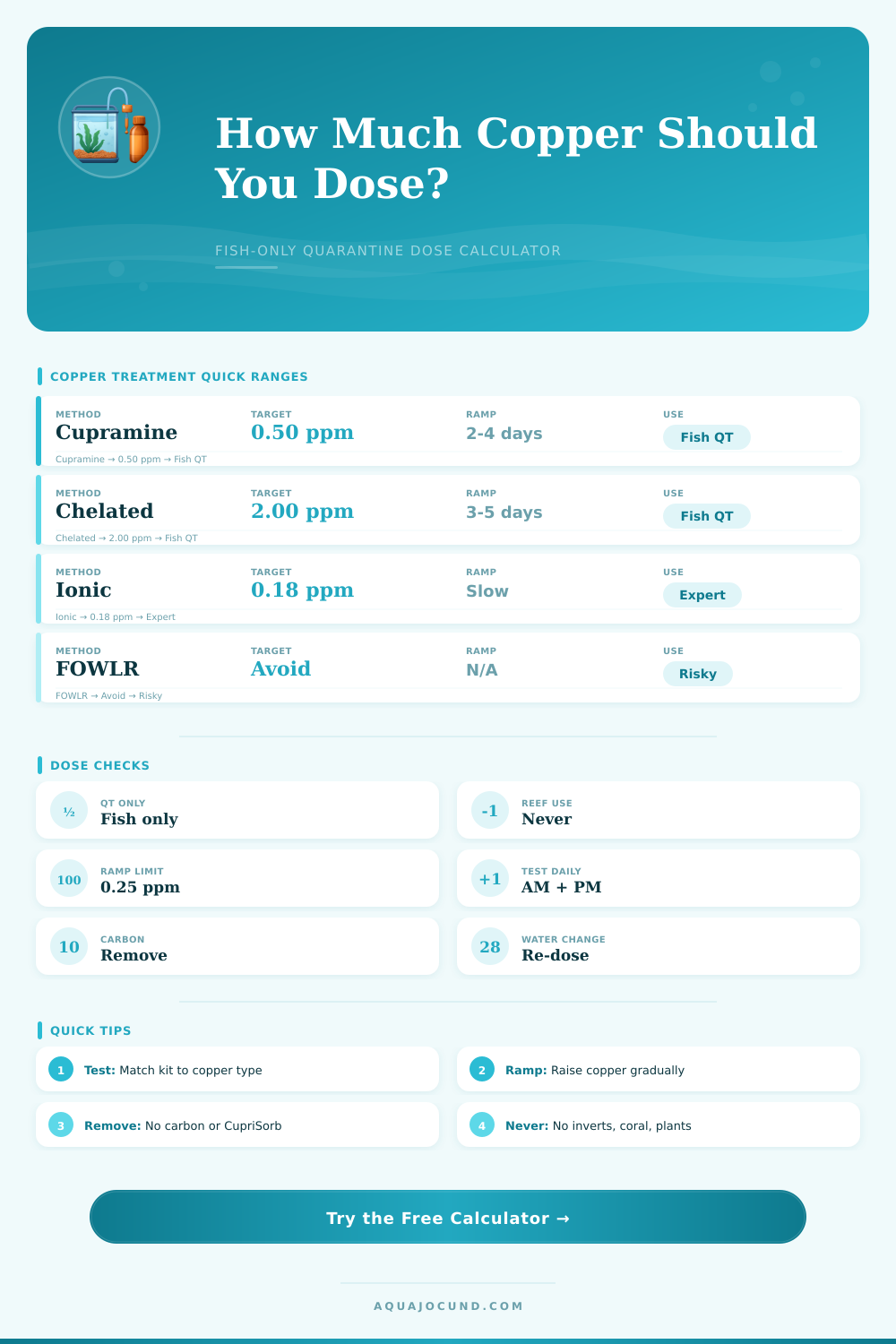
| Copper type | Typical target | Test-kit match | Ramp note | Do not use with |
|---|---|---|---|---|
| Amine copper | About 0.50 ppm for many Cupramine-style treatments | Kit known to read amine copper reliably | Split into multiple doses over 2-4 days | Reducers, binders, reef tanks, inverts |
| Chelated copper | Often around 2.00-2.50 ppm depending on label | High-range kit or checker suited to chelated copper | Raise slowly and confirm with daily tests | Carbon, copper removers, porous display rock |
| Ionic copper sulfate | Narrow low range; expert use only | Low-range ionic copper kit | Small increases; toxicity margin is thin | Sensitive fish, soft water errors, uncertain kits |
| Fish-only display | Avoid unless it is a dedicated treatment system | Confirm substrate and rock do not absorb copper | Quarantine tank is usually safer | Future reef use, shrimp, snails, coral, macroalgae |
| Tank | Typical dimensions | Measured water | Copper use case | Practical note |
|---|---|---|---|---|
| 5 gal hospital | 16 x 8 x 10 in | 4-5 gal | Short observation or small fish | Errors concentrate quickly |
| 10 gal QT | 20 x 10 x 12 in | 8-10 gal | Small fish quarantine | Use tiny measured doses |
| 20 long QT | 30 x 12 x 12 in | 16-19 gal | General marine QT | Good gas exchange and footprint |
| 29 gal QT | 30 x 12 x 18 in | 23-27 gal | Moderate fish or longer stay | Height adds dilution, not territory |
| 40 breeder QT | 36 x 18 x 16 in | 32-37 gal | Tangs and active swimmers | Large footprint helps stress |
| 75 gal QT | 48 x 18 x 21 in | 60-70 gal | Large fish quarantine | Needs strong aeration |
| Scenario | Current level | Change | Replacement level | Post-change level |
|---|---|---|---|---|
| Fresh saltwater top-up | 0.50 ppm | 25% | 0.00 ppm | 0.38 ppm |
| Matched medicated water | 2.00 ppm | 30% | 2.00 ppm | 2.00 ppm |
| Partial under-dose | 1.80 ppm | 20% | 1.00 ppm | 1.64 ppm |
| Emergency dilution | 0.70 ppm | 50% | 0.00 ppm | 0.35 ppm |
| Correction item | Calculator input | What it means | When to use |
|---|---|---|---|
| Test kit reads low | 110% | 0.50 reading becomes 0.55 ppm | After cross-checking with a trusted kit |
| Test kit reads high | 90% | 0.50 reading becomes 0.45 ppm | When verified against a standard |
| Adsorbent loss | 5-25% | Dose target is raised to offset removal | Only when media or rock is pulling copper |
| Ramp limit | 0.10-0.25 ppm | Caps the dose suggested for today | Use lower values for sensitive fish |
Use a bare quarantine tank when possible. Copper binds to porous rock, sand, filter pads, and some plastics, making levels drift. It is not safe for corals, shrimp, snails, crabs, macroalgae, or most planted aquariums.
Never dose only from a calendar. Test copper, adjust for water changes, and dose in small measured steps. If the fish are distressed, pause dosing, increase aeration, and verify ammonia and copper readings.
Copper treatments in the quarantine tank are used due to the fact that copper ions will interferes with the metabolism of the parasites, but the copper ions necessary to kill the parasites will also stress the fish in the tank. The difference between an effective dose of copper and an overdose of copper is very small, meaning that treating the tank for parasites with copper treatments is similar to a medical procedure. In order to calculate the proper amount of copper treatment for the tank, you must measure the volume of the water in the tank, understand the reading of the copper test kit, and determine the rate at which the fish in the tank can tolerate copper.
A dosing calculator will help to find the volume of medication that is recommended for that day based off these variables. One of the first decisions to be made is the type of copper product to use. Products based upon amines tend to reach a concentration of.5 ppm of copper, while chelated copper products reach 2 ppm.
How to Dose Copper in a Quarantine Tank
Copper sulfate products maintain a lower concentration in the water, however. Each copper product will behave differently in the water, and each will have different requirement to measure copper in the tank. If the copper test kit that is used to measure the amount of copper in the water was calibrated for different chemistry than the water in the quarantine tank, the amount of copper that is measured may be incorrect.
In this case, you can use the correction factor for the copper test kit in the dosing calculator to ensure the calculations are even with the water chemistry in the tank prior to adding copper treatment. The volume of the water in the quarantine tank must also be measured. A tank that is listed as containing 20 gallons of water will not contain that many gallon of water in the tank if it also contains the rock, substrate, and other equipment.
The water line should be measured after placing the rock, substrate, and other items in the tank. The dosing calculator allows for the volume of the tank to be entered directly, or you can enter the dimensions of the tank in order to calculate the true water volume. Once you know the true volume of the water in the tank, the other calculations will provide the correct amount of copper medication to be added.
The percentage of the water that will be changed in the quarantine tank must also be considered. If you change water in the tank, that percentage of copper will be removed. You can enter the percentage of water to be changed and the copper concentration in the new water into the dosing calculator.
The calculator will show the copper level in the tank prior to adding copper medication. This prevents adding the same amount of copper to the tank after each water change, which could lead to copper levels that are too high for the fish in the tank. Another variable to consider is the ramp in which the copper levels will be increased each day.
Depending upon the species of fish in the tank, they may be more or less sensitive to copper. You can enter the sensitivity to copper for the fish in the quarantine tank into the calculator, which will adjust the amount of copper that is to be added to ensure that the copper level does not go beyond what the fish is able to tolerate. The output of the dosing calculator will show how much copper still needs to be added to the tank, as well as the capped amount of copper that can be added today.
Media loss in the tank can also be a variable. Media loss may cause copper levels in the water to drop. Rock, sand, filter media, and other plastic products in the aquarium may bind to copper in the water, decreasing the copper levels in the water.
If the amount of media loss in the tank is known, the loss field in the dosing calculator can be used to increase the target copper level to account for this loss. If the media loss is significant, the tank may not be ideal for copper treatments. In this instance, the absorbent media may be removed from the tank.
The reference tables will provide context for the individual using the dosing calculator. The reference tables include information about the typical ranges for copper levels for each type of copper, the typical volumes of the quarantine tanks, and the impact that water changes have upon copper levels. Additionally, the reference tables may indicate instances in which copper should not be used, such as when the tank will contain invertebrates or plants.
These tables will not provide the decision for whether copper should be used in the treatment regimen for the fish, but they will help with the mathematics of adding copper medication to the water if copper treatment is selected. Because copper treatments are to be temporary, copper must be removed once the parasites are gone. To remove copper from the water, you can use carbon, copper-specific resins, as well as performing water changes.
The same level of discipline should be used to remove the copper from the tank as were used to add copper to the water. Before the newly treated fish are to be added to the main tank, copper levels should be brought back to zero. In order to successfully use copper in the quarantine tank, it is necessary to measure the volume of water in the tank, match the copper test kit to the copper products, and understand the ramp in which copper should be added to the water each day.
Prior to adding any more copper to the water, it is also important to retest the copper levels in the tank. The dosing calculator will provide the calculations necessary for adding copper to the tank, but the individual is still responsible for the management of copper levels and the health of the fish in the tank.