Aquarium Carbon Removal Time Calculator
Estimate how long activated carbon needs to run after medication, tint, odor, or dissolved organic load changes.
Carbon removal plan
Adjust carbon dose, water flow, and target removal to compare timelines.
| Carbon type | Best fit | Rate profile | Planning note |
|---|---|---|---|
| Lignite granular | Color and broad organics | Fast start | Low density; rinse very well |
| Bituminous granular | General freshwater polishing | Balanced | Good default for bags and trays |
| Coconut shell | Odor and smaller molecules | Moderate | Often dense with high micropore share |
| Pelletized carbon | Canister and reactor use | Steady | Flows evenly with less dust |
| ROX style extruded | Reef clarity and low dust | High | Strong capacity in a compact bed |
| Catalytic carbon | Chloramine prefilter tasks | Moderate | Not a substitute for conditioner in a tank |
| Carbon pad | Short polish pass | Low | Convenient but limited capacity |
| Mixed cartridge | Small filters | Moderate | Capacity depends on carbon fraction |
| Load type | Carbon response | Common target | Useful check |
|---|---|---|---|
| Tannins / tea tint | Good for color reduction | 50-80% | Stop before blackwater is stripped too far |
| Odor and light organics | Good polishing load | 60-85% | Check source of odor if it returns |
| Yellow water DOC | Good with steady flow | 70-90% | Pair with maintenance water changes |
| Dye medication color | Often strong adsorption | 80-95% | Run after treatment period is complete |
| Organic medication residue | Varies by active ingredient | 70-90% | Check the medication label first |
| Unknown mixed load | Use conservative timing | 60-80% | Replace carbon if water does not improve |
| Tank | Typical water volume | Standard carbon | Heavy cleanup flow |
|---|---|---|---|
| 5 gal nano | 4-5 gal / 15-19 L | 5 g / 0.18 oz | 20-30 gph / 76-114 L/h |
| 10 gal | 8-10 gal / 30-38 L | 10 g / 0.35 oz | 40-60 gph / 151-227 L/h |
| 20 long | 16-20 gal / 61-76 L | 20 g / 0.7 oz | 80-120 gph / 303-454 L/h |
| 29 gal | 23-29 gal / 87-110 L | 29 g / 1.0 oz | 120-175 gph / 454-662 L/h |
| 40 breeder | 32-40 gal / 121-151 L | 40 g / 1.4 oz | 160-240 gph / 606-908 L/h |
| 55 gal | 44-55 gal / 167-208 L | 55 g / 1.9 oz | 220-330 gph / 833-1249 L/h |
| 75 gal | 60-75 gal / 227-284 L | 75 g / 2.6 oz | 300-450 gph / 1136-1703 L/h |
| 125 gal | 100-125 gal / 379-473 L | 125 g / 4.4 oz | 500-750 gph / 1893-2839 L/h |
| Result signal | Meaning | Adjustment | Retest point |
|---|---|---|---|
| Capacity under 100% | Carbon may be exhausted early | Add fresh carbon or change more water | 6-12 hours |
| Turnover below 3x/hr | Water reaches media slowly | Improve directed flow through carbon | 12-24 hours |
| Contact under 1 sec | Bed is too small or flow is too high | Use a larger bed or slower reactor pass | 4-8 hours |
| Time over 48 hours | Load is heavy or uncertain | Water change, new carbon, or split batches | 24 hours |
| Fast target below 6 hours | Likely a light polish load | Avoid leaving old carbon indefinitely | End of day |
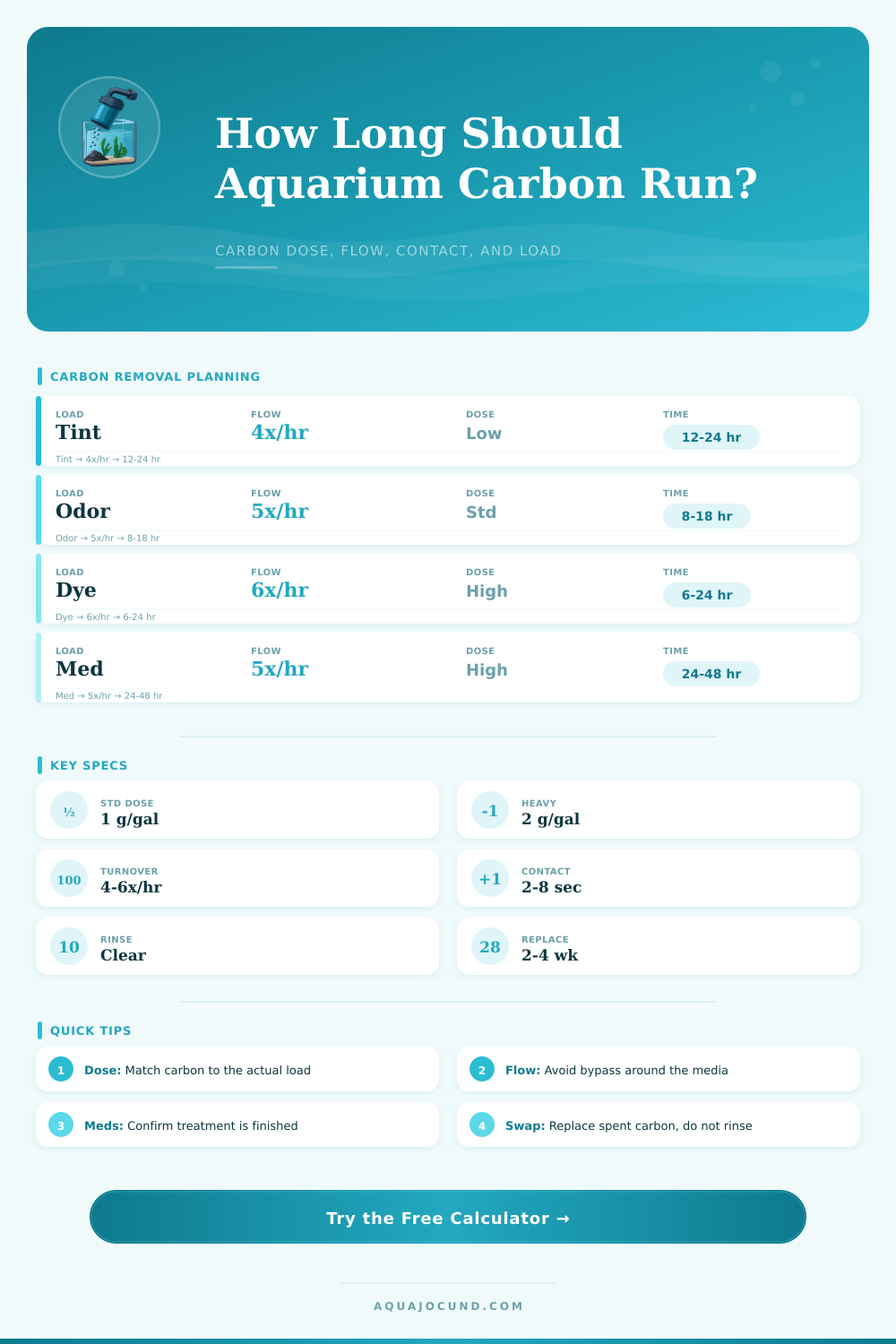
Aquarium water dont remain clear on its own due to the amount of dissolved organics that eventually build up in the aquarium water. The dissolved organics that contribute to the tinting and algae bloom in the aquarium originate from the waste, food, and medication that are added to the aquarium water. Activated carbon is able to remove these dissolved organics from the water, but the time that the activated carbon need to remain in the filter to remove all of the dissolved organics from the aquarium water must be determined.
There are several variable that contribute to the length of time that activated carbon should remain in the filter. Such variables include the volume of the aquarium, the type of organic load that is present in the aquarium, the amount of activated carbon that is placed into the filter, and the flow rate of the water that pass through the activated carbon. The activated carbon lifespan calculator calculates each of these variables, but it is important for the new aquarium or filter maintenance hobbyist to understand each of these variables and there effect upon the lifespan of activated carbon within the filter.
How Long Activated Carbon Lasts in Your Aquarium
The volume of the aquarium is one of the variables to calculate; however, the volume of the water is more important than the volume of the aquarium itself. If the aquarium is not filled with water to the top with fish, then the volume of the water is less than the volume of the aquarium. Therefore, the user need to enter the volume of the water into the activated carbon lifespan calculator.
The type of organic load that is placed into the aquarium is another of the variables. For instance, if the organic load are tannins from wood placed into the aquarium, there is a different amount of activated carbon necessary than if the organic load is medication that is used in the aquarium. The calculator determine the amount of activated carbon necessary according to the type of organic load that enters the water.
The dose of activated carbon is another of the variables. Too much activated carbon will result in cost and benefit for the aquarium owner of having to purchase too much activated carbon. Too little activated carbon will result in the activated carbon become saturated with the dissolved organics in the aquarium.
The activated carbon lifespan calculator will calculate the amount of activated carbon necessary for the organic load to ensure that there is a safety margin in the dose of activated carbon that is placed into the filter. Another of the variables to consider is the placement of activated carbon within the filter. If the person places the activated carbon into a low water flow area within the filter, the water will not pass through the activated carbon at an efficient rate; if the activated carbon is placed into an area where the water is forced to pass through the activated carbon grains, more contact time will allow for activated carbon to be more efficient in the removal of dissolved organics from the aquarium water.
This efficiency in contact time is accounted for in the activated carbon lifespan calculator. Activated carbon should not be run while there is an active medication being provided to the aquarium water. Activated carbon can remove many of the chemical compound from the aquarium water.
If one of the chemical compounds that is being removed is the medication for the aquarium inhabitants, the fish may not recieve the proper amount of that medication. Therefore, the medication cycle should be complete before you introduce activated carbon into the aquarium water. Activated carbon is not a permanent solution to clear aquarium water; activated carbon does have a limited life in which it will work for the aquarium.
Eventually, activated carbon will reach its capacity to bind to the dissolved organics in the aquarium water. At such a time, the activated carbon will no longer be able to remove those dissolved organics from the water. Additionally, the activated carbon may begin to release the bound dissolved organics back into the aquarium water.
Therefore, there is a limited time frame during which activated carbon will work; it may only work for a few week in the aquarium. Activated carbon lifespan calculator will calculate the length of time that activated carbon will work within the aquarium; however, the aquarium owner must remember that there is a limited life span for activated carbon. In order to achieve clear aquarium water, you must match activated carbon to the organic load in the aquarium.
Additionally, the water must flow through the activated carbon rather than around it. By performing each of these steps, activated carbon will work efficient to provide the owner with the clear aquarium water that he or she desire.