Aquarium Carbon Footprint Calculator
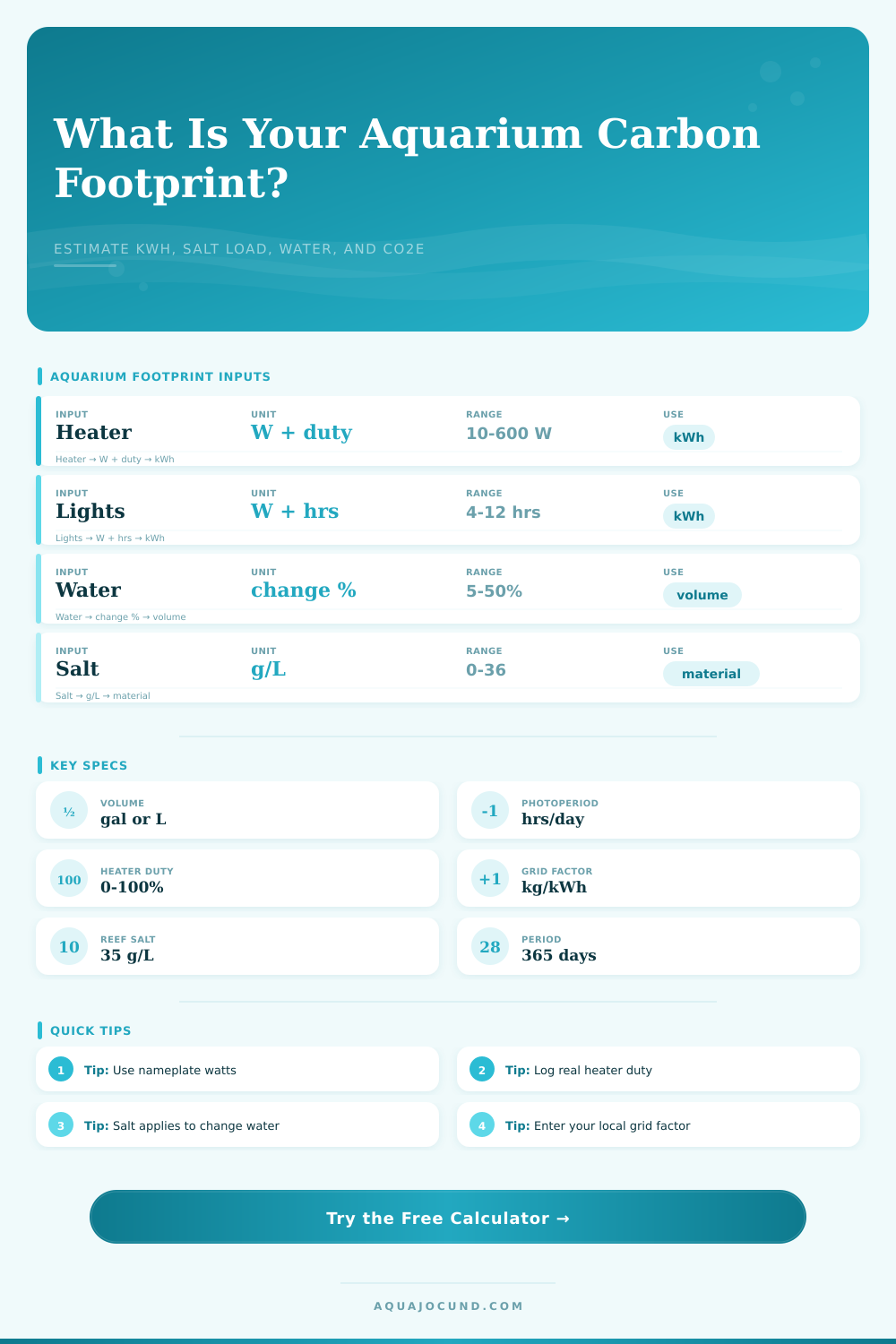
Estimate annual aquarium kWh, equipment CO2e, water-change volume, salt material load, and total footprint from wattage, duty cycle, and local grid factor inputs.
Annual Footprint Estimate
| Profile | Salt target | Prep electricity basis | Material load use |
|---|---|---|---|
| Freshwater tap | 0 g/L | Low mixing load | No salt material counted |
| RO/DI freshwater | 0 g/L | Higher prep electricity | Prepared fresh water counted |
| Planted freshwater | 0 g/L | Light prep allowance | Water-change volume only |
| Brackish | 10 g/L | Mixing and circulation | Partial salt load counted |
| Marine fish-only | 32 g/L | RO/DI and salt mixing | Salt load from changes |
| Reef saltwater | 35 g/L | RO/DI and stronger mixing | Full marine salt load |
| High salinity | 36 g/L | RO/DI and stronger mixing | Higher salt load per liter |
| Equipment | Input method | Formula used | Common planning note |
|---|---|---|---|
| Heater | Watts and duty cycle | W x duty x 24 / 1000 | Duty cycle changes with room temperature |
| Lights | Watts and photoperiod | W x hours / 1000 | Use the actual programmed hours |
| Filters and returns | Watts and runtime percent | W x runtime x 24 / 1000 | Most run continuously |
| Powerheads | Watts and runtime percent | W x runtime x 24 / 1000 | Average variable pumps if known |
| UV or accessories | Watts and hours | W x hours / 1000 | Timed accessories can dominate small tanks |
| Tank | Dimensions | Volume | 20% weekly saltwater |
|---|---|---|---|
| 5 gal nano | 16 x 8 x 10 in / 41 x 20 x 25 cm | 5 gal / 19 L | 6.9 kg salt/year at 35 g/L |
| 10 gal | 20 x 10 x 12 in / 51 x 25 x 30 cm | 10 gal / 38 L | 13.8 kg salt/year at 35 g/L |
| 20 long | 30 x 12 x 12 in / 76 x 30 x 30 cm | 20 gal / 76 L | 27.6 kg salt/year at 35 g/L |
| 40 breeder | 36 x 18 x 16 in / 91 x 46 x 41 cm | 40 gal / 151 L | 55.1 kg salt/year at 35 g/L |
| 75 gal | 48 x 18 x 21 in / 122 x 46 x 53 cm | 75 gal / 284 L | 103.3 kg salt/year at 35 g/L |
| 125 gal | 72 x 18 x 21 in / 183 x 46 x 53 cm | 125 gal / 473 L | 172.2 kg salt/year at 35 g/L |
| Factor type | Example input | What it affects | Best calculator use |
|---|---|---|---|
| Low-carbon electricity | 0.05 to 0.15 kg/kWh | Equipment and prep kWh | Use if your utility or meter report supports it |
| Mixed grid electricity | 0.25 to 0.50 kg/kWh | Equipment and prep kWh | Use for a middle planning estimate |
| High-carbon electricity | 0.60 to 0.90 kg/kWh | Equipment and prep kWh | Use when local data shows a higher factor |
| Salt material factor | kg CO2e per kg salt | Synthetic salt material load | Use supplier or lifecycle data if available |
That equipment doesn’t run by itself. Those lights don’t run by themselves. That water doesn’t pump itself. That water heater doesn’t heat that water. Even with all those features, you still bought that fifty gallon tank because it fit nicely into the living room. It’s pretty and shiny and makes a nice sound. You get lost in the moment. You feel as though you’ve captured a little bit of the ocean, tamed it, and put it in your house.
It’s easy to lose track of how much energy it takes to maintain that image, and when I say “energy”, I mean the environmental kind. Your aquarium has a carbon footprint. The carbon footprint of a home aquarium is rarely about the fish but rather the equipment keeping them alive in a room that was not built for tropical marine life.
How to Save Energy with Your Fish Tank
Once you know your water profile and your wattage (which you must input into the calculator), it do the rest of the work for you. It removes the guessing game and tells you exactly how much your hobby cost the planet each year.
Heater: This one surprises most beginner aquarists the most. Why? Because you assume water is just some stable medium. It’s not. It actualy has a high thermal mass, it requires a lot of energy to warm/cool the water and even more to maintain that change. Your house thermostat is generally set at 70ish degrees F, which we find comfortable as humans. Your tropical or reef tank must be at least 82 degrees. That twelve-degree difference are what shows up on your electrical bill.
The calculator requests the heater duty cycle because a heating element doesn’t continuously run at full blast throughout the entire day. It turns on and off. If your tank is located in a drafty hallway, it runs all day long; if it’s in your basement, the duty cycle would be lower. Get this number correct because overestimating it by 10% could of had a major impact on your total yearly kilowatt-hours consumed.
Next comes lighting. Moddern LED fixtures are far superior to those old T5 fluorescent sets which were inefficient heat lamps. LED fixtures also don’t cook the water and give off the right spectrum for plant photosynthesis or coral growth. You can even put the actual light cycle into the tool. A lot of folks just left their lights on because they always have. Chances are, you won’t need them on twelve hours per day. Eight to ten hours a day of simulated daylight is plenty for most corals. Turning your lights down by two hours each day will save energy and not stress the livestock. It is a small change it has a big impact.
There’s no secret ingredient: water changes You’re right. Water changes are the hidden material cost. Salt isn’t. But you don’t spend much time thinking about the salt. Each time you drain 5 gallons of saltwater, you’re dumping out dissolved minerals. That means you’ve got to refill those same 5 gallons with new mix (from mined salt and processed minerals). That creates a carbon footprint, too. The calculator takes into account the carbon footprint associated with mixing the water and creating that salt. Only, it assigns the salt load based on the water changed; not on the total volume of the tank. Why? Because the salt stays behind when you evaporate the water. All you have to add back is fresh water, not salt mix. If you confuse this by accounting for top-offs as water changes, you’ll blow up your materials footprint in an unnecessary way.
The other huge factor here is your local electrical grid. One kilowatt hour produced from coal has a far larger footprint than one produced from solar or wind power. This is why the calculator allow you to tinker with the grid’s emission factor. In areas with a clean grid, this greatly reduces your equipment footprint. This happens on a coal heavy grid. Same tank, more carbon burned. While you can’t do anything about your utility company, you can do something about how efficiently it runs. Running it off a smart plug that measures its true draw instead of just going off sticker wattage will help. Sticker wattage is a worst-case scenario. Real-world draw tend to be less.
Keeping aquariums is a balance between physics, biology, and beauty. This hobby require an input of energy to keep something in a state that nature does freely. Knowing how much and where it’s going helps us control it. Being responsible doesn’t mean giving up the tank. Just knowing what all that hum from the filter really cost. The numbers may shock you, but they’ll also guide you towards making smarter decisions.
Lowering your footprint doesn’t have to mean sacrificing the view. A better-insulated room or even a more efficient light lowers the footprint but maintains the view. The fish are still happy. The water is still clear. The only difference is the load on the grid.