Aquarium Boron Dosing Calculator
Estimate elemental boron dose from tank volume, current and target ppm, supplement concentration, reef salt baseline, water change correction, and a daily rise cap.
| Supplement context | What to enter | Calculation note | Best check |
|---|---|---|---|
| Elemental boron liquid | Label mg/mL as B | Direct mL dose | ICP or trusted boron test |
| Boric acid stock | Converted elemental B mg/mL | B is about 17.5% of pure boric acid by mass | Confirm stock recipe |
| Borax or borate stock | Converted elemental B mg/mL | Hydration state changes the conversion | Use exact chemical label |
| Trace element blend | Manufacturer boron strength | Other traces may limit dose size | Follow product constraints |
| Lab mixed standard | Assayed elemental B mg/mL | Most precise for repeat dosing | Check dilution math |
| Common tank | Typical size | Volume | 0.5 ppm B need |
|---|---|---|---|
| Nano reef | 24 x 12 x 16 in / 61 x 30 x 41 cm | 20 gal / 76 L | 38 mg elemental B |
| Breeder reef | 36 x 18 x 16 in / 91 x 46 x 41 cm | 40 gal / 151 L | 76 mg elemental B |
| Mixed reef | 48 x 13 x 21 in / 122 x 33 x 53 cm | 55 gal / 208 L | 104 mg elemental B |
| Standard reef | 48 x 18 x 21 in / 122 x 46 x 53 cm | 75 gal / 284 L | 142 mg elemental B |
| Large reef | 72 x 24 x 24 in / 183 x 61 x 61 cm | 180 gal / 681 L | 341 mg elemental B |
| Range | Boron ppm | Context | Action |
|---|---|---|---|
| Low | Below 3.5 | Below common reef baseline | Correct slowly after verification |
| Natural seawater | About 4.4 | Common reference point | Maintain with salt and trace dosing |
| Elevated | 5.0-6.0 | Above many target ranges | Pause extra boron and monitor |
| High | Above 6.0 | Risk of overcorrection | Use water changes and retesting |
Boron is another element that exist within reef tanks and help to maintain teh chemistry of the water within the reef tank. Many reef keepers often overlook Boron due to the fact that it dont receive as much attention as do elements like calcium and alkalinity. However, if the boron levels within the reef tank drift away from the target level, the coral populations within the tank can begin to suffer.
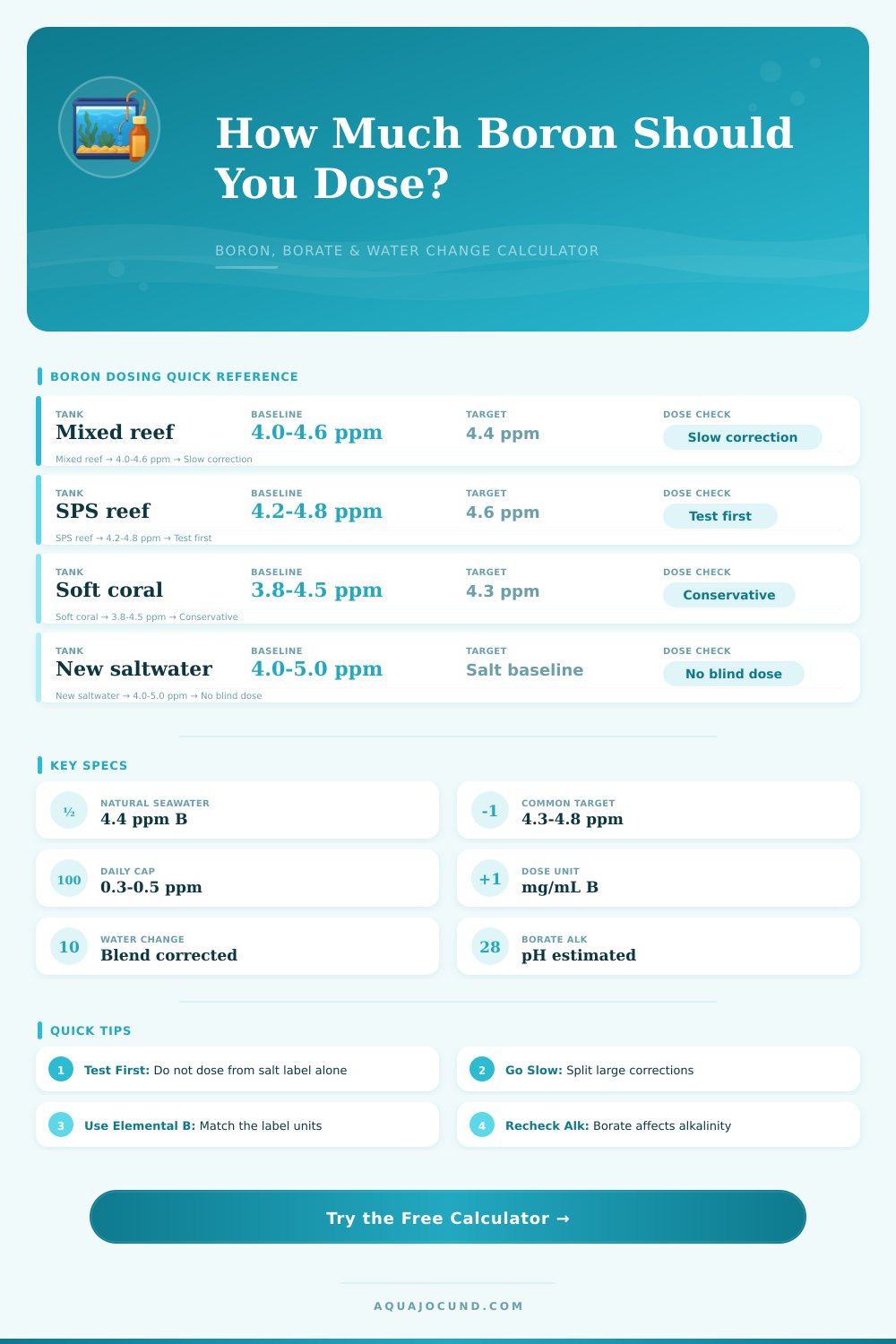
Seawater naturaly contains approximately 4.4 part per million of boron, and most reef keepers aim to maintain the boron levels in their tanks to be near this naturally occurring level. However, the type of corals that is contained within the tank can change the target level for boron within a reef tank. Whether the tank contains soft corals, mixed reef tank, or SPS (Large corals) populations, each of these contain different requirement for the boron levels within the tank.
How to Check and Adjust Boron in Your Reef Tank
In order to determine how much boron to add to the tank, it is first essential to understand both the current and target boron levels within the reef tank. Furthermore, it is also essential to understand how the addition of boron will interact with the other chemical component of the tanks water. The calculator requires a few different parameter to be entered in order to determine the correct amount of boron to be added to the tank.
The first of these parameters that must be entered is the volume of the tank. For this calculation, it is possible to use the known gallon figure of the reef tank. However, it is also possible that the known gallon figure are inaccurate due to the possibility of the reef tank having an irregularly shape tank.
Therefore, the calculator also provides options regarding the shape of the reef tank to allow for a better estimation of the volume of the tank. Following the volume of the tank, the current and target levels of boron within the reef tank must be entered into the calculator. Each of these figure must be accurate.
As with many other elements within the tank, the levels of boron change slowly. Therefore, an older reading of the levels of boron may be helpful in understanding the current status of that element. However, any water changes that have occurred since that reading must be accounted for in the calculation of the amount of boron that should be added to the reef tank.
The fields for water changes and reef salt baseline allow for these parameters to be accounted for in the calculation. Any new salt that is added to the tank contains a specific amount of boron. Therefore, this amount of boron can be accounted for within the calculation of the starting point for the tank when boron is corrected.
Following entering the parameters regarding the volume of the tank and the levels of boron within that tank, the supplement concentration must be entered into the calculator. Errors in the supplement concentration are among the most common error in the tank. Supplements often list the percentage of boric acid or borate within the supplement.
However, boric acid and borate is not the same as elemental boron. Therefore, the elemental boron in milligrams per milliliter must be entered into the calculator. If the supplement concentration is entered incorrect, the amount of boron that is added to the tank will be incorrect.
The supplement form selector allows for the proper entry of the supplement concentration. Finally, the calculator incorporates fields for adding a daily rise to the boron levels in the tank. As with many other parameters, the boron levels should be gradually adjusted rather than being quick adjusted to the desired level.
The fields for alkalinity, pH, and a safety margin allow to account for the impact that the addition of boron may have on the rest of the chemistry of the tank. These fields can provide guidance regarding whether only the amount of boron calculated by the calculator should be added to the reef tank, or whether a lesser amount of boron should be added by the reef tank owner. Additionally, water changes affect the amount of boron within the tank.
If large quantity of salt are changed into the tank, this will have a resetting effect upon the amount of boron within the tank. If the amount of salt that is added to the tank has a higher concentration of boron than that within the reef tank, the water change will increase the amount of boron that exists within the tank. These fields within the calculator allow reef tank owners to view the blended result of the water change and the current level of boron within the tank.
Based on this calculation, reef tank owners can determine if the water change was sufficient to add to the tank, or if the addition of boron supplement should occur. The reference tables located within the reef tank allow individuals to better understand the levels of boron that should be present in their tanks. The tables within the calculator are not exact recipe for the amount of boron that should be added to the tank.
However, each of these tables allow reef tank owners to understand how the type of tank that is established can compare to natural seawater, as well as to understand the amount of elemental boron that is required to make a 0.5 ppm correction to the levels of boron within their reef tank. Another potential error in the management of reef tanks is the error regarding the understanding of boron as an element that need to be replaced. Boron does not need to be replaced by reef tanks in the same way that elements like magnesium and strontium need to be replaced within reef tanks.
Boron, instead, needs to be maintained in a steady baseline within the reef tank. Therefore, the reef tank owner will want to use this calculator to determine if a water change or a supplement addition will allow for the boron levels within the tank to remain within a safe and healthy window for those coral populations within the tank. In addition to calculating the amount of boron that should be added to the tank, the calculator also asks that the reef tank owners to input the amount of time in which they will execute the tank correction.
Therefore, after determining the amount of boron that should be added to the reef tank, the reef tank owners must retest the tank to determine if the levels of boron within the tank has been successfully corrected. The test kits for boron levels can be slightly less precise than those measuring other elements of the tank. Due to the significant impact that errors in the dose amount will have within small reef tanks, it is essential to add the calculated amount of boron to the tank in stages.
By adding the calculated amount of boron to the tank in stages, the reef tank owner can better adjust the amount of boron that is added should fresh test result emerge from the reef tank. Thus, the goal of maintaining adequate levels of boron within the tank will allow the boron to not have an impact upon the remainder of the chemistry of the reef tank.