🍃 Aquarium Blackwater Calculator
Estimate botanicals, extract, peat, tint loss, pH/KH caution, and re-dose timing for blackwater aquariums.
| Source | Approx Strength | Release Window | Best Use |
|---|---|---|---|
| Catappa leaf blend | 0.8 AU/g per 10 L | 5-10 days | Betta, gourami, general soft water |
| Oak and beech leaves | 0.5 AU/g per 10 L | 10-18 days | Slow leaf litter tint |
| Alder cones | 1.4 AU/g per 10 L | 4-8 days | Small tanks and precise tinting |
| Seed pods and cones | 1.1 AU/g per 10 L | 8-16 days | Longer display botanicals |
| Driftwood heavy tank | 0.35 AU/g per 10 L | 14-30 days | Background tint maintenance |
| Balanced mixed botanicals | 0.9 AU/g per 10 L | 7-14 days | Most community blackwater tanks |
| Gentle shrimp leaf mix | 0.45 AU/g per 10 L | 12-20 days | Sensitive shrimp systems |
| Strong biotope mix | 1.25 AU/g per 10 L | 5-12 days | Dark Rio Negro style tanks |
| Tank | Dimensions | Volume | Amber Dose Range |
|---|---|---|---|
| 5 Gal Nano | 16 x 8 x 10 in | 19 L | 3-8 g leaves or 2-5 mL extract |
| 10 Gal Standard | 20 x 10 x 12 in | 38 L | 6-15 g leaves or 5-10 mL extract |
| 20 Gal Long | 30 x 12 x 12 in | 76 L | 12-30 g leaves or 10-20 mL extract |
| 29 Gallon | 30 x 12 x 18 in | 110 L | 18-45 g leaves or 15-30 mL extract |
| 40 Breeder | 36 x 18 x 16 in | 151 L | 25-60 g leaves or 20-40 mL extract |
| 55 Gallon | 48 x 13 x 21 in | 208 L | 35-85 g leaves or 30-55 mL extract |
| 75 Gallon | 48 x 18 x 21 in | 284 L | 45-115 g leaves or 40-75 mL extract |
| 125 Gallon | 72 x 18 x 21 in | 473 L | 75-190 g leaves or 65-125 mL extract |
| Profile | Typical Tint | KH Range | Weekly pH Pace |
|---|---|---|---|
| Delicate wild blackwater fish | 3-6 AU | 0-2 dKH | 0.15 pH or less |
| Common soft-water community | 2-5 AU | 1-4 dKH | 0.25 pH or less |
| Adaptable tank-raised fish | 1-4 AU | 2-8 dKH | 0.35 pH or less |
| Caridina / sensitive shrimp | 1-3 AU | 0-2 dKH | 0.10 pH or less |
| Maintenance Event | Tint Removed | Common Re-dose | Notes |
|---|---|---|---|
| 10% water change | About 10% | 10% of base dose | Usually minor if botanicals remain active |
| 25% water change | About 25% | 20-30% of base dose | Typical weekly soft-water routine |
| 50% water change | About 50% | 40-60% of base dose | Split re-dose for delicate livestock |
| Fresh carbon added | Fast decline | Wait or remove carbon | Carbon can strip visible tint quickly |
Blackwater aquariums uses tannins to change the color and chemistry of the water. Many of the fish species lives in water that naturaly contains these tannins, so recreating that environment for the fish is a major motivation for using tannins in the aquarium. The tannins come from plants such as leaves, cones, and wood, and the tannins naturally release into the water to create a dark tint to the water.
In order to maintain such an aquarium, the person must manage the tint of the water and its chemistry at the same time. If the tint of the water is correct, but the chemistry of the water is unstable, the fish can become ill. Factors that impact the chemistry of the tank include the amount of tannins that are added, the buffering power of the water in the tank, and the frequency with which the person changes the water in the tank.
How to Use the Blackwater Aquarium Calculator
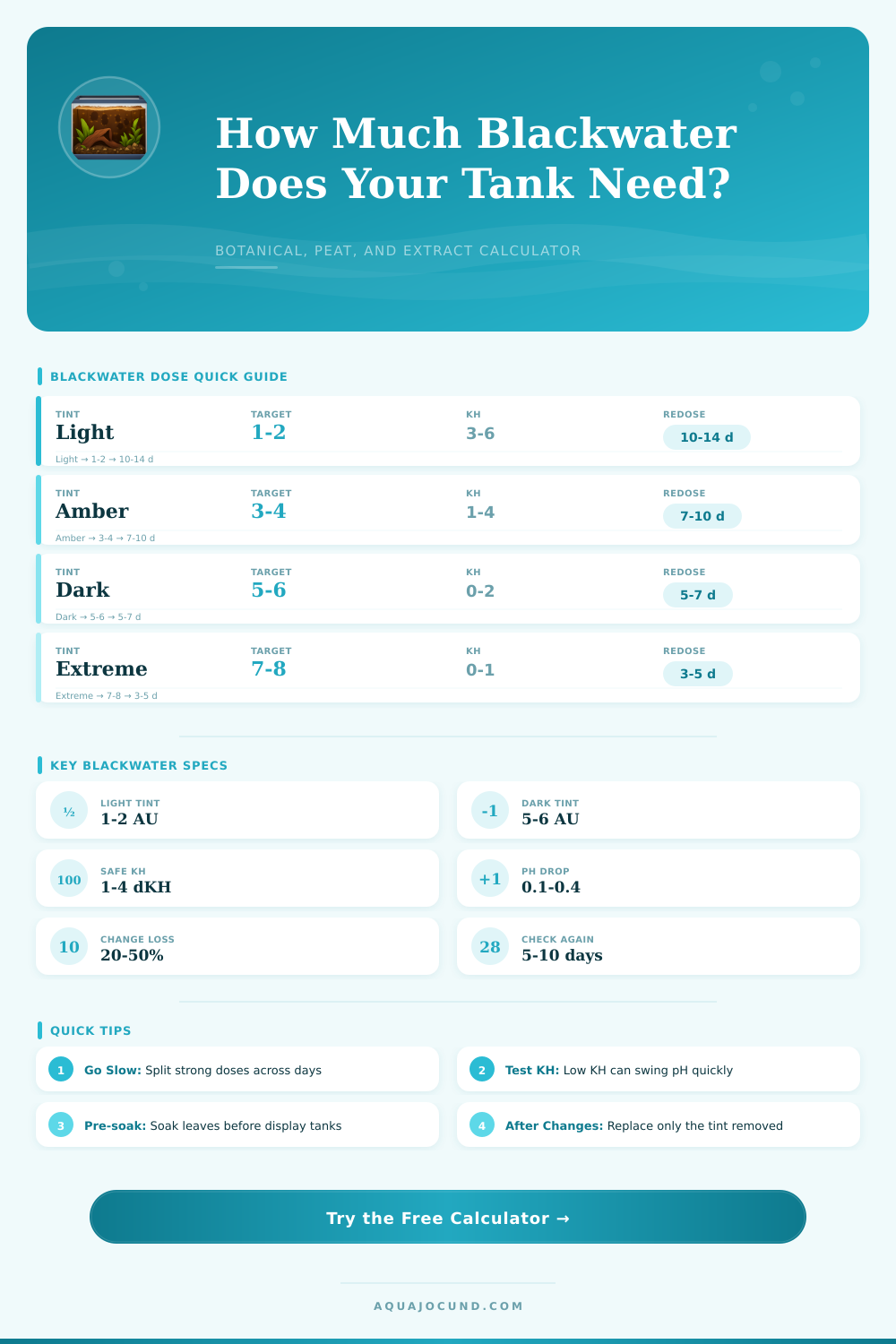
If a person dont take the time to estimate these factors, a person may either add too few tannins to achieve the desired color of the water, or a person may add too many tannins to the tank, which can lead to the pH of the water rapidly changing. The blackwater calculator requires the user to enter specific data into the calculator to perform the mathematical calculations that determines the appropriate amount of tannins to add to the tank. Information that the user must enter into the calculator includes the dimensions of the aquarium, the desired level of tint in the water, the current pH level in the tank, the KH level of the tank, the type of botanicals or extract that the user will add to the tank, and the size and frequency of the water changes in the tank.
Each of these variables can impact the outcome of the chemistry of the tank, so each is required. Factors that have an impact upon the outcome of the blackwater aquarium include the buffering power of the tank; water with a low KH value will change pH more rapid than water with a KH of four or five dKH; the media used in the filter; chemical media will remove color from the water more rapidly than media that only performs mechanical filtration; and the type of tannin source that is used; leaf litter will release tannins at a different rate than alder cones, for instance. Data that the calculator provides to the user as a result of entering the variables described above is the amount of tannins (in grams or milliliters) that should be added to the aquarium as a first dose.
Additionally, the calculator will provide an estimate of the amount of tint that will be lost during normal maintenance of the tank. Furthermore, the calculator will provide a time window during which the user should perform the next addition of tannins. Additionally, the calculator will indicate if the resulting shift in pH is safe for the type of fish that are contained in the aquarium.
Because each type of fish has different tolerance levels to changes in pH, the blackwater calculator allows for different types of livestock to be entered into the aquarium; for instance, a person that keeps discus fish may allow for the pH to slowly drop, while a person that keeps Caridina shrimp will need to maintain the pH almost entirely constant. Thus, the calculator automatically adjusts the target tint level and the movement of the pH based off the type of livestock in the tank, and displays those adjusted variables to the user to make a decision about whether to split the suggested dose of tannins or to wait until the next maintenance cycle to add the suggested amount of tannins. Finally, there are reference tables that are provided to the users that include information that can assist in the use of the blackwater aquarium calculator.
The reference tables will show you the size of different types of tanks and the range of botanicals and extracts that should be added to achieve the desired result. The reference tables will show you the color strength of different types of leaves and for how long they will release their color into the water. You can use these tables to see if your addition of botanicals and extracts will be within the normal bounds of a blackwater tank before you prepare your addition.
The reference tables will also show you the typical amount of tint loss that will happen with various percentages of water changes. This will allow you to understand why the timing of the re-dosing of the aquarium changes from 10 percent water changes to 40 percent water changes. Many people struggle with creating a blackwater aquarium because they tend to add a large amount of botanicals at once.
After adding these botanicals, the water may darken for a short time before it becomes pale once they change the water in the tank. Dilution, the natural decay of the tannins from the botanicals, and the use of the filtration system in the aquarium cause the fading of the color of the water. The calculator takes into account all of these variables so that it can provide an accurate recommendation for the addition of tannins to the aquarium.
This recommendation will take into account both the water change that was just completed and the natural loss of color from the filtration system. The type of livestock that you keep in the aquarium is another factor that will play a role in the maintenance of your blackwater aquarium. Most wild-caught fish will do best if the parameters of the tank remain in a narrow range.
These types of fish will require more frequent and smaller additions of tannins than those that were tank-raised. Tank-raised fish tend to be more tolerant of changes in the pH of their water, but the difference in the tolerance between these two types of fish isnt very significant. The livestock setting in the calculator allows for the user to adjust the parameters for the water to account for these two types of fish.
The settings in the calculator will provide you with the results that you need to know whether or not your water parameters are within the safe range for the type of livestock that you keep. The output of the calculator is merely a starting point for adding tannins to your blackwater aquarium. The first addition of tannins will require that you also add pH and KH testing tools so that you can test the water in one or two days.
Depending upon the results of these tests, you can either make the next addition of tannins smaller or larger. Over time, you will be able to rely upon your tank and it’s parameters rather than the calculator. Learning the pattern of your blackwater aquarium will allow you to maintain the color of the water in your tank.
When you establish this pattern, you will have learned how quickly the tannins from your botanicals are released into the water. You will also be familiar with how much the KH of your water buffers the acid that is commonly found in blackwater aquariums. While the calculator will provide you with the information that you need to start your aquarium and to replenish the tannins that are naturally lost from the tank, your blackwater aquarium will also provide you with the information that you need to adjust the settings on the calculator.
Following these steps will allow you to establish a routine for maintaining the color of the water in your aquarium.