Aquarium Bioload Per Species Calculator
Estimate adult stocking pressure, filtration demand, and weekly water change load from species size, count, waste profile, and feeding level.
| Species | Typical Adult Size | Waste Factor | Group Note | Bioload Caution |
|---|---|---|---|---|
| Betta splendens | 2.5 in / 6.4 cm | 1.00x | Usually one male | Low count, warm stable water |
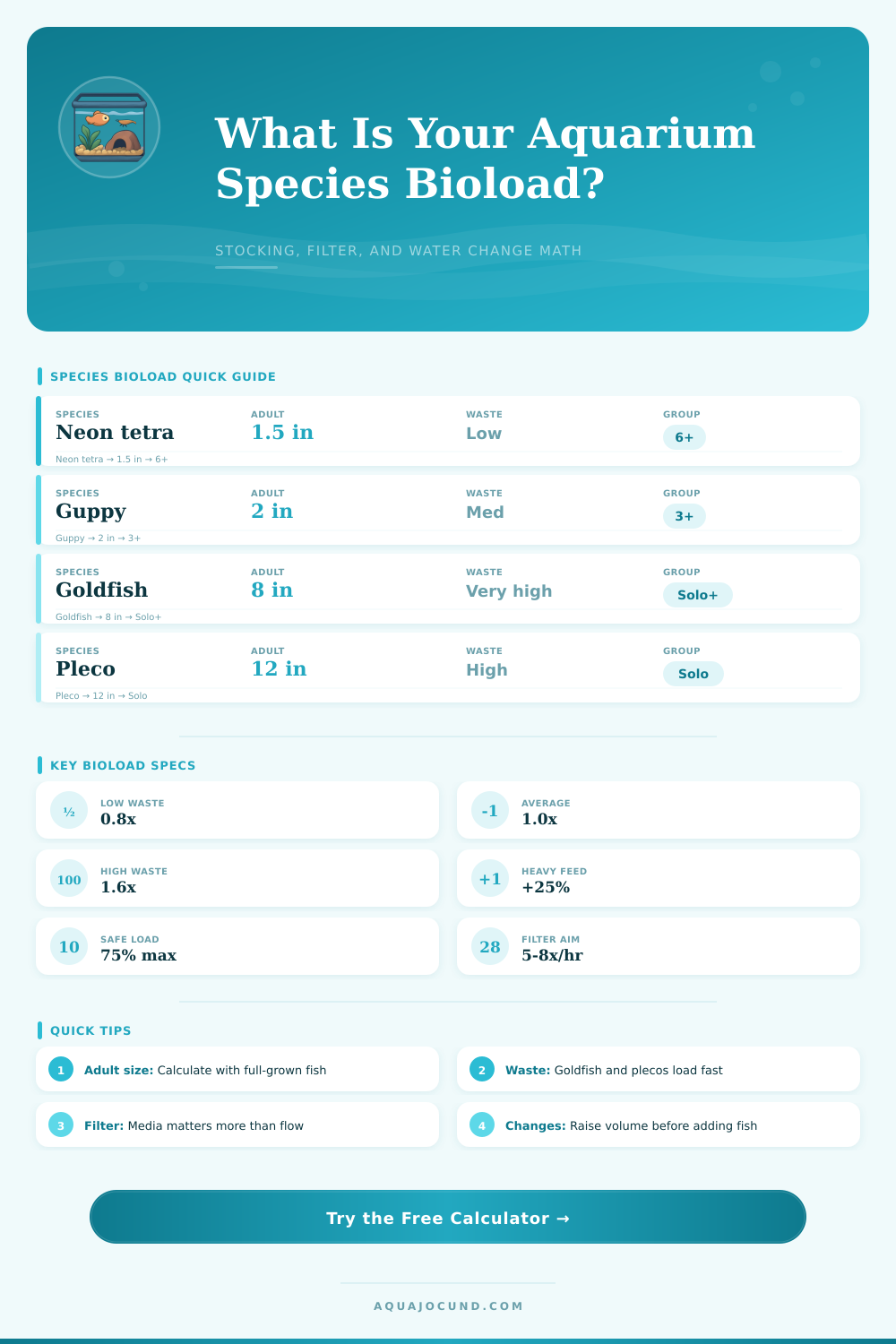
| Neon tetra | 1.5 in / 3.8 cm | 0.80x | School of 6 or more | Low per fish, group load adds up |
| Guppy | 2.0 in / 5.1 cm | 1.00x | Active livebearer group | Breeding can double load quickly |
| Corydoras | 2.5 in / 6.4 cm | 1.20x | School of 6 or more | Bottom feeding raises detritus load |
| Angelfish | 6.0 in / 15.2 cm | 1.35x | Pair or calm group | Deep body makes load higher |
| Fancy goldfish | 8.0 in / 20.3 cm | 2.20x | Keep with strong filtration | Very high ammonia and solids |
| Common pleco | 12.0 in / 30.5 cm | 2.20x | Usually a large-tank single | Long-term load is often underestimated |
| Formula Item | Calculator Method | Why It Matters | Safe Reading |
|---|---|---|---|
| Base load | Count x length^1.7 x body x waste | Adult mass rises faster than length | Lower is easier to stabilize |
| Volume capacity | Gallons x 0.85 adult units | Conservative freshwater estimate | Under 75% is comfortable |
| Filter capacity | Flow turnover x bio media x volume | Media and oxygen support bacteria | Under 85% is preferred |
| Water change load | Base 20% plus pressure adjustment | Dilutes nitrate and dissolved organics | 25-50% weekly is common |
| Tank | Dimensions | Volume | Conservative Load | Typical Fit |
|---|---|---|---|---|
| 5 gallon | 16 x 8 x 10 in | 18.9 L | 4.3 units | One betta or shrimp |
| 10 gallon | 20 x 10 x 12 in | 37.9 L | 8.5 units | Small school with care |
| 20 long | 30 x 12 x 12 in | 75.7 L | 17 units | Community nano fish |
| 40 breeder | 36 x 18 x 16 in | 151 L | 34 units | Pair plus community |
| 75 gallon | 48 x 18 x 21 in | 284 L | 64 units | Cichlids or large groups |
| 125 gallon | 72 x 18 x 21 in | 473 L | 106 units | Large display stocking |
| System Type | Turnover Target | Weekly Change | Extra Margin | Best Use |
|---|---|---|---|---|
| Betta or low flow | 3-5x/hr | 20-30% | Gentle sponge filter | Calm species |
| Community freshwater | 5-8x/hr | 25-35% | Established media | Tetras, corys, guppies |
| Goldfish | 8-10x/hr | 40-50% | Oversized biofilter | Heavy solid waste |
| African cichlid | 8-12x/hr | 35-50% | High oxygen flow | High feeding and aggression |
| Reef fish | 10x+ display flow | 10-25% | Skimmer/refugium | Marine nutrient control |
Bioload is an amount of waste that the fish will produce within the aquarium. Additionally, bioload is the measurement of the total waste that the fish will create as they grow to there full adult bodies. While many individual purchase fish based off the appearance of the fish when they are within the store, few people consider how the bioload that each of these fish will create.
Should individuals fail to account for the bioload that the fish will create, they may experience issue with the water within the tank, such as cloudy water and high levels of nitrates. Thus, it is essential for each aquarium owner to understand the concept of bioload and how it indicate the amount of waste that is present in the tanks water. The size that the fish will reach as adults is one of the most critical factor in calculating the bioload that each fish will create.
What Is Aquarium Bioload and How to Manage It
The amount of waste that fish will create will not increase at the same rate than the length of the fish. For instance, if a fish doubles in length, it will produce more than double the amount of ammonia waste. The amount of ammonia waste that fish create will increase at a faster rate than the length of those fish increases.
Thus, when calculating bioload, the adult length of each fish should be considered, as well as the body shape of each type of fish. For instance, angelfish have deep bodies that contain more internal volume than slim-bodied fish like tetras. Thus, despite the similar length of both types of fish, the deep body of angelfish creates a higher bioload than the slim body of tetras.
Beyond the length and body shape of each species of fish, other factor that must be considered are the feeding levels of the fish, as well as the waste that each species of fish will create. Some fish species are more messily than others due to the fact that they create more waste when consuming food. For instance, goldfish and large plecos create a high amount of waste, indicating that they will contribute to the bioload of an aquarium more than other types of fish.
Conversely, a school of small tetras may create a high headcount within the tank, but their lesser amount of waste indicates that their bioload is lower than other tanks filled with different species of fish. These factors can be adjusted within the bioload calculator to determine bioload based upon these factors. Another factor to consider within the bioload calculator is the capacity of the aquarium filter.
Both the flow rate of the filter, as well as the amount of biological media include within the aquarium determine the capacity of the filter. The flow rate is not the only determinant of the capacity of the filter. For instance, the turnover of the aquarium is the measurement of the number of times that the water passes through the filter during a given hour, but the biological media within the filter is where the beneficial bacteria live that will process the waste from the fish.
Filters that have a high flow rate but thin biological media will perform differently than those with slower pumps but thick biological media. Thus, the user should account for both factors in the bioload calculator to determine if the filter is sufficient for the bioload of the aquarium. Beyond the factors related to the fish themselves, water changes are another means of managing the bioload of the tank.
The bioload calculator will provide an indication of the amount of volume of water that should be changed each week for the tank to remain healthy. For most tanks, 30% water change each week are sufficient for community tanks. However, tanks with heavier bioloads or tanks with fewer types of plants require more frequent water changes.
Thus, water changes are another factor to consider in addition to the bioload of the aquarium. One of the mistakes that should be avoided is using the size of the fish in the aquarium during the first few months as a means of determine the size of the tank that the fish will reach when they are fully grown. Because fish will grow over time, their bioload will increase with the growth of the fish themselves.
Thus, the eventual adult size of the fish should be entered into the bioload calculator at the beginning of setting up the aquarium to ensure that it is not overcrowded with fish. Additionally, it is another mistake to believe that any amount of the biological filter will solve the problems that are created in the aquarium. Factors like the amount of surface area for the biological media and the frequency with which the tank is maintained are just as important as the pump of the filter.
The reference tables included with the bioload calculator can aid in determining the bioload of an aquarium. These tables include information about the different species of fish and the amount of waste that they create. Additionally, the tables also include the typical number of individual of each species that live within a group of fish in their natural homes.
Thus, these tables can provide an understanding of the bioload of each type of fish group. Furthermore, the aquarium owners themselves can utilize the calculator to determine the bioload. Bioload itself is a planning tool for aquarium owners.
Bioload can help each owner to decide how many fish to add to the tank, what type of filtration system to setup in the aquarium, and how often to perform water changes for the tank. Bioload, combined with the size of the aquarium, can help each owner to understand the balance of the aquarium and how the fish will remain healthy and the water within the tank will remain clear.