Aquarium Background Area Calculator
Estimate aquarium background coverage from back length, waterline height, side wraps, trim allowance, seam overlap, cutouts, roll width, and waste margin.
📏Tank background dimensions
Measure the visible glass height you want covered, not the outside frame height.
Extra material beyond the visible rectangle for trimming after placement.
✂Cutouts, waste, and cutting margin
Use for overflow slots, cable ports, return holes, braces, or exposed equipment openings.
Used only for sheet, coroplast, and foam panels to estimate tile count.
Calculation Breakdown
🧰Background material quick specs
🖼Background material and layout comparison
📋Reference tables
| Material | Typical width | Good seam allowance | Waste margin |
|---|---|---|---|
| Adhesive vinyl film | 12, 18, 24, 36, 48 in / 30, 46, 61, 91, 122 cm | 0.5 in / 1.3 cm | 5 to 10% |
| Static cling film | 17, 24, 35 in / 43, 61, 89 cm | 0.75 in / 1.9 cm | 10 to 15% |
| Laminated photo sheet | 18, 24, 36, 48 in / 46, 61, 91, 122 cm | 0.25 in / 0.6 cm | 5 to 10% |
| Frosted privacy film | 17.5, 24, 35 in / 44, 61, 89 cm | 0.5 in / 1.3 cm | 8 to 12% |
| PVC or coroplast sheet | 24, 36, 48 in / 61, 91, 122 cm | butt joint or 0.25 in gap | 5 to 8% |
| Foam rock panel | 12, 18, 24 in / 30, 46, 61 cm | interlock or trim line | 10 to 20% |
| Tank preset | Actual back glass | Visible area | Typical background need |
|---|---|---|---|
| 5.5 gallon | 16 x 10 in / 41 x 25 cm | 1.1 sq ft / 0.10 sq m | about 1.3 sq ft with trim |
| 10 gallon | 20 x 12 in / 51 x 30 cm | 1.7 sq ft / 0.15 sq m | about 2.0 sq ft with trim |
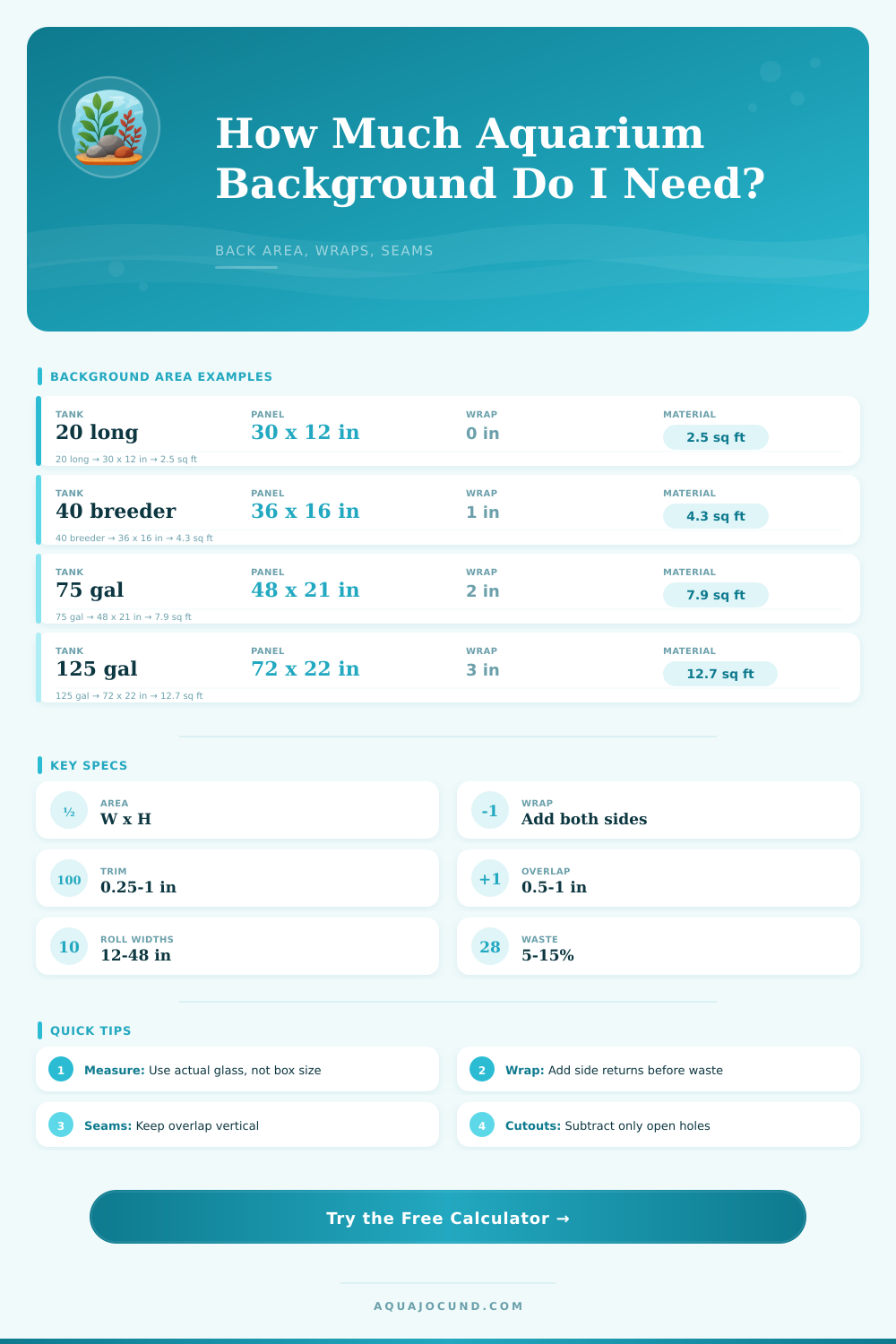
| 20 long | 30 x 12 in / 76 x 30 cm | 2.5 sq ft / 0.23 sq m | about 3.0 sq ft with trim |
| 29 gallon | 30 x 18 in / 76 x 46 cm | 3.8 sq ft / 0.35 sq m | about 4.4 sq ft with trim |
| 40 breeder | 36 x 16 in / 91 x 41 cm | 4.0 sq ft / 0.37 sq m | about 4.7 sq ft with trim |
| 55 gallon | 48 x 20 in / 122 x 51 cm | 6.7 sq ft / 0.62 sq m | about 7.8 sq ft with trim |
| 75 gallon | 48 x 21 in / 122 x 53 cm | 7.0 sq ft / 0.65 sq m | about 8.2 sq ft with trim |
| 90 gallon | 48 x 24 in / 122 x 61 cm | 8.0 sq ft / 0.74 sq m | about 9.3 sq ft with trim |
| 125 gallon | 72 x 22 in / 183 x 56 cm | 11.0 sq ft / 1.02 sq m | about 12.8 sq ft with trim |
| Roll or sheet width | Can cover height up to | Best layout | Seam note |
|---|---|---|---|
| 12 in / 30 cm | nano and shallow tanks | horizontal film strip | tall tanks need stacked seams |
| 18 in / 46 cm | 20 long, 29 high, many breeders | one-piece height on small tanks | good for most low rims |
| 24 in / 61 cm | 55, 75, 90 gallon backs | one-piece height for many displays | often avoids horizontal seams |
| 36 in / 91 cm | deep or wrapped panels | wide roll or vertical panel | may reduce side-wrap seams |
| 48 in / 122 cm | large sheets and rigid backers | wide sheet planning | large panels need square cuts |
| Cutout type | Measure as | Usual allowance | Planning note |
|---|---|---|---|
| Overflow box opening | rectangle width x height | add 0.25 in / 0.6 cm clearance | subtract only if material is removed |
| Cable pass-through | small rectangle or slot | round up to nearest inch | group cords before cutting |
| Return bulkhead | hole bounding box | use diameter plus clearance | rigid panels need cleaner hole cuts |
| Center brace shadow | visible blocked patch | optional visual cutout | usually not subtracted for film |
💡Background measuring tips
When I talk about these dimensions I’m referring to what manufacturer claims they are. These is suggestions. You shouldn’t think of them as exact numbers. For example, “twenty gallons long” might realy be an inch shorter on each side due to the silicone bead around the glass pane and the rim. So if you buy some background film and use label for reference, you’re going to end up with a patchy rectangle that stops short of the corners.
That’s just one type of headache you can save yourself with the calculator above, which force you to enter your tank’s true visible area, instead of relying on marketing copy. A tiny step but it saves hours of trimming and reapplication of sticky vinyl. It is as simple as that because it’s just geometry, but there are some tricky variables: waterline height (usually a couple inches under the top edge to prevent the film from peeling off at splash zone), back length, and whether or not you want material to wrap over side glass.
How to Measure Your Tank Correctly
That’s the big gotcha on most projects; do you want look of a half-inch wrap? It makes the project look clean & professional by hiding the raw cut edge of the backing. Or do you want a two-inch wrap (more immersive feel, takes far more material & precision-cutting)? The tool figure out all this stuff for you so you can get an idea of total area required before purchasing.
The difference when it comes to waste and seams depends entirely on what material you use. Under tension, adhesive vinyl will stretch; it’s forgiving, as you can move it around a bit then let it set into position. On the other hand, static cling films is thinner (and more easily torn); so, they require a larger margin of waste factored in your calculation. For rigid materials such as corrugated plastic or PVC, the issue becomes how to handle seams rather than stretching. Because rigid sheets won’t flex around corners, you’ll have to account for separate panel that either overlap each other (with joint visibility) or have clear space between them. This material comparison is clearly shown in the reference tables of the tool, which include standard roll dimensions and suggested overlap amounts.
Before making a purchase, take into consideration cut outs as well. Heater cords, overflow boxes, cable ports; all of these leave gaps in background’s underlying surface. With film you can simply stick it over the gap and trim around later, but with rigid panels you’ll have to measure holes and then deduct that area from your overall amount needed. You can enter an average number of cut outs and their approximate size into the calculator, which reduces the ultimate material estimate by a bit. It sounds trivial, but large tanks may has many such holes, and those square inches add up.
This is most overlooked aspect of all (Waste Margin). Assuming no mistakes or imperfect cuts gives you maybe 5% margin. Anyone who’s tried to get a roll cut perfectly flush against a corner will tell you 10-15% are more reasonable. For complex pattern matching or very luxurius printed images that need to be seamless across their seams, bump this up even further. There’s a waste percentage field in the tool where you can be realistic (and honest) about how good/careful you are and how forgiving the material you’re using is.
You get back a cut panel size (what you’ll physically shape out on your table) and a total material plan (the additional width of roll you need for that cut shape, plus some safety buffer). Why does this matter? This keeps you from having to buy two rolls instead of one, or worse, cutting your final piece only to discover you’re an inch too short.
In conclusion, good background turns an aquarium into a scene, not just a container. It eliminates clutter. It relieves stress in the fish. Most importantly, it makes the aquarium look intentional. The hard part of getting it right is measuring correctly so that end product seems effortless. You don’t have to be a math wiz to do a good job, but you should of take the time to measure and allow for some human error. That’s realy what all those nice looking installs are hiding.