Aquarium Altitude Oxygen Calculator
Estimate dissolved oxygen saturation, altitude loss, stocking demand, surface exchange, and reserve margin for aquariums above sea level.
🌊Real Altitude Presets
⛰Altitude and Water Conditions
🐟Stocking and Aeration
Altitude Oxygen Estimate
⚠Altitude Risk Comparison Grid
📊Water Profile Oxygen Factors
| Water profile | Typical salinity | Oxygen effect | Planning note |
|---|---|---|---|
| Soft freshwater | 0 ppt | Highest capacity | Altitude and heat are the main reducers |
| Freshwater community | 0-1 ppt | Near fresh | Use biomass and surface motion to size reserve |
| Brackish aquarium | 5-15 ppt | Moderate reduction | Keep warm brackish tanks well aerated |
| Marine fish only | 30-33 ppt | Large reduction | Surface exchange matters more at altitude |
| Reef aquarium | 34-36 ppt | Large reduction | Overflow, skimmer, and flow add reserve |
🌡Temperature, Altitude, and Saturation Reference
| Condition | Freshwater O2 | Altitude example | Risk note |
|---|---|---|---|
| 68°F / 20°C sea level | 9.1 mg/L | About 7.7 at 5,000 ft | Cooler water gives more buffer |
| 78°F / 26°C sea level | 8.1 mg/L | About 6.8 at 5,000 ft | Common tropical range |
| 84°F / 29°C sea level | 7.7 mg/L | About 6.4 at 5,000 ft | Warm tanks need stronger exchange |
| Marine 78°F / 26°C | About 6.8 mg/L | About 5.7 at 5,000 ft | Salt and altitude stack together |
💨Aeration Exchange Planning Table
| Aeration setup | Exchange level | Typical use | Altitude adjustment |
|---|---|---|---|
| Still surface | Very low | Very light stock only | Avoid at high elevation |
| Light ripple | Low | Small community tanks | Upgrade when warm or covered |
| Moderate movement | Medium | Most standard aquariums | Good baseline below 5,000 ft |
| Air stone / sponge | High | Growouts and warm tanks | Useful reserve for altitude |
| Overflow / skimmer | Very high | Reef and sump systems | Best for marine oxygen margin |
| Backup air | Emergency high | Power-loss planning | Important for dense high-altitude stock |
📐Common Tank Surface Area Reference
| Tank size | Typical footprint | Surface area | Altitude note |
|---|---|---|---|
| 10 gallon | 20 x 10 in | 200 sq in | Use light stock at high altitude |
| 20 long | 30 x 12 in | 360 sq in | Better oxygen ratio than tall tanks |
| 29 gallon | 30 x 12 in | 360 sq in | Same surface as 20 long with more water |
| 40 breeder | 36 x 18 in | 648 sq in | Strong surface reserve |
| 55 gallon | 48 x 13 in | 624 sq in | Long but narrow footprint |
| 75 gallon | 48 x 18 in | 864 sq in | Good for larger active fish |
By now you’re probably aware that cold water contain more dissolved oxygen than warm water. Perhaps you’ve also heard that, for reasons we don’t need to get into here, freshwater needs less gas exchange then saltwater. However, what surprises most hobbyist is how rapidly the altitude eats away at the safety margin they designed into their tanks.
The fish won’t notice the decrease in atmospheric pressure. Instead, they’ll just be left with sensation of breathing from thinner and thinner air as their metabolism remains unchanged. That’s where difference lies between maintaining a healthy aquarium in Seattle (or Miami) versus one in Salt Lake City (or Denver). It’s all about physics, not biology.
How Altitude Affects Your Aquarium Oxygen
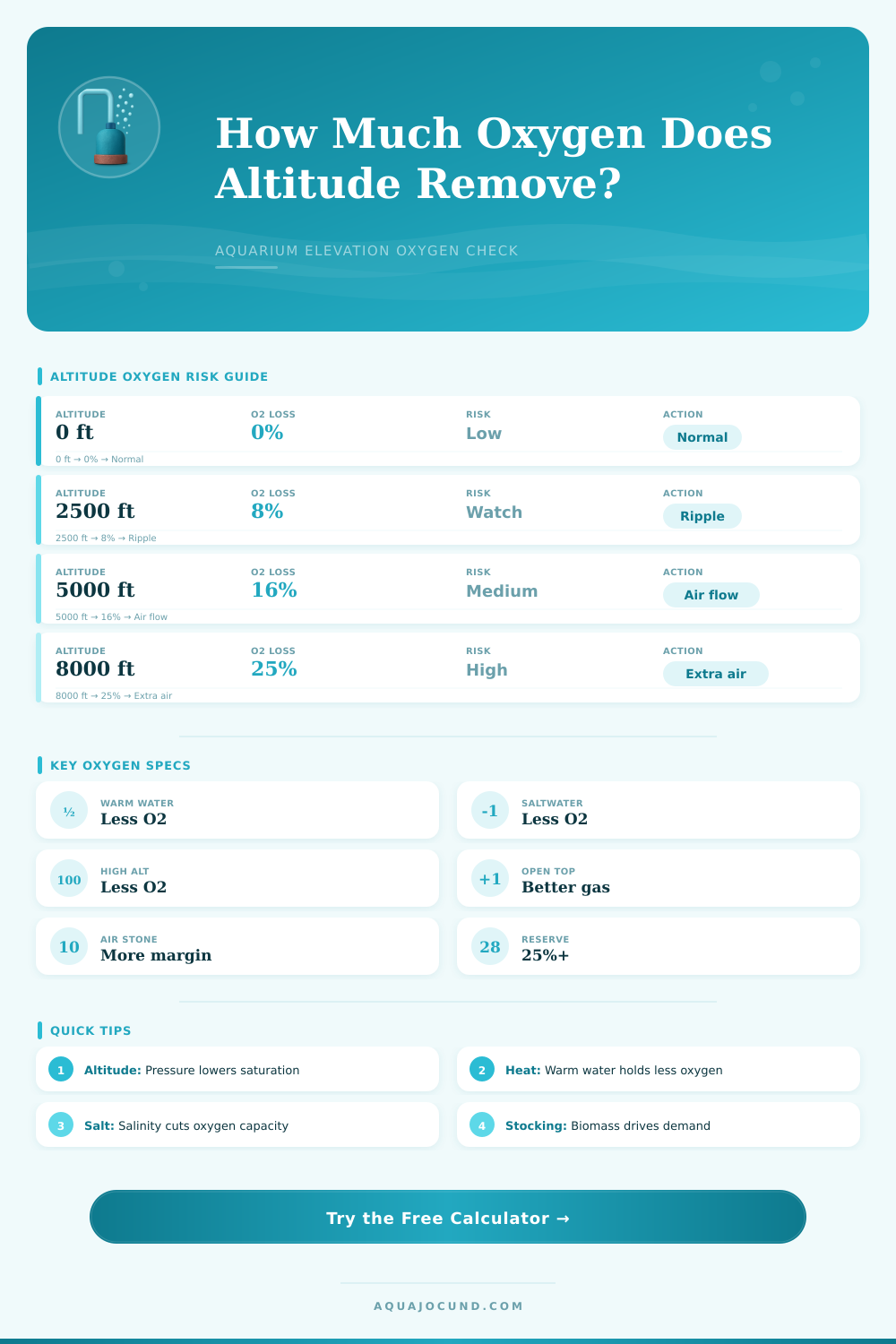
Partial pressure of the gas above the water dictates how many oxygen molecules will dissolves in the water. There is plenty when at or near sea level because there’s more pressure pushing those O2 molecules down into the water. There is less as you ascend because push becomes weaker. Fortunately, someone did the complicated math required to create those saturation curves; now we don’t need charts for each and every elevation/temperature combo. We can use the one on this page. It crunches the numbers and provides a simple visualization of just how tight things are getting, i.e., just how much breathing room you’ve got.
Altitude stress is compounded by temperature. For instance, water contains quite a bit of dissolved oxygen at sea level when the ambient temperature in your tank is a comfy eighty degrees Fahrenheit. Now bring that same water to an elevation of five thousand feet. The saturation point decrease dramatically. Then compound this with marine salinity (salt ions occupy space within the water structure) and it gets worse still. It’s like you are fighting three battle at once. Your reef tank at elevation has to fight low pressure. It also has to fight high salt content. Often, it has to fight warm temperatures too.
A common misconception among many is that bigger is always better when it comes to filtration. A higher-powered pump must mean that it can absorbs oxygenate better, right? Wrong. It doesn’t work that way. While mechanical filtration can remove particulates from the water column, that in itself has no impact on gas exchange…unless it’s designed to generate surface agitation. Remember, the oxygen diffuses across the air/water interface. Nothing you do to the water inside the tank is going to force any additional oxygen into it if there’s no water/air interface exposed. This happens if it’s all buried beneath duckweed, trapped underneath a snug-fitting lid, or still behind glass. The table(s) on the page clearly outline relationship between various aeration techniques and their exchange abilities.
An active budget means stocking density turns the equation from passive to active. Oxygen is consumed by your fish/inverts while waste is produced, which then needs processing by bacteria (more oxygen consumption). A heavily stocked tank full of cichlids or grazers such as goldfish will turn the tank into a high turnover situation. A lightly stocked tank of shrimp or bettas doesn’t put much demand on the system. Combine this with lower saturation levels from increased elevation, this creates a formula for trouble if something goes wrong with any piece of equipment. It can quickly become dangerous overnight.
To show that weakness, the tool’s reserve margin displays the gap between overall need and available supply. Ideally, a good system will be running far short of its absolute limit. That cushion covers variables we cannot predict. These include a heat wave, a drop in air pressure before a storm, or a surge of bacteria after a feeding frenzy. The goal is to think of oxygen as something with an allowance, not just a static value, which avoids crashing systems when they are under the most stress.
In conclusion, managing an elevated tank means treating the environment with more respect rather than trying to make it match sea level conditions. This means moving things on the surface, limiting what is stocked and knowing that every percent of salt and degree of heat added will limit the amount of air present. When all these are known, then making your tank stable isn’t as much chance as it is smart planning. You should of just keep in mind that you want nothing in your tank to worry about where its next breath will come from.