⚫ Activated Carbon Quantity Calculator
Estimate aquarium activated carbon mass, loose media volume, flow contact, and replacement interval from real tank conditions.
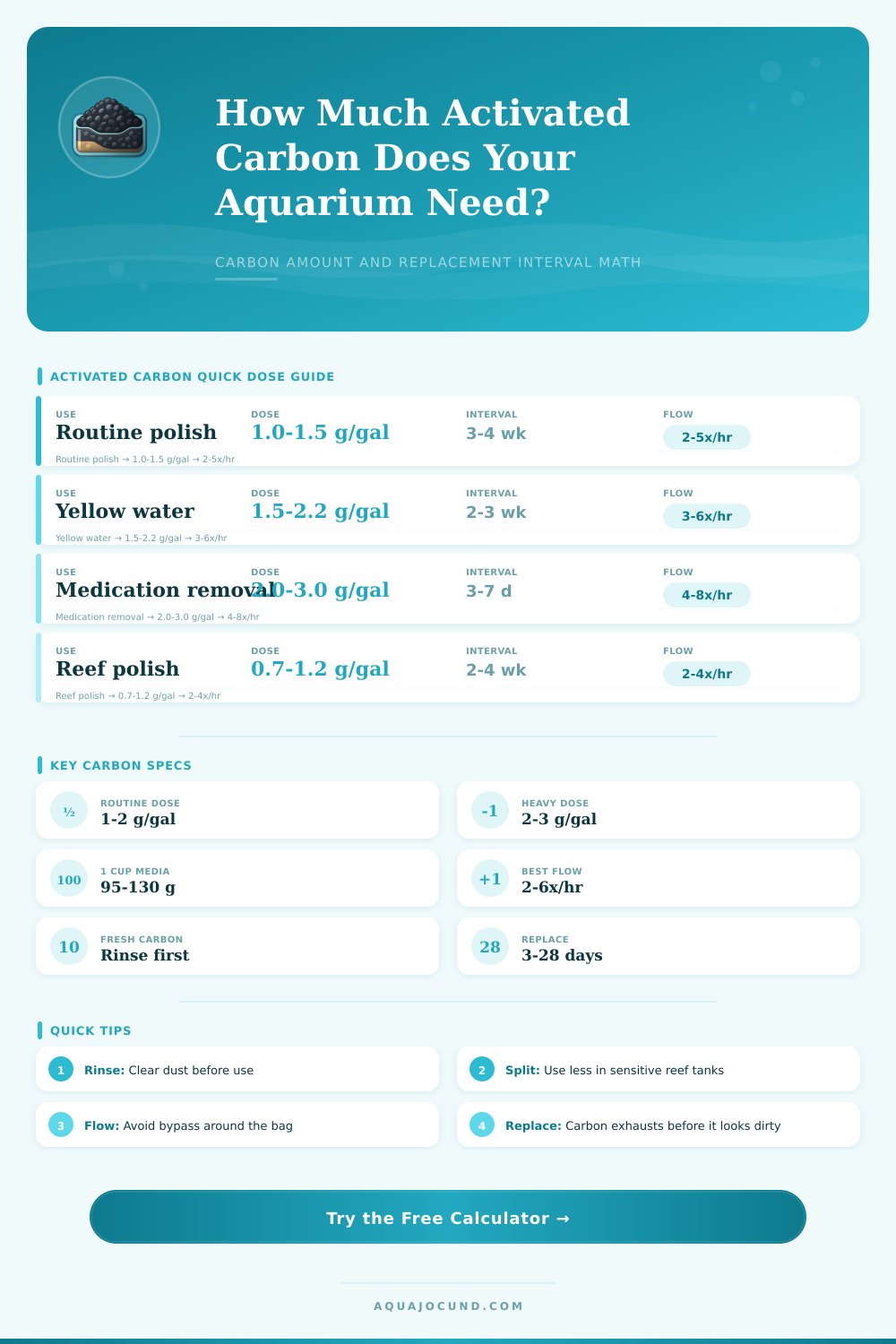
| Purpose | Starting Dose | Typical Interval | Notes |
|---|---|---|---|
| Routine polishing | 1.0-1.5 g per gal | 21-28 days | Good for normal clear freshwater tanks. |
| Reef chemical polish | 0.7-1.2 g per gal | 14-28 days | Use high-grade low-phosphate carbon and moderate flow. |
| Yellow water or tannins | 1.5-2.2 g per gal | 10-21 days | Replace sooner if tint returns quickly. |
| Medication removal | 2.0-3.0 g per gal | 3-7 days | Use after the treatment course, then discard media. |
| Emergency contaminant cleanup | 2.5-3.5 g per gal | 1-5 days | Combine with water changes and fresh batches. |
| Media Type | Bulk Density | Capacity Factor | Best Use |
|---|---|---|---|
| Bituminous granular | 0.50 g/mL | 1.00x | General aquarium polishing. |
| Lignite granular | 0.42 g/mL | 0.85x | Fast color removal, more rinsing needed. |
| Coconut shell | 0.48 g/mL | 1.15x | Hard, durable media for small organics. |
| Pelletized reactor carbon | 0.54 g/mL | 0.90x | Controlled flow through reactors. |
| Acid-washed low ash | 0.46 g/mL | 1.20x | Sensitive reef or planted use. |
| High capacity extruded | 0.43 g/mL | 1.25x | Longer service with low dust. |
| Tank | Dimensions | Routine Carbon | Heavy / Medication |
|---|---|---|---|
| 10 gal | 20 x 10 x 12 in / 51 x 25 x 30 cm | 10-15 g | 20-30 g |
| 20 long | 30 x 12 x 12 in / 76 x 30 x 30 cm | 20-30 g | 40-60 g |
| 40 breeder | 36 x 18 x 16 in / 91 x 46 x 41 cm | 40-60 g | 80-120 g |
| 55 gal | 48 x 13 x 21 in / 122 x 33 x 53 cm | 55-85 g | 110-165 g |
| 75 gal | 48 x 18 x 21 in / 122 x 46 x 53 cm | 75-115 g | 150-225 g |
| 125 gal | 72 x 18 x 21 in / 183 x 46 x 53 cm | 125-190 g | 250-375 g |
| Flow Through Carbon | Contact Result | Interval Effect | Adjustment |
|---|---|---|---|
| Under 1x tank volume per hour | Low contact | Slower cleanup | Move bag into stronger flow. |
| 2-4x tank volume per hour | Strong contact | Normal interval | Good target for bags and baskets. |
| 4-6x tank volume per hour | Fast polishing | May exhaust sooner | Good after medication removal. |
| Over 8x tank volume per hour | Short dwell time | Bypass risk | Use a reactor, tray, or more media depth. |
To determine the amount of activated carbon that should be used in an aquarium, there are many different piece of information that is required about each aquarium. Each aquarium may have a different size, or each aquarium may have a different number of fish that lives within it, and each aquarium may have different feeding regime. Therefore, there is no one rule that can be applied to each aquarium to determine the amount of activated carbon that should be added.
Instead, you can use the information within the activated carbon calculator to determine the amount of activated carbon that should be added based off information about that specific aquarium, such as its dimension, its carbon grade, the color of its water, the bioload of the water, and the water flow rate within the tank. Activated carbon is generaly added to an aquarium that is either yellow in color, or that has recently utilized medications for the fish within the aquarium. The amount of activated carbon that is added may differ between these two instance.
How much activated carbon does my aquarium need
For example, you may add activated carbon to an aquarium in routine dose for several weeks, but larger amounts of activated carbon may be added if the aquarium has recently used medications to treat the fish. Furthermore, the number of water change that are made each week are accounted for in the calculation of the amount of activated carbon that should be added to the aquarium, since water changes help to remove some of the organic material from the aquarium that the activated carbon would otherwise have to remove. The flow rate of the water within the aquarium and the placement of the activated carbon within that aquarium are two parameter that must be accounted for in the activation carbon calculator.
The flow rate and the placement of the activated carbon will impact the amount of contact time that the water has with the activated carbon. The amount of contact time will impact the amount of the surface area of the activated carbon that is actualy work to clean the aquarium. For example, if you place activated carbon into a section of the aquarium with low flow rate, there will be a need to use a greater mass of activated carbon than if the same amount of activated carbon is placed into a reactor.
Reactors are manufactured to pass water through the pores of the activated carbon, allowing for the activated carbon to work more efficiently. Therefore, the activated carbon calculator accounts for these different variable. The grade of the activated carbon that is to be used in the aquarium will also impact the amount of activated carbon that is required.
For example, activated carbon with a coconut shell and acid-washed activated carbon will have more micropores per gram of activated carbon than activated carbon that utilizes lignite-based activated carbon. Therefore, you will have to use fewer grams of activated carbon with these different types of activated carbon than with activated carbon that utilizes lignite-based materials. Furthermore, manufacturers manufacture pelletized reactor activated carbon to allow for the passage of water at high velocity, unlike activated carbon with a coconut shell base.
These different factor are accounted for in the activated carbon calculator. Aquarium conditions may change, and any change to those conditions may necessitate a change in the calculation of the amount of activated carbon to be added to that aquarium. Factors such as the feeding of the fish in the aquarium or the addition of new fish to the aquarium may increase the organic load within the aquarium, suggesting that more activated carbon is required to perform it’s necessary task.
These factors are account for in the activated carbon calculator. Furthermore, while activated carbon does look dirty when it has become exhausted of its tasks, most individual will make mistakes in the timing of the replacement of activated carbon. The activated carbon calculator accounts for the organic load and the flow rate of the aquarium, rather than the appearance of the activated carbon.
Finally, the volume of the aquarium and the number of water change that are performed each week will impact the amount of activated carbon that should be used in that aquarium. If water changes are performed frequently, less activated carbon will be required in the aquarium, since each water change will remove some of the organics from the aquarium. The activated carbon calculator accounts for these different factor.
Finally, regardless of the settings that are configured in the activated carbon calculator, the aquarium and its parameters must be observed. If the water becomes tinted, it is possible that the organic load of the aquarium has increased or that the flow of the water through the activated carbon has changed. In these instance, the activated carbon calculator should of been rechecked to ensure that the amount of activated carbon that is added to the aquarium is accurately match to the condition and workload of that specific aquarium.