💧 Aquaponics Water Top Up Calculator
Estimate daily refill water, multi-day reserve size, sump drawdown, and safe top-up timing for aquaponics systems.
✅ Water Top Up Results
| System Type | Open Water | Plant Demand | Climate Risk | Daily Loss Range | Reserve Habit | Main Watch Point |
|---|---|---|---|---|---|---|
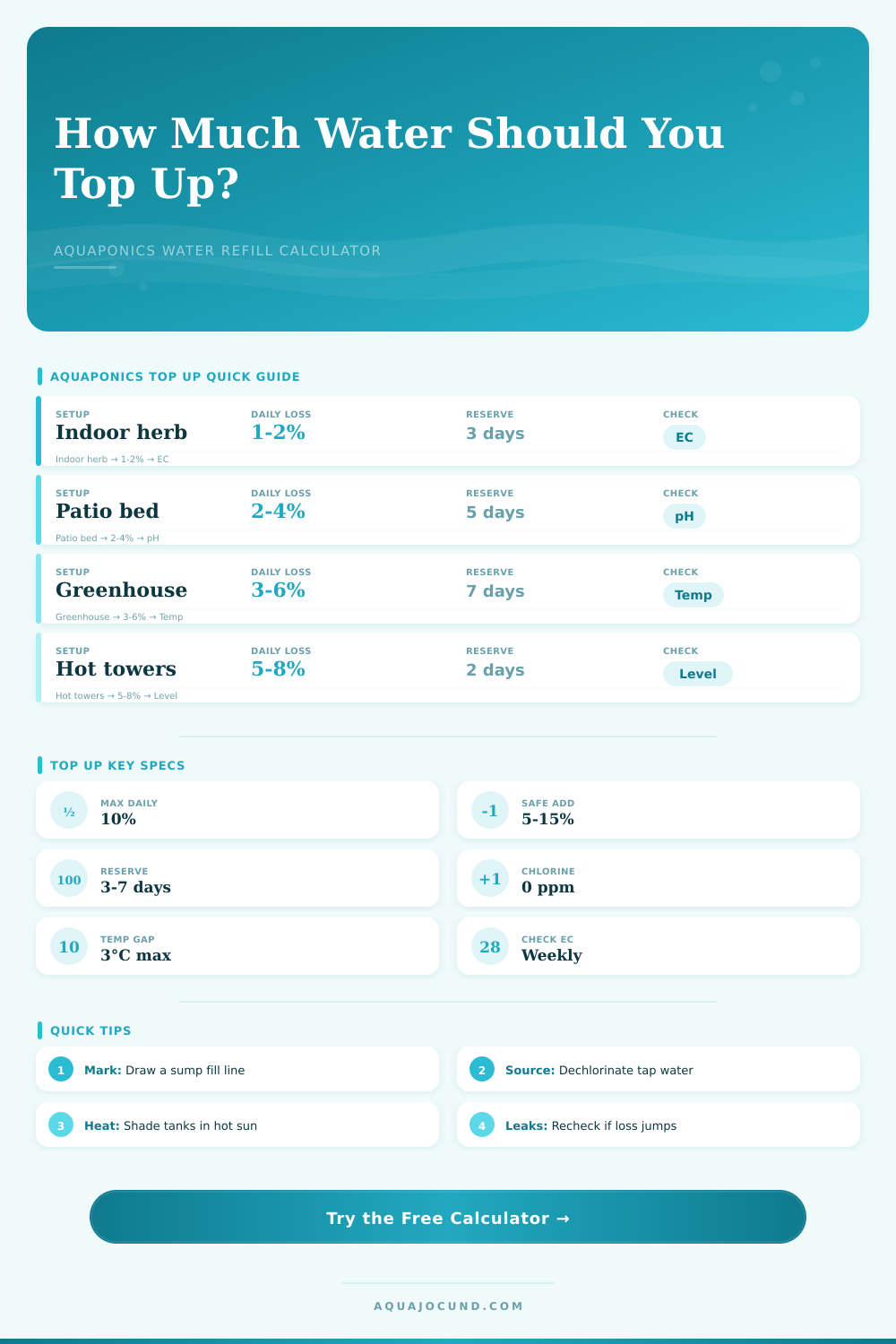
| Countertop Herbs | Small tank, often covered | Low to moderate | Low indoors | 1% to 2% | Check every 2 to 3 days | Small sumps drop quickly |
| Media Bed Backyard | Tank plus grow bed cycling | Moderate leafy growth | Medium in sun | 2% to 4% | Keep 3 to 5 days ready | Siphon intake height |
| DWC Raft Table | Large raft channel surface | High when full canopy | Medium to high | 2% to 5% | Use a marked reservoir | Aeration after refill |
| NFT Rail Rack | Small film surface | High per gallon | High when exposed | 3% to 6% | Top up before roots dry | Pump pickup depth |
| Vertical Towers | Drippers and returns exposed | Very high canopy | High in wind | 4% to 8% | Use daily float check | Top emitter flow |
| Outdoor Pond Loop | Large pond surface | Moderate grow beds | Weather dependent | 2% to 6% | Cover reserve from debris | Rain dilution swings |
| Condition | Evaporation Pressure | Calculator Multiplier | Top Up Habit | Useful Control |
|---|---|---|---|---|
| Cool indoor room | Low | 0.70x | Check twice weekly | Cover sump openings |
| Mild shade house | Moderate | 0.90x | Check every 2 days | Shade raft channels |
| Typical backyard | Moderate | 1.00x | Mark a normal fill line | Reduce splash returns |
| Warm greenhouse | High | 1.25x | Size reserve for a week | Vent heat before noon |
| Hot dry outdoor | Very high | 1.50x | Check daily | Shade tank and sump |
| Strong sun and wind | Extreme | 1.70x | Automate or refill daily | Windbreak exposed water |
| Plant Stage | Canopy Signal | Water Use Factor | System Clue | Adjustment Note |
|---|---|---|---|---|
| Seedlings | Open media visible | 0.45x | Loss mostly evaporation | Do not oversize from tiny plants |
| Leafy growth | Leaves spreading | 0.75x | Steady daily drop | Good default for greens |
| Mature canopy | Bed mostly covered | 1.00x | Water use follows light | Watch warm afternoons |
| Fruiting crops | Tomato, cucumber, basil | 1.35x | Higher transpiration | Top up gently in stages |
| Dense summer | Heavy leaves and fruit | 1.60x | Sump drops fast | Use larger reserve volume |
| Water Source | Before Adding | Top Up Strength | Main Risk | Best Use |
|---|---|---|---|---|
| Treated tap water | Remove chlorine or chloramine | Small to medium refills | Disinfectant stress | Routine marked top ups |
| Rainwater | Screen debris and test pH | Gentle mineral input | Low alkalinity swings | Blending with harder water |
| RO water | Check KH and minerals | No salt buildup | pH instability | High evaporation systems |
| Well water | Test iron, hardness, pH | Reliable supply | Mineral accumulation | Outdoor high-volume loops |
| Mixed source | Match temperature first | Balanced chemistry | Inconsistent batches | Stable refill routine |
| Example System | Operating Volume | Exposed Area | Likely Daily Top Up | Practical Reserve |
|---|---|---|---|---|
| Counter Herb Loop | 10 to 15 gal | 2 to 4 ft² | 0.1 to 0.3 gal | 1 to 2 gal |
| 20 Gal Media Bed | 20 to 30 gal | 5 to 8 ft² | 0.4 to 1.0 gal | 3 to 5 gal |
| 55 Gal Patio System | 55 to 80 gal | 12 to 20 ft² | 1.0 to 3.0 gal | 8 to 15 gal |
| IBC Backyard Bed | 200 to 300 gal | 35 to 60 ft² | 4 to 12 gal | 30 to 70 gal |
| DWC Raft Table | 150 to 350 gal | 50 to 120 ft² | 4 to 18 gal | 40 to 100 gal |
| Greenhouse Hybrid | 300 to 800 gal | 90 to 220 ft² | 12 to 45 gal | 100 to 300 gal |
“Aquaponic systems lose water, and you find out through experience.”
“Fill up your tank, put the fish into it, and then a couple days later, the water’s gone down again. Why? Because water evaporates if it’s exposed to air (open water) and because plants transpire (lose water). What combination of the two happen will depend on your set-up. Left unchecked, the water will go below your pump and it’ll run dry. And extreme changes in temperature can shocks the fish. The page does the math for you with its calculator. It helps you know what to believe when you see the numbers if you understand why they’re there.”
Why Aquaponic Systems Lose Water
What causes most water loss? It is surface area. Very little water evaporates from a covered sump. Wide beds of media expose gallons of water to the air. Raft beds are big surfaces too. Plants suck water out through their root systems and give off that water again as vapor. Breezy, warm days speed up this evaporation. To account for that, the tool allows you to enter the size of your plants’ canopy areas and what stage they’re in. Seedlings don’t pull much water. Heavy leaves on greens or a full tomato canopy will pull a lot of water. It makes a difference, since water that evaporates replaces just that portion of water; over time it concentrates minerals. Water used by plants need to be replenished with fresh nutrients. So knowing what factor dominates your losses will help you both manage how much water you replace, and how to manage water chemistry.
Water also evaporates from the tank at a much faster rate when it’s hot out. For example, a system in an enclosed and cool room loses significantly less water than one sitting outside of a hot sun under a greenhouse roof. Wind blows away the layer of humidity that floats atop your water. This increases evaporation rates dramatically. Environment-specific multipliers is listed in the reference table on the page. If you operate a vertical tower system outdoors where it is windy, you’ll notice greater daily loss estimates. If someone operates a similar system inside a still room, they will see lower estimates. It’s not all about the plants. It’s about air moving around them.
Another frequently forgotten item is splash and purge loss. Regularly flooding and draining media beds causes agitation. If you have a return line dumping water forcefully, then you’re losing water mechanically. Solids purging daily will result in water loss as well. These are predictable and consistent losses, which is why there are fields on the calculator for this type of operational loss. What happens weather-wise each hour doesn’t matter; it’s based off how you maintain your system and how your plumbing’s designed.
Adding water is critical, especially regarding speed and temperature. Adding a gallon of cold tap water to a warm system will stress the fish as well as shock the bacteria. Ideally, match the temps or allow the new water to adjust first in a separate bucket prior to adding. Also, be sure to dechlorinate any tap water before putting it in the loop. The chlorine kills off the good bacteria that keep your system clean.
The tool allows for planning out how much space you need for a reservoir that covers multiple days worth of expected losses. That way you have a buffer when the sun gets hottest and you aren’t scrambling for water.
For the fish tank and/or sump, draw a normal fill line on the tank as a good rule of thumb. This way you can eyeball it and know if there’s been significant change vs. It is just regular evaporation. Even better; don’t guess, use visual confirmation. The next time you check the water level, if it has dropped noticeably since last check, that could be a sign of a leak (not just normal evaporation). The output from the calculator provides a starting point: what should be normal? What doesn’t fit with “normal” stands out. In other words, it turns a thought like “I’m worried the water level isn’t right” into an actionable question: “What am I doing differently today that is causing this?
Consistency is key when it comes to managing water in an aquaponic system. Rather than making huge infrequent water additions, small but regular top ups are preferable. By knowing how much your system loses, you know what reserve you need and can plan for that accordingly. What would of been a crisis becomes just another thing on your weekly list to do. It’s not about doing everything perfectly. Consistent, predictable conditions are where both the fish and the plants will thrive.