💧 Aquaponics Pump Flow Rate Calculator
Estimate delivered flow, turnover, head loss, and the pump label rating needed at your real lift height.
✅ Pump Flow Sizing Results
| System Type | Tank Turnover | Plant Loop Demand | Head Sensitivity | Typical Pump Style | Best Sizing Check |
|---|---|---|---|---|---|
| Flood And Drain Media Bed | 1x to 2x per hour | Fill bed before siphon timing fails | Medium | Submersible or external utility | Delivered GPH plus cycle fill volume |
| Constant Flood Media Bed | 1x per hour | Steady media circulation | Low to medium | Small submersible pump | Tank turnover and even bed distribution |
| DWC Raft Bed | 0.75x to 1.5x per hour | Slow, oxygen-backed water exchange | Low | Continuous low-head pump | Water exchange plus aeration redundancy |
| NFT Rail Loop | 1x to 2x per hour | Small stream through each rail | Medium | High-reliability continuous pump | Minimum flow at the farthest rail |
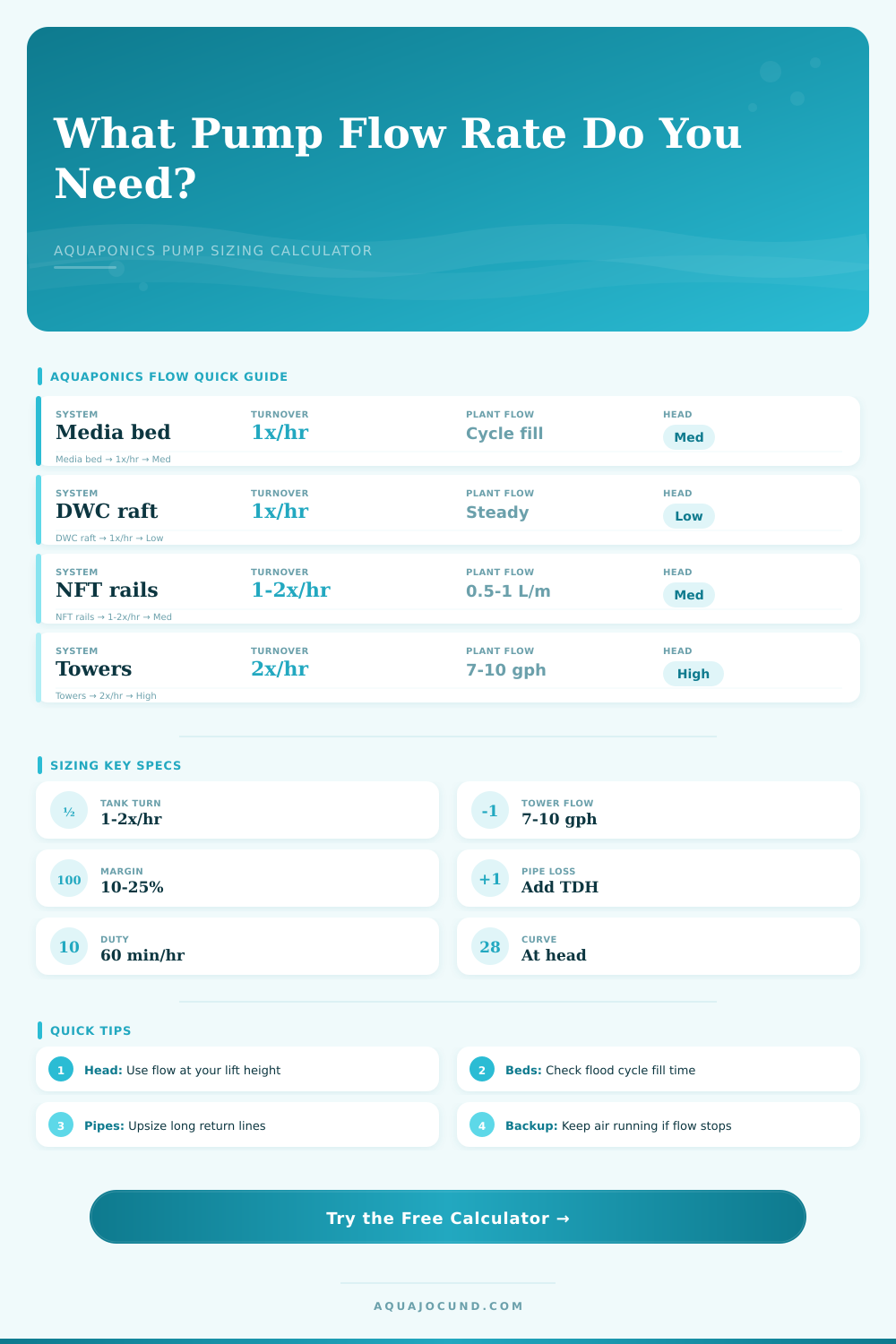
| Vertical Tower Loop | 1.5x to 3x per hour | About 7 to 10 GPH per tower | High | Higher-head submersible pump | Flow at top drippers, not pump box rating |
| Hybrid Media And Raft | 1x to 2x per hour | Manifold split across bed zones | Medium | Utility pump with valves | Balance valves after measuring bucket flow |
| High Fish Load Patio System | 1.5x to 3x per hour | Strong solids lift to filtration | Medium | Oversized pump with bypass | Turnover, oxygen, and filter capacity together |
| Classroom Demonstration System | 0.75x to 1x per hour | Gentle circulation for small tanks | Low | Quiet mini submersible | Low noise with enough flow at head |
| Use Case | Rule Of Thumb | Why It Matters | Calculator Input |
|---|---|---|---|
| Starter media aquaponics | Move fish tank volume about once per hour | Keeps ammonia-rich water moving through biofilter media | Turnover target 1x |
| Heavy feeding or koi load | Use about 1.5x to 2x per hour before aeration checks | Improves solids transport and biofilter contact frequency | Turnover target 1.5x or 2x |
| Vertical towers | Allow about 7 to 10 GPH per tower | Small top emitters need enough delivered flow after lift | Module count plus tower system type |
| NFT rails | Use a thin continuous stream in each rail | Roots need wet contact without turning rails into pipes | Module count plus NFT system type |
| DWC or raft beds | Use gentle exchange and strong air stones | Raft beds rely heavily on dissolved oxygen support | Grow zone volume and duty schedule |
| Timed flood cycles | Increase pump rate when it runs part of each hour | A 15-minute schedule must deliver hourly turnover faster | Pump run schedule |
| Pipe Inside Size | Best For | Approx Friction Allowance | Fitting Allowance | Sizing Note |
|---|---|---|---|---|
| 1/2 in | Desktop and very small loops | High, use short runs | About 1.5 ft per fitting | Easy to lose flow at modest head |
| 3/4 in | Small backyard systems | Moderate for 100 to 400 GPH | About 2 ft per fitting | Good default for compact media beds |
| 1 in | IBC totes and multi-bed manifolds | Lower for 300 to 800 GPH | About 2.5 ft per fitting | Often worth it when head is above 4 ft |
| 1 1/4 in | Long runs and raft returns | Low for many backyard flows | About 3 ft per fitting | Useful when splitting to several zones |
| 1 1/2 in | High-flow manifolds | Very low at moderate velocity | About 3.5 ft per fitting | Best for bigger pumps and long plumbing |
| System Example | Fish Water | Typical Lift | Delivered Target | Likely Label Range |
|---|---|---|---|---|
| Counter Herb Loop | 10 to 15 gal | 2 to 3 ft | 15 to 30 GPH | 40 to 80 GPH |
| 20 Gal Media Bed | 20 gal | 3 to 4 ft | 25 to 45 GPH | 80 to 160 GPH |
| 55 Gal Media System | 55 gal | 4 to 5 ft | 65 to 110 GPH | 180 to 350 GPH |
| IBC Tote System | 200 to 275 gal | 4 to 6 ft | 250 to 550 GPH | 600 to 1200 GPH |
| NFT Salad Rack | 75 to 150 gal | 4 to 7 ft | 120 to 300 GPH | 300 to 700 GPH |
| Vertical Tower Rack | 100 to 200 gal | 6 to 10 ft | 200 to 500 GPH | 600 to 1500 GPH |
| Greenhouse Hybrid | 300 to 600 gal | 5 to 8 ft | 500 to 1200 GPH | 1200 to 3000 GPH |
| Pump Curve Item | Meaning | Good Aquaponics Practice | Calculator Connection |
|---|---|---|---|
| Zero-head flow | Flow with no lift or restriction | Do not size only from this number | Shown as pump label rating |
| Shutoff head | Height where flow falls near zero | Keep TDH comfortably below this height | Entered as pump maximum head |
| Flow at head | Real flow at your vertical lift | Use this value for aquaponics turnover | Required delivered flow card |
| Valve bypass | Excess flow returned to tank | Helpful when the closest bed gets too much flow | Covered by safety margin choice |
| Dirty-screen loss | Reduced flow from roots, biofilm, and solids | Clean lines and strainers before blaming the pump | Safety margin keeps reserve capacity |
Pump, Water needs to move so most people who set up an aquaponics system use a pump. Even with correct grow media and the appropriate fish, without sufficient flow of water (pushed by the pump) the biology fail. Too small a pump mean the roots of your plant go dry/stagnant and ammonia accumulates in the tank.
A pump failure? That’s rare. Typically it’s a pump sized for no resistance which isnt real. There is always resistance from real plumbing. Simply input your pipe length, lift height, and tank volume into the calculator above and it will do the math for you.
How to Choose the Right Pump
The number it spits out is the actual flow at the outlet, without all of the moddern marketing hype found on pump boxes. Why? Because pump manufacturers rates their products at zero head (no friction/no lift). In the real world there are always gravity and pipe walls. What’s important is the delivered flow, not the theoretical maximum.
Your water moves through your plumbing. And that’s where you pay a tax on your water movement: Head loss. Pressure get lost each time it goes up or around. Each elbow. Each valve.
You lift your water four feet up to a media bed, then use twelve feet of pipe with a few fittings? Your pump needs to overcome physics and lose a big chunk of its pumping power. That’s why it figures out the total dynamic head on your design, what your specific layout would cost in terms of a realistic flow rate. Plumbing resist water. The tool accounts for that resistance to translate your layout into a realistic flow rate.
And then there’s the safety margin that people routinely forget. Screens get clogged up with sludge and roots; pipes grows biofilm. The new system runs fine, after six months it feels slow. Fifteen to twenty-five percent margin above the needed flow will assure that the system continues to turn over as it ages. That’s cheap insurance against stagnation.
The goal is to have a bit of an oversized pump for today but not too big, enough to not strip out oxygen from the water and flood the beds. Balance.
Where our gut feelings trip up is at the turn-over rate. In general, one turn of water through your fish tank each hour will keep it aerated and wetted so that biofiltration media can process ammonia efficienty. If you’re heavily feeding or housing a large number of fish, you may require two turns per hour to remove solid waste before they settle out.
For vertical towers, it’s not as much about total volume but rather how hard the pump has to works to push water all the way up to the dripper on top. The reference chart on the page details these differences by type of system.
Why does a raft bed need a different pump profile then a tower? It’s not just power that matters in sizing, but also the curvature of the performance curve. On paper, that tiny little submersible may have some serious horsepower, but when it can’t push water at six feet of head it doesn’t matter much for a two-story configuration. Likewise, an industrial pump could cause turbulence and shock the fish with power usage and high-flow output in a small desktop loop.
The best choice is somewhere between those ends, a pump that fits nicely in the middle of the performance curve. It should be quiet, run cool, and push enough water to make the system tick.
Know the pipe diameter. Smaller-diameter pipes cause both higher friction and velocity. Going up from half- to three-quarter- or one-inch pipe can regain gallons of lost flow while using the same pump. That often cost less than buying a more expensive motor.
Shorter loops can stand narrower constrictions; long runs require wider veins. Pipe size and number of fittings are part of the calculator’s estimate of how much pressure will drop between pump and first plant.
Finally, measure it. Estimates are just that. Real-world measurements has some noise, such as exact fitting geometry, wear on your pumps, and water temperature. How long does it take to fill up a bucket out of the grow bed? Compare that to the target turnover.
Too slow? Shorten the length of the pipe. Get rid of extra elbows. Upgrade the pump.
Too fast? Install a bypass valve to redirect excessive water back into the tank. You want steady, reliable motion. Get the water flowing, the rest would of followed.