💡 Aquaponics Grow Light Coverage Calculator
Estimate fixture count, canopy coverage, PPFD, DLI, spacing, and mounting height for indoor aquaponics grow beds.
✅ Grow Light Coverage Results
| Fixture Type | Typical PPF | Power Range | Best Height | Leafy Coverage | Best Aquaponics Use |
|---|---|---|---|---|---|
| 24 in LED Strip Bar | 70 umol/s | 25 to 35 W | 8 to 12 in | 1 to 2 sq ft | Seedlings, narrow herb shelves, and small NFT rails |
| 48 in LED Strip Bar | 140 umol/s | 45 to 70 W | 10 to 16 in | 2 to 4 sq ft | Counter beds, lettuce rails, and shallow leafy trays |
| 100 W Quantum Board | 230 umol/s | 90 to 110 W | 14 to 22 in | 4 to 6 sq ft | Small media beds, herb beds, and starter rafts |
| 150 W Quantum Board | 360 umol/s | 135 to 165 W | 16 to 24 in | 6 to 9 sq ft | Leafy green rafts and dense culinary herb canopies |
| 240 W Bar Fixture | 600 umol/s | 220 to 260 W | 18 to 30 in | 10 to 16 sq ft | IBC beds, wide troughs, and mixed leafy production |
| 320 W Wide Bar Fixture | 820 umol/s | 300 to 340 W | 22 to 36 in | 14 to 22 sq ft | Large rafts, multi-bed benches, and greenhouse supplementing |
| 180 W COB Pendant | 410 umol/s | 160 to 200 W | 20 to 32 in | 5 to 9 sq ft | Round tubs, vertical towers, and focused fruiting zones |
| Four Tube T5 HO Fixture | 180 umol/s | 96 to 216 W | 4 to 10 in | 2 to 4 sq ft | Seed starting racks and cool leafy production shelves |
| Crop Group | Useful PPFD Range | Daily Light Target | Typical Photoperiod | Coverage Note |
|---|---|---|---|---|
| Seedlings / Starts | 100 to 200 umol/m²/s | 6 to 10 mol/m²/day | 14 to 18 hours | Keep lights close and even so starts do not stretch. |
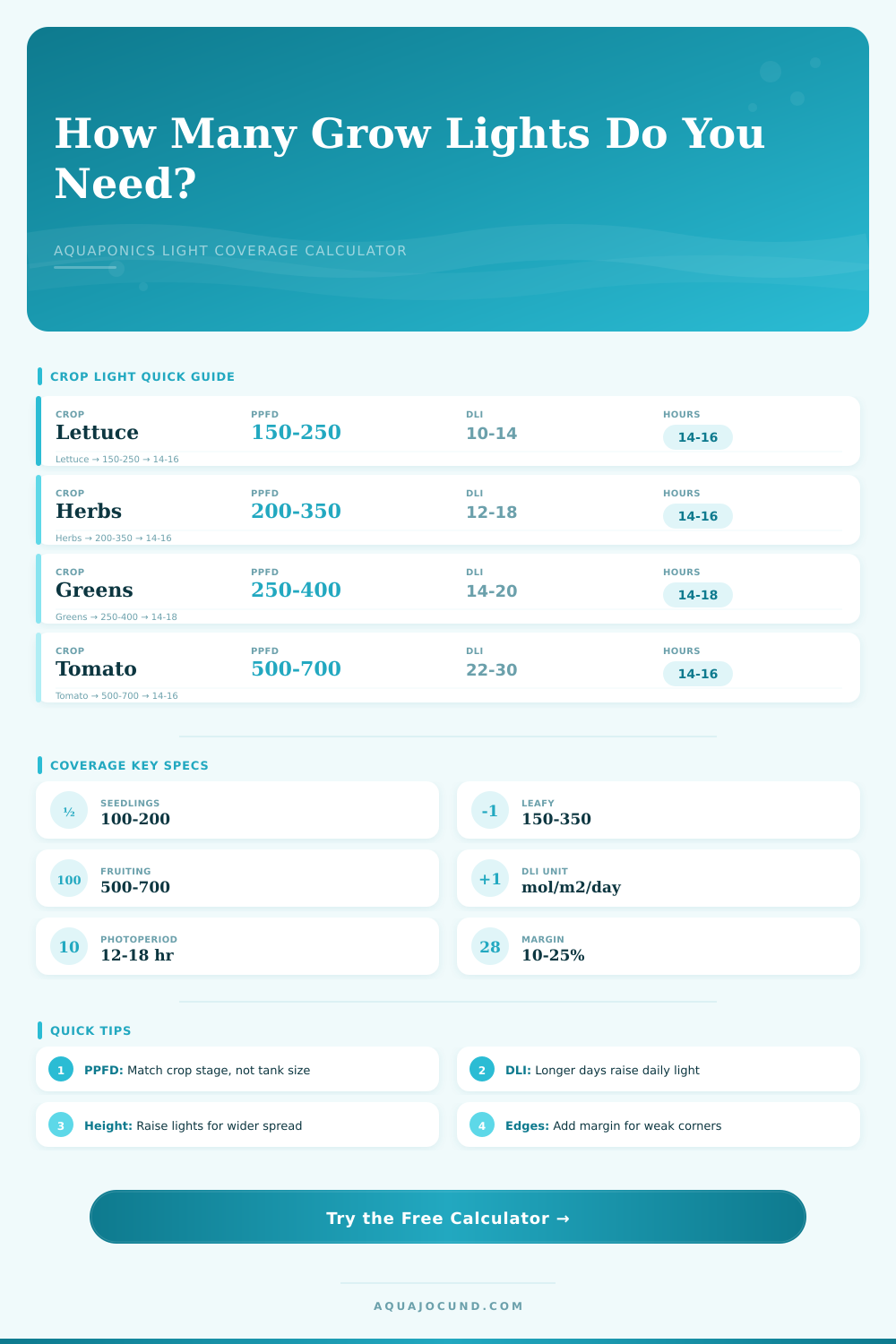
| Lettuce And Tender Greens | 150 to 250 umol/m²/s | 10 to 14 mol/m²/day | 14 to 16 hours | Moderate intensity works well when water temperature stays stable. |
| Culinary Herbs | 200 to 350 umol/m²/s | 12 to 18 mol/m²/day | 14 to 16 hours | Basil, mint, and parsley usually benefit from stronger edges. |
| Kale, Chard, Bok Choy | 250 to 400 umol/m²/s | 14 to 20 mol/m²/day | 14 to 18 hours | Use extra overlap where mature leaves shade the bed. |
| Strawberry / Compact Fruit | 350 to 500 umol/m²/s | 18 to 24 mol/m²/day | 14 to 16 hours | Even canopy coverage helps flower and fruit quality. |
| Pepper / Fruiting Crop | 450 to 650 umol/m²/s | 20 to 28 mol/m²/day | 14 to 16 hours | Plan taller mounting height and stronger central intensity. |
| Tomato / Cucumber | 500 to 700 umol/m²/s | 22 to 30 mol/m²/day | 14 to 16 hours | Use supplemental lighting only if heat and nutrition can keep up. |
| Microgreens | 120 to 220 umol/m²/s | 8 to 12 mol/m²/day | 12 to 16 hours | Uniformity is often more important than maximum intensity. |
| Area Style | Dimensions | Area | Leafy Target | Typical Lighting Approach |
|---|---|---|---|---|
| Seedling Shelf | 24 x 12 in | 2 sq ft | 100 to 200 PPFD | One short strip bar mounted close to the tray. |
| Counter Herb Bed | 30 x 18 in | 3.8 sq ft | 200 to 350 PPFD | Two strip bars or one small board with side reflection. |
| 20 Long Greens | 30 x 12 in | 2.5 sq ft | 150 to 300 PPFD | One 48 in strip or dimmed board above the canopy. |
| 2 x 4 Foot Tray | 48 x 24 in | 8 sq ft | 200 to 400 PPFD | One 150 W board or two smaller boards for uniformity. |
| IBC Top Bed | 48 x 40 in | 13.3 sq ft | 250 to 400 PPFD | One 240 W bar fixture or two boards with overlap. |
| Greenhouse Bench | 96 x 30 in | 20 sq ft | 150 to 300 PPFD | Wide bars used as supplemental light during short days. |
| Mounting Choice | Typical Height | Coverage Effect | Intensity Effect | Use When |
|---|---|---|---|---|
| Close Strip Lighting | 4 to 10 in | Narrow but even | Strong under strip | Seedlings, microgreens, and low shelves |
| Low Board Mount | 12 to 18 in | Moderate spread | High for leafy beds | Small rafts and herbs that need compact growth |
| Standard Bar Mount | 18 to 30 in | Wide overlap | Balanced canopy | IBC beds, raft trays, and mixed crop benches |
| High Supplemental Mount | 30 to 48 in | Very wide spread | Lower PPFD boost | Greenhouse supplementing and aisle coverage |
| Focused Pendant Mount | 20 to 36 in | Round footprint | Strong center | Round tubs, towers, or one high-light crop zone |
New aquaponic growers typicaly purchase lights according to the size of their tank. Why? Bad move! Tank size has no bearing on what light your plant require. Instead, consider the canopy. Use the calculator above to do the math for you. It converts bed dimensions and desired crops to actual fixture count and daily light integral. No guesswork required; just precise planning.
In aquaponics, lighting isn’t so much a matter of buying the brightest bulb but one of use. How are you distributing energy? Plants don’t care about watts; they care about photons. More precisely: How many photosynthetically active photons is landing on them per second? That’s called PPFD.
How to Choose the Right Lights
Give your lettuce a low intensity for a long duration and it may stretch toward the sky, growing tall and leggy, reaching for the sun. Blast it with high intensity for to short a burst and you’ll end up scorching its leaves while accomplishing little increased yield. Balance. You want to provide enough light to encourage growth without stressing the biological filter or wasting electricity.
To make it easy on us, there’s some presetting of the physics problem. There’s a list of common bed setups (a little raft for herbs, an IBC tote bed) and their usual mounting height. Pick your crop and then pick your setup. Tomatoes is greedy: they ask for much higher intensities because they’re trying to produce fruit. Moderate light is fine for leafy things such as lettuces. Pick your crop and the system figures out what target intensity to aim for.
Then it will take into account mounting height, which affects the intensity at the center of the light. Raise the light and it covers a wider area, but its intensity decrease at the center. That’s a real trade off. You can’t get high intensity and lots of coverage using the same light mounted at the same distance. Choose one or buy multiple lights.
Basil wants more photons per second than does arugula. The calculator knows that. The calculator knows that.
The other input I commonly overlook is overlap margin. Real-world fixtures has a falloff on their edge of coverage zones. Too much distance between lights result in dark zones in the middle of your bed. Add an overlap margin (as a percent) to the edges and corners. This guarantees that all parts of the canopy are receiving enough light. Failing to do so will result in your outside plants lagging behind the middle plants. It is a little tweak in the settings, but you will have no more uneven harvests.
DLI stands for Daily Light Integral. That’s the sum of all light that hits a plant during a day. It’s composed of both duration and intensity. Dim lights on 16 hours per day can be equivalent to brighter lights on eight hours. Use the tool’s photoperiod setting to determine your preference. Most growers like low-intensity long days due to the lower heat load in their small growing spaces.
Heat is the silent killer of indoor aquaponics. High intensity lighting can warms the water, decrease dissolved oxygen levels, and stress out the fish. You could of lessen this danger by running lights at a lower intensity for longer (or at least by keeping them further from the water).
On the page are some handy reference tables comparing various crops. These remind us that seedlings require much less light compared to full-size plant. Why? Because you can decrease your lighting as the plants increase in size. Get them off to a good start growing vegetatively, and then tweak it for bloom time if necessary. These tables also remind you that reflectors improve things. A white wall or a mirrored hood returns light to the plant, increasing efficiency. That’s why you may get by with fewer fixtures in a reflective enclosure than would of been required in an open rack.
Lighting is ultimately an investment in yield. Under-lighting is a waste of space and nutrients. Over-lighting is a waste of electricity. A good calculator give you a starting point to find the balance between marketing hype and science.
After you know how many fixtures you need, go install them, measure them, and fine tune. Look at the plants. If they are stretching, lower the lights or increase the duration. Pull them back or lower the lights. Are they turning yellow? Lower the lights or pull them back. The numbers will guide you but the plants will confirm the plan.
Use the data as your starting point. Let the harvest tell you the rest.