🌱 Aquaponics Grow Bed Volume Calculator
Size media beds, flood water, media bags, and fish tank ratios for backyard aquaponics.
✅ Grow Bed Sizing Results
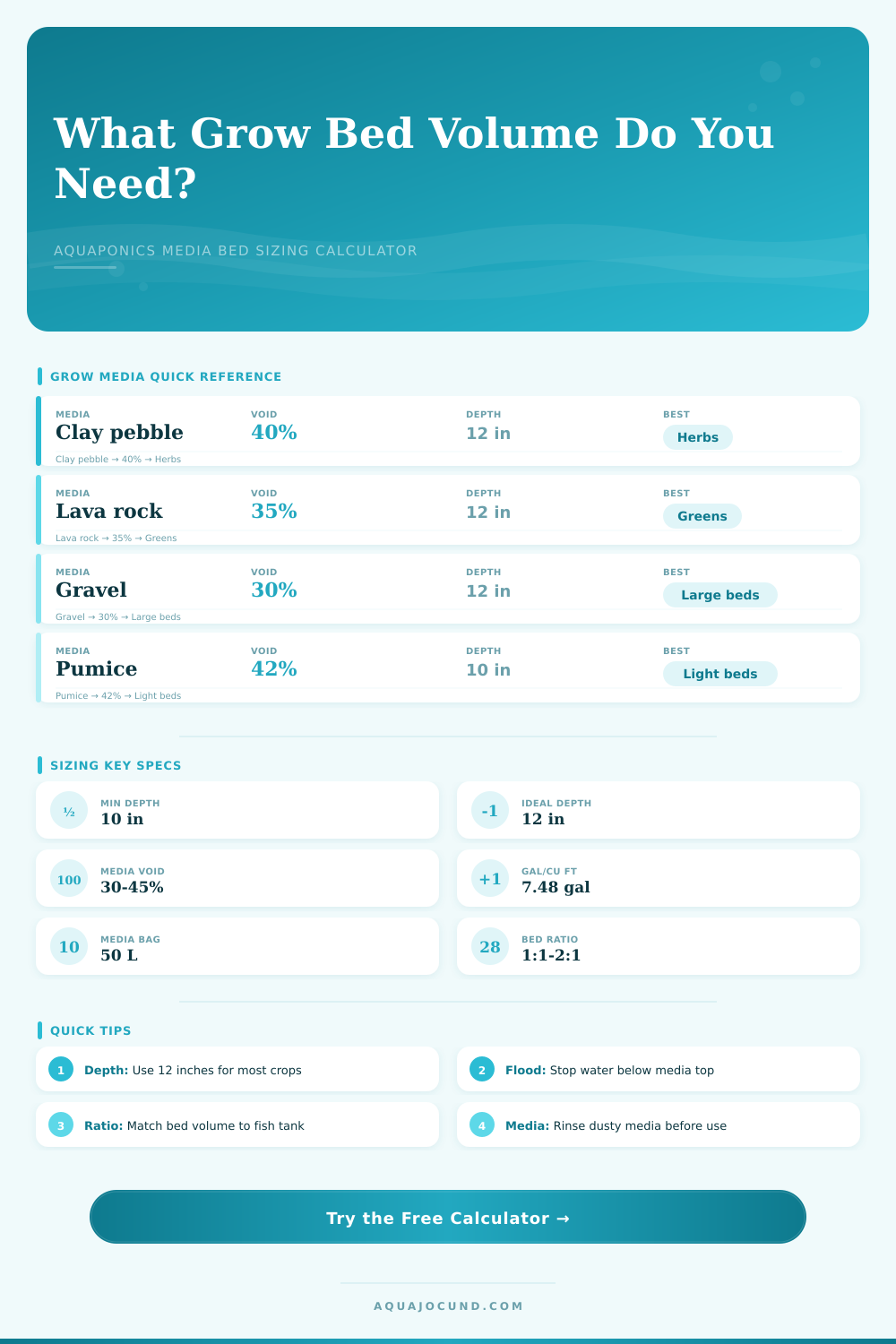
| Media Type | Typical Void Space | Bulk Weight | Common Depth | Best Use |
|---|---|---|---|---|
| Expanded Clay Pebbles | 40% | Light | 10 to 12 in | Herbs, leafy greens, small fruiting plants |
| Lava Rock | 35% | Medium | 12 in | Biofilter-heavy beds and rugged outdoor systems |
| Washed Gravel | 30% | Heavy | 12 in | Large fixed beds with strong support framing |
| Expanded Shale | 38% | Medium | 10 to 12 in | Balanced weight, drainage, and bacteria surface area |
| Pumice | 42% | Light | 10 in | Lightweight balcony beds and wicking media zones |
| Pea Gravel | 28% | Heavy | 12 in | Low-cost beds when limestone content is avoided |
| Clay / Lava Blend | 37% | Medium | 12 in | Mixed beds that need drainage and bacterial area |
| Mineral Media + Biochar | 43% | Light to medium | 10 to 12 in | Experimental beds with extra microbial habitat |
| Bed Style | Dimensions | Bed Volume | Approx Media | Typical Fish Tank |
|---|---|---|---|---|
| Counter Herb Bed | 24 x 12 x 8 in | 10 gal | 1.3 cu ft | 10 to 20 gal |
| Small Greens Tray | 30 x 18 x 10 in | 23 gal | 3.0 cu ft | 20 to 40 gal |
| 2 x 4 Foot Tray | 48 x 24 x 12 in | 60 gal | 8.0 cu ft | 55 to 100 gal |
| Half IBC Top | 40 x 48 x 12 in | 100 gal | 13.4 cu ft | 100 to 200 gal |
| Deep Tomato Bed | 48 x 30 x 16 in | 100 gal | 13.4 cu ft | 100 to 200 gal |
| Greenhouse Run | 96 x 30 x 12 in | 150 gal | 20.0 cu ft | 150 to 300 gal |
| Design Check | Rule Of Thumb | What It Means | Calculator Output |
|---|---|---|---|
| Bed To Tank Ratio | 1:1 beginner, up to 2:1 mature | Media volume compared with fish tank volume | Ratio status and guideline range |
| Flood Line | About 1 in below media surface | Keeps top dry while roots and bacteria stay wet | Working flood water per cycle |
| Turnover | Move fish tank volume about once per hour | Supports oxygen, solids transport, and biofiltration | Target pump flow before head loss |
| Media Bags | Round up, then keep spare media | Irregular beds and rinsing loss use extra volume | Rounded 50 L bag estimate |
That’s the aquaponics trap: You begin with this vision of a tank full of koi who keep themselves cleans and a tank of fresh salad greens. Soon after, you purchase the fish, hook up the pump and then find out you have no clue what size of clay pebble to purchase.
The trouble lies here: It’s not the fish or the plants that is the power behind an aquaponics system. It’s grow bed volume. Get it wrong and everything goes to crap.
Why Grow Bed Size Matters
Enter the tool above. Plug in your measurements and it spits out the math for you. You avoid having to guess at conversions and cubic footages.
So the basic shape of the bed is important; it’s actualy the media to void space ratio that most people gets wrong in their backyard systems. They just build some sort of rectangular box out of whatever material (usually plastic or wood), and call it good. Sixty gallons is a decent start, a typical two by four foot tray with sides about a foot tall will hold ~60 gallons of total volume. But here’s the kicker, total volume doesn’t mean much unless you know what is filling up that volume.
Eventually half of that space will be filled with your chosen media, and the other half will be empty… Also known as void space, where actual water, roots, and beneficial bacteria reside. So most folks end up buying their media according to the total container size, and they wind up wondering why their roots is either drowning or starving.
The other thing that makes a difference is what you put in there. For instance, why do people use expanded clay pebbles? Because they’re lightweight, they’re sterile, and their void space is pretty consistent at about forty percent. So only six-tenths of a gallon of the volume in your bed are solid rock, leaving the rest for the water to go through. Switching to gravel reduces the void space down toward thirty percent, and you’ll end up needing additional physical volume to achieve the same biological filtration capacity.
You can see this laid out in the reference table on the page; how various media compare in terms of porosity and weight. Gravel or lava rock (both heavier media) will need a much beefier frame than would of been needed to support the wooden stand holding all those clay pebbles. It is a small matter of structure, but it makes a difference.
Depth is another key control factor. For most herbs and leafy greens, twelve inches is the sweet spot. That’s plenty of root zone to hold things in place. Yet, it doesn’t create a water column so tall that oxygen gets stripped out off the water during the flood cycle. To go deeper. Say, sixteen inches like with tomatoes, you’re betting on a slower drain time and a heavier bed.
The calculator allows you to adjust the depth, which is reflected in the media volume. This lets you see immediately how much media you’ll need to buy. It’s always wise to round up, since some media will settle as you rinse it into place and begin operating. Getting one additional bag is far less expensive than scrambling when system is all plumbed in.
But what about the ratio of the fish tank to the grow bed? This is where the ratio comes into play. For a newbie, starting at one-to-one is fine. That means the fish tank and grow bed has approximately equal volumes. This provides enough surface area for all that biological activity to handle the waste produced by the fish.
Once you’re up-and-running and know how the system balances out, you could go higher, say, two-to-one; because the more media, the more bacteria, the better your water will be. But don’t add media without a plan, because doing so would break the purpose of the ratios.
You still need to consider your pump. The target turnover rates will shows you what equipment size to use. Ideally, your water will move throughout the entire system roughly once per hour. If you go faster then that, you risk channeling. This is when water takes the shortest route to the outlet, leaving other areas of the media dry and non-functional. If you go slower than that, solids will begin to settle.
Last, don’t neglect the freeboard. A small tip is to leave about an inch or two of media uncovered above the flood line. This dries out the top layer. This keeps the medium aerobic and prevents algae growth. It also keeps fungus gnats at bay. You can also specifically set your freeboard here using the calculator. Enter amount of media to stay dry above the water level, and it will tell you exactly how much water will flood the bed compared to how much will be left dry. How much will be left dry.
A small change to the input makes a big difference for long-term maintenance of your system. It’s not rocket science to build an aquaponics set-up, it’s all about basic volume calculations. If you can determine how much water moves through the system and how much volume your media occupies, everything else is a tweak-and-observe thing.
You figure out the dimensions, then the ratios, and then let nature handle the work. So long as you don’t miss the math part, that dream of fresh greens and clean water is fully achievable.