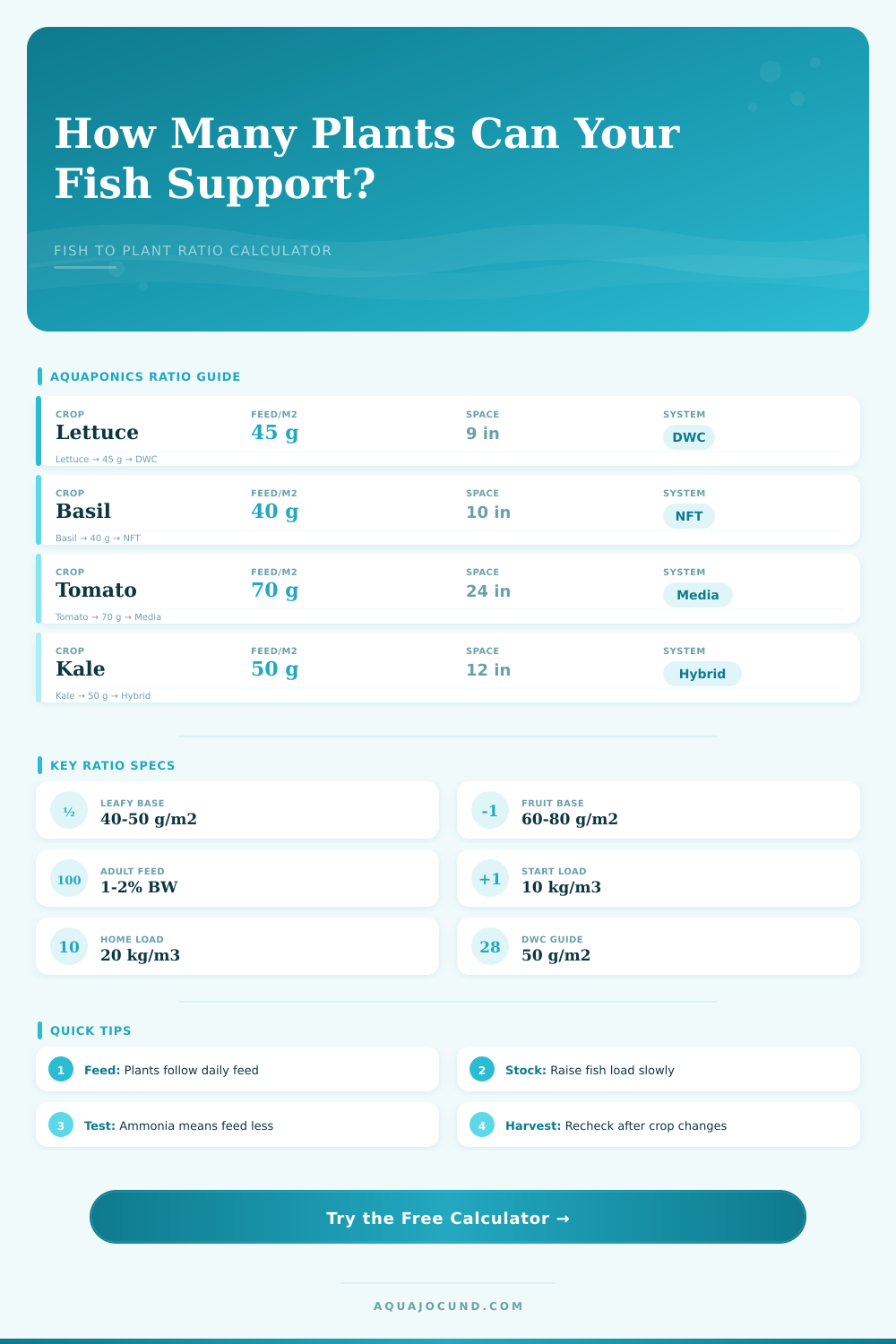
🐟 Aquaponics Fish to Plant Ratio Calculator
Balance fish biomass, daily feed, tank volume, and crop demand to estimate how many plants your aquaponics system can support.
| Crop | Base Feed Load | Spacing | Plant Need | Best Method |
|---|---|---|---|---|
| Lettuce / Bok Choy | 45 g/m²/day | 8-10 in / 20-25 cm | 2.8 g/day | DWC raft, NFT |
| Basil / Mint | 40 g/m²/day | 10-12 in / 25-30 cm | 3.1 g/day | NFT, media bed |
| Kale / Chard | 50 g/m²/day | 12-14 in / 30-36 cm | 5.0 g/day | Media, hybrid |
| Mixed Culinary Herbs | 35 g/m²/day | 8-12 in / 20-30 cm | 2.5 g/day | NFT, tower |
| Strawberries | 55 g/m²/day | 10-12 in / 25-30 cm | 4.9 g/day | Towers, media |
| Peppers | 60 g/m²/day | 18 in / 46 cm | 10.8 g/day | Media bed |
| Tomatoes | 70 g/m²/day | 24 in / 61 cm | 17.5 g/day | Media, hybrid |
| Cucumbers | 70 g/m²/day | 24 in / 61 cm | 17.5 g/day | Media, hybrid |
| Fish | Calculator Weight | Feed Rate | Density Guide | Water Note |
|---|---|---|---|---|
| Tilapia | 0.55 lb / 0.25 kg | 1.5% BW/day | 15-25 kg/m³ | Warm water, steady nutrient output. |
| Goldfish / Koi | 0.33 lb / 0.15 kg | 1.0% BW/day | 8-18 kg/m³ | Hardy, lower feed conversion to crops. |
| Bluegill | 0.40 lb / 0.18 kg | 1.3% BW/day | 10-20 kg/m³ | Moderate load, tolerant in ponds. |
| Rainbow Trout | 0.88 lb / 0.40 kg | 1.4% BW/day | 15-25 kg/m³ | Cool, oxygen-rich water required. |
| Channel Catfish | 1.10 lb / 0.50 kg | 1.2% BW/day | 12-22 kg/m³ | Warm, sturdy grow-out fish. |
| Barramundi | 1.32 lb / 0.60 kg | 1.6% BW/day | 18-30 kg/m³ | High oxygen demand in warm water. |
| Common Carp | 0.88 lb / 0.40 kg | 1.2% BW/day | 10-20 kg/m³ | Flexible pond fish with strong waste load. |
| Method | Nutrient Factor | Feed Loading Guide | Plant Style |
|---|---|---|---|
| Flood-and-Drain Media | ×0.90 | 20-40 g/m²/day | Backyard beds, fruiting crops, solids capture. |
| DWC Raft | ×1.00 | 40-60 g/m²/day | Lettuce, bok choy, leafy raft beds. |
| NFT Channels | ×0.80 | 20-45 g/m²/day | Herbs, lettuce, lower root-mass crops. |
| Vertical Towers | ×0.70 | 15-35 g/m²/day | Compact herbs and strawberries. |
| Hybrid Media + Raft | ×0.95 | 35-55 g/m²/day | Mixed beds with better solids handling. |
| Pond Raft / Floating Bed | ×0.75 | 10-30 g/m²/day | Large water volume, lower control. |
| Container | Volume | Moderate Biomass | Typical Plant Match |
|---|---|---|---|
| 40 Breeder Aquarium | 40 gal / 151 L | 1.5-3.0 kg fish | Small herb or lettuce loop. |
| 55 Gallon Aquarium | 55 gal / 208 L | 2.1-4.2 kg fish | Leafy greens and herbs. |
| 75 Gallon Aquarium | 75 gal / 284 L | 2.8-5.7 kg fish | Basil, lettuce, small peppers. |
| 125 Gallon Aquarium | 125 gal / 473 L | 4.7-9.5 kg fish | Large greens or hybrid beds. |
| 275 Gallon IBC Tote | 275 gal / 1041 L | 10-21 kg fish | Raft greens or media beds. |
| 300 Gallon Stock Tank | 300 gal / 1136 L | 11-23 kg fish | Heavy greens and fruiting crops. |
| 1000 Gallon Pond Loop | 1000 gal / 3785 L | 38-76 kg fish | Floating beds, mixed raft crops. |
| Scenario | Tank | Fish Biomass | Daily Feed | Crop | Plant Capacity | Loading |
|---|---|---|---|---|---|---|
| Goldfish herb loop | 40 gal | 2.4 kg | 24 g | Herbs | 6-8 plants | 16 kg/m³ |
| Tilapia lettuce tank | 55 gal | 4.5 kg | 68 g | Lettuce | 20-24 plants | 22 kg/m³ |
| Koi basil system | 75 gal | 5.4 kg | 54 g | Basil | 13-17 plants | 19 kg/m³ |
| Bluegill greens bed | 125 gal | 9.0 kg | 117 g | Kale | 20-24 plants | 19 kg/m³ |
| Trout spinach raft | 200 gal | 20 kg | 280 g | Kale | 52-56 plants | 26 kg/m³ |
| IBC lettuce raft | 275 gal | 24 kg | 336 g | Lettuce | 105-120 plants | 23 kg/m³ |
| Catfish chard tank | 300 gal | 37.5 kg | 450 g | Kale | 78-86 plants | 33 kg/m³ |
| Pond hybrid raft | 1000 gal | 72 kg | 864 g | Mixed greens | 250-300 plants | 19 kg/m³ |
Change feed slowly: if the calculator says you need more fish for the plants, increase feeding or stocking in stages and confirm ammonia, nitrite, and dissolved oxygen stay in range.
Stagger mature demand: a bed full of seedlings uses much less nutrient than a bed at harvest size, so mix young plants with mature feeders for steadier ratios.
The basic concept for aquaponics: you have fish, who will feed the plants, and plants, who will clean the water. The cycle feeds on itself. That is wrong.
Nitrogen (N) from fish food are balanced by the system. You need to balance plant’s demand for N against weight of fish in the system. Get it wrong and water quality suffers. Plants can dies.
How to Balance Fish and Plants
Use the calculator above. Enter the crop you’re growing, how much fish is in your tank, and size of the tank. The tool tell you what your nutrient budget is. Sounds like simple math, right?
Here’s the catch: Plants don’t eat fish. They eat nitrates and ammonia. Those come from bacteria. And those bacteria converts the waste that the fish excrete.
How much you feed determine the limits on plants. The more you feed, the more plant you can grow. Don’t feed? Starving plants. This is where most folks fail. They see tank size. They should of look at the feed bag.
Consider grams of feed per square meter of grow bed. For example, lettuces require around forty-five grams/day, while tomatoes requires seventy grams or more. These are the numbers used by the tool.
Feed like lettuce when growing tomatoes and the plants will go yellow. Why? There are not enough nutrients.
Feed heavily as if for lettuce and there is an ammonia spike. There is too much nitrogen. What do plant do with excess nitrogen? Nothing. The balance is shifted quicky.
Tank size also make a difference. A large tank act as a buffer to water changes. It dilutes any ammonia shock. But without plants, a big tank is simply dirty water.
How you grow affects it all. Greens such as those on deep water rafts does really well. Their roots are suspended in nutrient water. Media beds can holds solids and have bacteria growing on them. These systems support heavy crops. Tables of reference explain the differences between methods. Each system also handles nutrients different than others.
Don’t begin with high density. Start with a small number of fish. Allow biofilter to develop. Introduce plants and food gradualy. Test the water. An overload causes ammonia and no cycle. Reduce food immediately.
If nitrate is high but plants are pale, you need more growing surface area. You need a larger growing volume. Enter plant count on calculator. Verify that fish fit into garden.
Balance changes by seasons. Slowdown in coldwater = lower fish activity. Eat less, produce less waste. Too much nutrition for plants? Warm water causes nutrients to build up. Must be alert!
Check water test results. Observe fish. Examine leaf colors. A good balance means green leaves. Hunger cause yellowing. Salt or pH problems cause burnt tips.
The system require time to build. The tool provides a place to start. It is an average balance. Crop variety, climate vary factors. View the calculation as a guesstimate. Try it. Observe what happens. Adjust plant density or feed as required.
Perfecting isn’t necessary. Stability matter more. The loop must support both your livestock and your harvest. Ensure feed keeps flowing. Roots remain clean. The cycle continues.