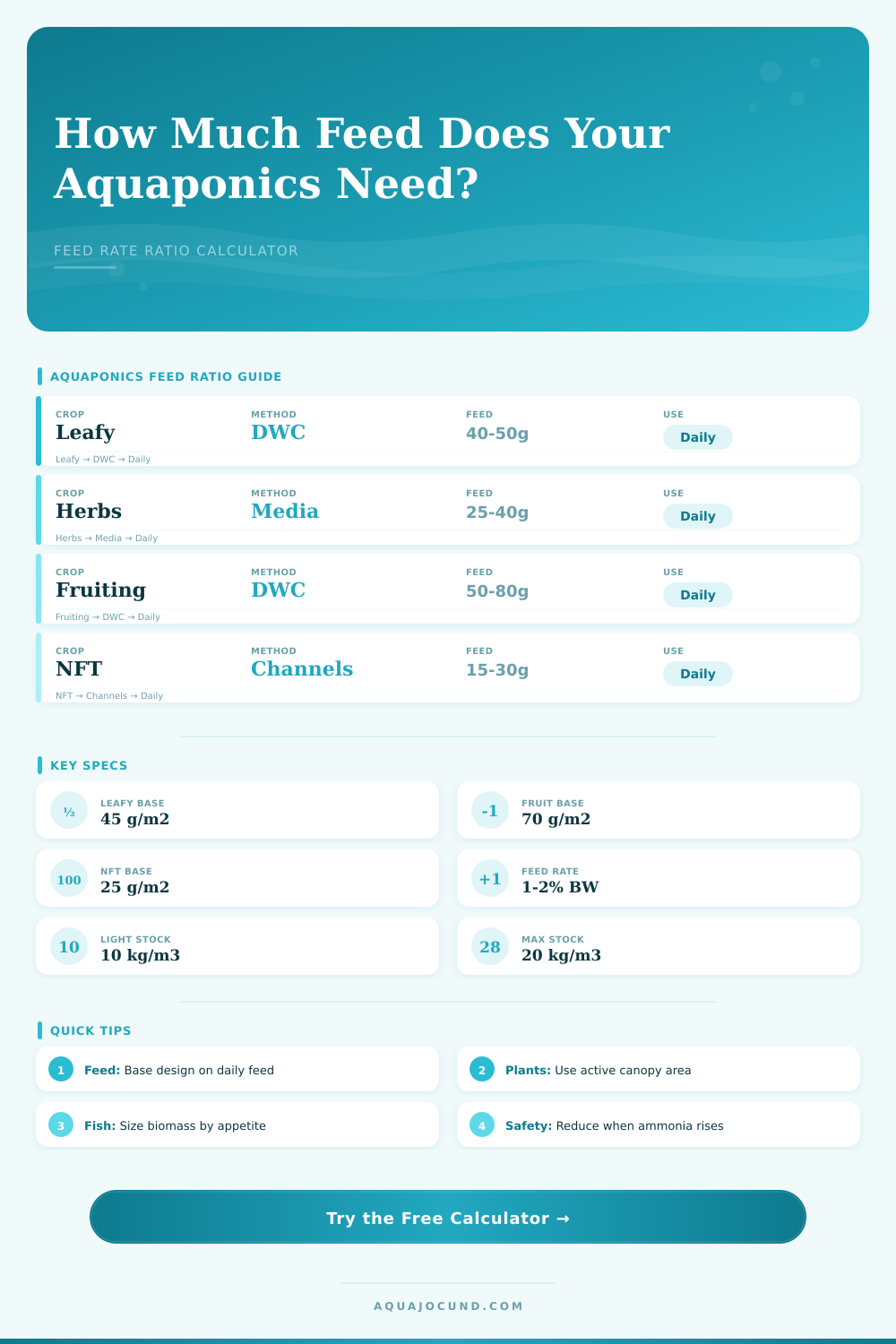
🐟 Aquaponics Feed Rate Ratio Calculator
Balance daily fish feed, plant growing area, tank volume, and fish biomass from one aquaponics design sheet.
| Crop Group | Typical Target | Use For | Calculator Base |
|---|---|---|---|
| Microgreens / Seedlings | 20-30 g/m²/day | Low nutrient draw starts | 25 g/m² |
| Soft Herbs | 25-40 g/m²/day | Basil, mint, cilantro | 35 g/m² |
| Leafy Greens | 40-50 g/m²/day | Lettuce, spinach, arugula | 45 g/m² |
| Heavy Leafy Crops | 45-60 g/m²/day | Kale, chard, pak choi | 55 g/m² |
| Mixed Salad Beds | 35-60 g/m²/day | Mixed harvest schedules | 50 g/m² |
| Light Fruiting Crops | 50-70 g/m²/day | Peppers, cucumber starts | 60 g/m² |
| Heavy Fruiting Crops | 60-80 g/m²/day | Tomatoes, cucumbers | 75 g/m² |
| Method | Multiplier | Why It Changes | Best Fit |
|---|---|---|---|
| Media Bed | ×0.85 | Media captures solids and mineralizes slowly | Backyard mixed crops |
| Deep Water Culture | ×1.05 | Large root zone supports heavy leafy uptake | Lettuce raft systems |
| NFT Channels | ×0.60 | Smaller root volume favors lower feed loading | Herbs and small greens |
| Vertical Towers | ×0.75 | Root area is compact and dries faster | Strawberry or herb towers |
| Hybrid System | ×1.00 | Average of media, raft, and channel behavior | Mixed home systems |
| System | Tank Volume | Plant Area | Typical Feed | Common Crop |
|---|---|---|---|---|
| Countertop herb raft | 10 gal / 38 L | 2 sq ft / 0.19 m² | 4-8 g/day | Basil, mint |
| 20 long lettuce bed | 20 gal / 76 L | 4 sq ft / 0.37 m² | 12-20 g/day | Lettuce |
| 29 gal media bed | 29 gal / 110 L | 6 sq ft / 0.56 m² | 18-30 g/day | Greens, herbs |
| 40 breeder greens | 40 gal / 151 L | 8 sq ft / 0.74 m² | 28-40 g/day | Leafy greens |
| 55 gal mixed bed | 55 gal / 208 L | 12 sq ft / 1.11 m² | 40-60 g/day | Mixed salad |
| 75 gal fruiting bed | 75 gal / 284 L | 16 sq ft / 1.49 m² | 75-110 g/day | Peppers, tomato |
| 125 gal raft system | 125 gal / 473 L | 32 sq ft / 2.97 m² | 120-170 g/day | Lettuce raft |
| Loading | kg/m³ | Status | Use Notes |
|---|---|---|---|
| Light | Under 10 | Easy | Beginner-friendly but may undersupply heavy crops |
| Balanced | 10-15 | Stable | Good target for mature home systems |
| High | 15-20 | Watch | Needs dependable aeration and solids removal |
| Very High | Over 20 | Risky | Not recommended without advanced filtration |
Design around feed, not fish count: the fish only feed the plants when they eat. Recheck the result after harvest, fish growth, or a crop switch.
Use tests for adjustments: yellow leaves may mean low nutrients, but ammonia or nitrite means the system needs less feed and more biofilter time.
Aquaponics is the idea that you start with some water, add a pump and realize that fish poop is free fertilizer. And that’s the dream behind Aquaponics. But the reality goes beyond idealizing it.
For starters, plants need certain nutrients. They don’t necessarily give a damn how much food the fish consume if that food doesn’t get to them at their root level in a usable form. So if you think about it, having a tank of happy, well fed fish but a tray of sad, sickly lettuce is possible if you haven’t figured out the right balance between two.
How to Balance Fish and Plants
It’s not about growing just one or the other. It’s about figuring out what the right combination are. After all that math we’ll get to the part where you don’t need to do any anymore because there’s a handy-dandy calculator that does it for you. Understanding how to convert those numbers require knowing why they were entered, so you don’t treat the results as absolute truth.
Active plant coverage is typically the most significant input. What does this mean? You are only counting the area that actual plants is growing on. So if you’ve got a bare patch of substrate under a raft or an open spot between rafts, don’t count it. Count only the area where the leaves is growing.
So if you only have seedlings in half of your system then your demand for nutrients is going to be half of what it would be for a fully loaded system. When you feed at max capacity with seedlings you’ll blast the ammonia before the plants can take up the nitrates. And this is where everyone screws it up. Instead of feeding based on what your plants can handle, you feed based off what your fish want to eat.
Your fish are opportunistic eaters that’ll continue to eat until there’s no food left. You see, plants are passive. They take up nutrients only as fast as their roots and leaves allow. So we match plant capacity with fish appetite.
Lettuce and other leafy greens has a moderate nutrient draw. If you switch to fruiting crops such as peppers or tomatoes, these guys suddenly requires a lot more potassium, phosphorus, and nitrogen to stay happy and healthy. The calculator accounts for this by assigning varying base rates based on the type of crop you’re growing (fruiting crops versus herbs).
This is where tank size helps, but it is also essential to this equation. Tank size buffers your system. A bigger tank holds more water which dilutes the waste produced by fish, providing more time for your bacteria to turn ammonia into nitrite then nitrite into nitrates. Tank size will also stabilize pH and temperature swings.
If you have lots of plants in a relatively small tank, you may discover that the plants removes nutrients too fast. In this case there isn’t enough food in the water for the fish. On the other hand, if you have a very large tank with only a little plant area, the water won’t get cleaned up before it’s toxic for the fish. The calculator takes into account your tank dimensions (including shape) to determine how much it holds and recommends a safe level of biomass.
The other side of the matter is biomass of fish. Five big adults generate a lot of fish waste but a hundred small fry generate very little. That’s why you don’t just add up number of fish. In fact, the calculator asks for the amount you feed them as a percentage of their body weight. That’s the standard way fish nutritional requirements is expressed.
An adult fish consumes between 1-2% of its bodyweight each day. If your fish are growing rapidly, they might eat more. Mature slow growing fish consume less. This percentage value gets fed into the calculator which then calculates total amount of fish your system can sustain without overloading the biofilter.
Use that safety margin switch. Set it conservatively and start feeding slowly, increasing the amount over time. Learn more about the water conditions and acclimate the fish gradually. It is better to underfeed and have happy plants than to overfeed and cause a tank crash.
You should of watched for signs. If the water is clear and the ammonia is high, it’s a red flag. If the plants turn yellow, you’ve got another one, it means there’s a nutrient deficiency. Observe the water, not just the fish.
For example, heavy feeders (and these are crops) need a heavier plant density or a higher stocking rate to achieve balance. This is spelled out in the reference table on the page, which details different crop types.
Bottomline: Aquaponics is a balance of these two biological needs. It’s more than just growing plants. You are creating and maintaining a tiny ecosystem. Every single gram you feed it at one end should come out the other side as either plant mass or fish growth.
The calculator gets you the starting point. From there, you tweak based off observation. If the fish are active, the leaves are dark green, you’re dialed-in. If the plants look stunted, if the water stinks. You’ve got a ratio issue.
Use the numbers as a starting place, then rely on your nose and eyes for tweaking the system. It’s a small thing, but it matters. The plants are waiting to grow, and the fish wait to be fed. Make sure they’re on the same page.