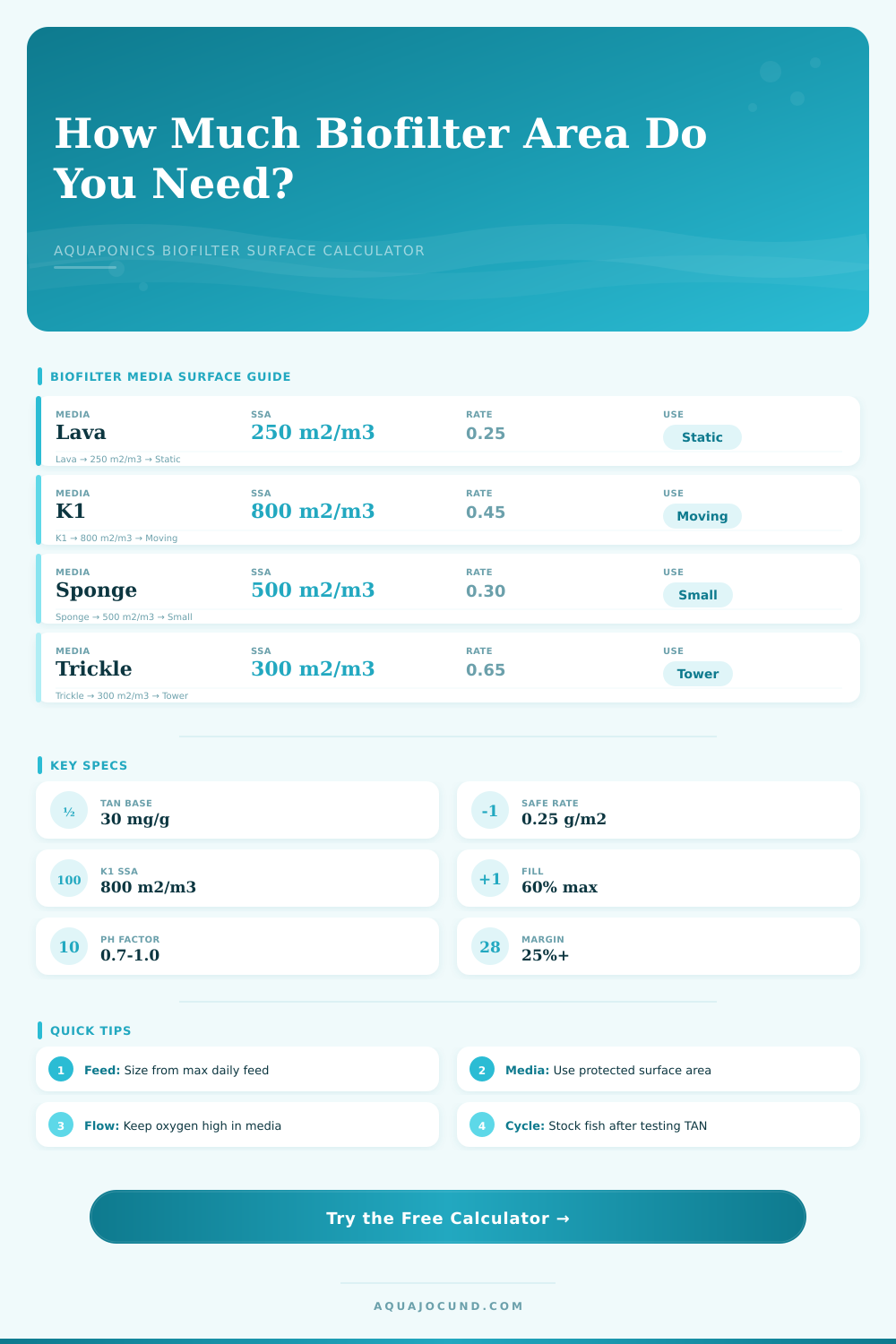
🧪 Aquaponics Biofilter Surface Area Calculator
Estimate protected media surface area, biofilter media volume, daily TAN load, and tank loading from feed rate and system size.
| Media | Protected SSA | Design Rate | Best Filter | Fill Range | Maintenance |
|---|---|---|---|---|---|
| K1 moving bed | 800 m²/m³ | 0.45 g/m²/day | MBBR barrel | 40-60% | Keep tumbling |
| K3 moving bed | 500 m²/m³ | 0.40 g/m²/day | Large MBBR | 40-60% | Air diffuser |
| Lava rock | 250 m²/m³ | 0.25 g/m²/day | Media bed | 70-90% | Pre-filter solids |
| Ceramic rings | 350 m²/m³ | 0.30 g/m²/day | Canister box | 70-90% | Rinse gently |
| Sponge foam | 500 m²/m³ | 0.30 g/m²/day | Small sump | 60-85% | Do not scrub clean |
| Filter mat | 400 m²/m³ | 0.28 g/m²/day | Mat chamber | 60-85% | Stage rinsing |
| Bio balls | 200 m²/m³ | 0.22 g/m²/day | Wet-dry box | 60-90% | Need flow spread |
| Trickle media | 300 m²/m³ | 0.65 g/m²/day | Shower tower | 50-80% | Protect from clogging |
| System | Fish Tank | Max Feed | TAN Load | Typical Biofilter |
|---|---|---|---|---|
| Counter herb raft | 10 gal / 38 L | 5-8 g/day | 0.15-0.24 g/day | Sponge or mini MBBR |
| 20 long lettuce | 20 gal / 76 L | 12-18 g/day | 0.36-0.54 g/day | Static media box |
| 29 gal media bed | 29 gal / 110 L | 18-28 g/day | 0.54-0.84 g/day | Grow bed plus guard |
| 40 breeder greens | 40 gal / 151 L | 30-45 g/day | 0.90-1.35 g/day | Small MBBR |
| 55 gal raft | 55 gal / 208 L | 45-65 g/day | 1.35-1.95 g/day | MBBR or trickle |
| 75 gal fruiting | 75 gal / 284 L | 70-95 g/day | 2.10-2.85 g/day | K1 barrel |
| 125 gal display | 125 gal / 473 L | 100-150 g/day | 3.00-4.50 g/day | Trickle tower |
| IBC tilapia | 250 gal / 946 L | 220-320 g/day | 6.60-9.60 g/day | Media bed plus MBBR |
| Factor | Low | Balanced | High | Use In Calculator |
|---|---|---|---|---|
| TAN per feed | 25 mg/g | 30 mg/g | 35 mg/g | Higher for rich protein feed |
| Feed protein | 28% | 32% | 40% | Adjusts nitrogen pressure note |
| Surface loading | 0.20 g/m² | 0.45 g/m² | 0.70 g/m² | Lower for cold or new filters |
| Activity factor | 55% | 90% | 110% | Captures pH, temperature, oxygen |
| Safety margin | 15% | 25% | 60% | Adds surface beyond exact load |
| Status | Installed Surface | Meaning | Action |
|---|---|---|---|
| Short | Under 85% | Filter may lag daily TAN load | Add media or reduce feed |
| Close | 85-110% | Usable but little buffer | Feed up gradually |
| Ready | 110-160% | Good everyday margin | Test after fish growth |
| Oversized | Over 160% | More media than load requires | Keep oxygen and flow even |
Use peak feed, not average feed: size the media for the heaviest normal feeding week so the filter does not fall behind when fish are growing fast.
Surface area is only useful when colonized: new media needs oxygen, alkalinity, and time before it can convert the TAN load shown in the calculator.
The tool takes all that and converts it to a volume requirement based off biological requirements. It calculates a required volume for your filter given your feed rate (the most important variable) and your media type. That’s why you don’t have to guess how much surface area is needed.
It know how much waste your fish produce based on the amount of protein in their food, not just their weight. More protein = more nitrate/nitrite/nitrogen. The tool guesses at that and divide it by capacity of your chosen media.
How to Choose the Right Filter Size
Various kinds of media will contain varying levels of bacteria. Lava rock is static, heavy, and requires more volume than similar sized K1 media due to its lower surface-to-volume ratio. K1 media allow you to achieve equivalent filtration with smaller size. Design rates and surface area is shown in this reference table.
Waste removal via trickle tower is efficient because water flows over the media, but trickle towers must be monitored closely to prevent clogging. The filter’s capacity are affected by temperature and pH. In the winter, an unheated tank will have less capacity as bacteria function slow in cold water. To account for this fact of biology, the tool also has an activity factor. More water flow won’t make the bacteria operate faster. Wait for the water to warm up or add more surface area.
Power outages and feed spikes happen; it’s wise to add a safety margin of twenty-five percent or more. This provide a buffer that maintains water quality when things go wrong. One mistake many people make is sizing their filter for their existing feed rate. They grow fish and they want to feed them more as time goes by, sizing for today results in having to rebuild the system next year. Plan on the heaviest week of feeding you normaly expect to maintain. Feed a little more than what you would do on slow days and put that number in the calculator. It is better to have extra media then a filter that cannot handle an ammonia spike.
In the cycling phase, surface area matter. Because new media doesn’t have bacteria, it has no starting population. It also take time for colonies to form. Adding fish won’t accelerate the process. A bit of acceleration can be achieved by providing a source of ammonia and keeping oxygen levels high. After the system matures, the calculator report its maximum capacity. It doesn’t estimate cycling duration, as that’s a function of both proper alkalinity and patience.
Less surface area are available for solids management: Bacteria need oxygen from the water. Feces and uneaten food clog up and prevent oxygen access. The surface area becomes useless if it’s all caked with sludge. Separate water from solids before it gets into the biofilter. The biofilter can double as a grow bed and get flushed periodically to maintain active surface area. Non-flushing lead to anaerobic conditions in inner layers, which won’t process ammonia.
Biofilters is made of water, rock, and plastic, which makes them a living system. They require space, air, and food. The daily habits address those latter two, while the calculator addresses the former: How much space do I need?
Size for the worst-case scenario (peak feed), not the best (average). Sizing right ensures good health of fish, clear water, and a well-nourished plant population. You should of used extra media to be safe.