💨 Aquaponics Air Pump Sizing Calculator
Estimate air delivery, pump label output, diffuser pressure, and emergency backup airflow for fish tanks, biofilters, and raft beds.
✅ Air Pump Sizing Results
| Outlet Type | Typical OTE | Start Pressure | Best Flow Each | Best Aquaponics Use | Sizing Note |
|---|---|---|---|---|---|
| Fine bubble disc | 7 to 9% | 0.55 psi | 2 to 8 L/min | Fish tank oxygen transfer | Good efficiency, keep pores clean |
| Medium air stone | 5 to 7% | 0.35 psi | 1 to 5 L/min | Small tanks and backup air | Cheap, but clogging changes pressure |
| Coarse bubble bar | 3 to 5% | 0.20 psi | 3 to 12 L/min | Degassing and moving solids | Moves water well, transfers less oxygen |
| Membrane tube grid | 6 to 8% | 0.45 psi | 4 to 15 L/min | DWC rafts and long troughs | Balance grid branches with valves |
| Weighted diffuser hose | 4 to 6% | 0.50 psi | 5 to 20 L/min | Sumps, fish tanks, and troughs | Needs stronger pump at deeper water |
| Air lift tube | 2 to 4% | 0.25 psi | 5 to 25 L/min | Moving water between zones | Size for lift flow as well as oxygen |
| Backup stone | 4 to 6% | 0.30 psi | 0.5 to 3 L/min | Battery outage protection | Place in fish tank, not plant bed only |
| Open airline | 1 to 2% | 0.05 psi | 2 to 10 L/min | Emergency circulation only | Very low transfer, use briefly |
| System Zone | Airflow Rule Of Thumb | Oxygen Driver | When To Increase | Watch Point |
|---|---|---|---|---|
| Light fish tank | 0.03 to 0.05 L/min per gallon | Fish respiration | Warm water or active feeding | Fish piping near surface |
| Heavy fish tank | 0.06 to 0.10 L/min per gallon | High biomass and solids | Harvest-size fish or low DO readings | Morning oxygen sag |
| DWC raft bed | 2 to 4 L/min per air point | Root oxygen and circulation | Dense lettuce roots or hot greenhouse days | Brown roots or slow growth |
| Moving bed biofilter | 1 to 3 L/min per gallon media | Nitrifying bacteria | Media stops rolling evenly | Ammonia or nitrite rise |
| Sump or mineral tank | 0.02 to 0.04 L/min per gallon | Degassing and mixing | Odor, solids, or long residence time | Anaerobic pockets |
| Battery backup | 50 to 100% of fish tank air | Outage survival | High stock density or hot weather | Run time under load |
| Diffuser Depth | Water Pressure | Typical Added Diffuser Loss | Suggested Pump Pressure |
|---|---|---|---|
| 12 in / 30 cm | 0.43 psi / 3.0 kPa | 0.2 to 0.6 psi | 1.5 psi or higher |
| 24 in / 61 cm | 0.87 psi / 6.0 kPa | 0.2 to 0.7 psi | 2.5 psi or higher |
| 36 in / 91 cm | 1.30 psi / 9.0 kPa | 0.3 to 0.8 psi | 3.5 psi or higher |
| 48 in / 122 cm | 1.73 psi / 11.9 kPa | 0.4 to 0.9 psi | 4.5 psi or higher |
| 60 in / 152 cm | 2.17 psi / 14.9 kPa | 0.4 to 1.0 psi | 5.5 psi or higher |
| 72 in / 183 cm | 2.60 psi / 17.9 kPa | 0.5 to 1.2 psi | 6.5 psi or higher |
| System Example | Total Water | Peak Fish | Air Outlets | Typical Delivered Air | Common Pressure Range |
|---|---|---|---|---|---|
| Counter herb loop | 8 to 15 gal | 0 to 2 lb | 1 to 2 stones | 1 to 4 L/min | 1.5 to 2.5 psi |
| 20 gal media bed | 20 to 35 gal | 2 to 6 lb | 2 to 3 stones | 4 to 10 L/min | 2 to 3 psi |
| 55 gal tilapia system | 55 to 90 gal | 10 to 20 lb | 3 to 5 outlets | 12 to 28 L/min | 3 to 5 psi |
| IBC media system | 220 to 330 gal | 25 to 60 lb | 5 to 8 outlets | 35 to 90 L/min | 4 to 6 psi |
| DWC lettuce raft | 150 to 500 gal | 10 to 40 lb | 6 to 18 air points | 40 to 160 L/min | 2.5 to 5 psi |
| Greenhouse hybrid | 500 to 1200 gal | 50 to 180 lb | 12 to 30 outlets | 120 to 400 L/min | 4 to 7 psi |
When you start an aquaponics system, your intention is healthy fish and fresh lettuce. However, the real work begin with what lies underneath the surface. Dissolved oxygen are the critical factor in any aquaponic system. Until the water warms up and the fish starts gasping, it’s all too easy to under-estimate how much air your system require.
Sizing your air pump correctly is essential. Why? Because it’s not just about making bubbles. It’s about keeping your nitrifying bacteria alive so your system doesn’t collapse when a power surge or heatwave hit.
Why Choosing the Right Air Pump Is Important
Once you input your system parameters into the calculator above, it takes care of the math. It calculates oxygen transfer efficiency and pressure loss. You won’t have to guess whether this pump or that one will make it through the winter.
The single biggest blunder newbies make is only checking out “free-air flow” rating on the pump box. The free-air flow rating tell you how much air moves when there is zero resistance. Great if you’re buying a desk fan, worthless if it’s going in your aquarium.
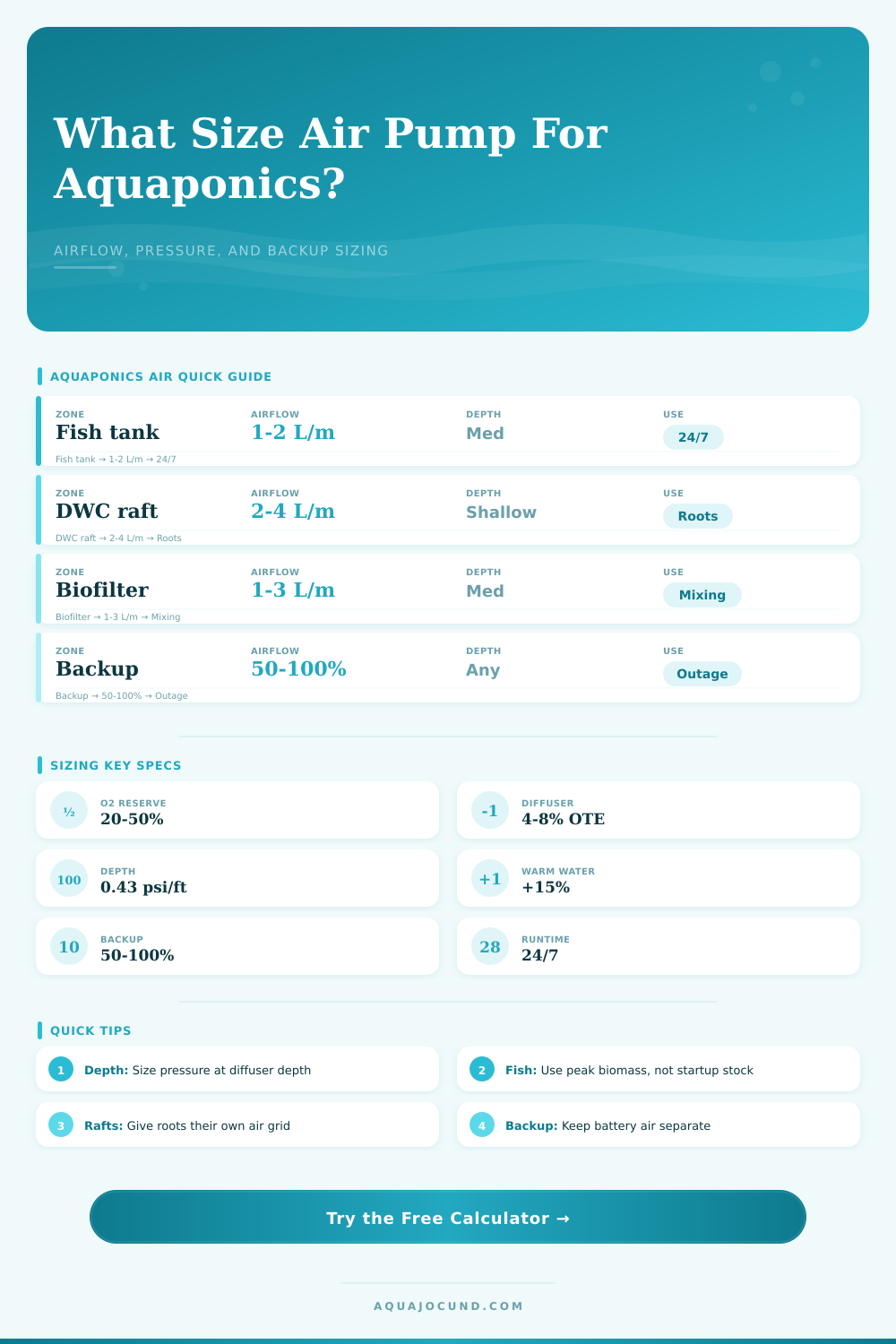
Water is heavy, meaning water pressure exist, and each foot of water depth add approximately 0.43 pounds per square inch to the equation. Therefore, when your diffuser is installed two feet below the surface, it puts about 0.86 psi of pressure on the pump, which mean the pump must overcome this pressure before blowing any air out.
Long airline runs, check valves, sharp elbows… All these increase amount of resistance and lead to drastically reduced delivery rates. Your pump should be rated so its pressure curve allow it to overcome the depth of your setup without stalling.
The other key variable in the demand curve is fish biomass. Two inches of catfish don’t consume as much O2 than six inches of tilapia do. It’s all about the metabolic rate of those fish and how dense they gets at maximum harvest weight. It is not the initial stocking size.
Also, feed rate is important, waste plus uneaten food must be broken down by bacteria. This use up your oxygen supply. What you have is basically a chemical plant going under water, which has to constantly be ventilated.
You’ve got warm water, which holds less oxygen than cold water, and perhaps didn’t plan for the temperature change. A system that works well in spring may not work so great in July.
It all depends on the diffuser used. Oxygen transfer efficiency are higher for fine bubble discs. The smaller bubble stays suspended longer, giving it more time to exchange with the water. But it takes more pressure to get those little buggers started.
Coarse stones are more easily driven, but use up air by shooting it directly to the top where it doesn’t dissolve. It’s a trade off: upfront expense vs. Energy efficiency.
On page there’s a reference table comparing typical efficiencies vs. This refers to startup pressure. This will help guide you as to whether or not your pump can drive what kind of hardware you like best. Do you want the smallest bubble that your budget and pump curve will support?
No One Wants To Buy The Insurance Policy But Everyone Needs One The power goes out. Water pump shuts off. Air pump shuts off. If there’s still enough O2 in the system, some fish will live for several hours. But they cannot survives hours without oxygen.
Get yourself a small battery operated pump specifically made for use on the fish tank. You do not need it in a biofilter or grow beds. Just keeps the fish alive until you figure out what’s up with the juice.
So what is a safety margin? The tool provides one so you can make up for imperfections in the real world. Pumps wears out, airlines get plugged up, algae grows. A safety margin is a way to add some buffer and have a strong system even if things go wrong.
It is a living system, not a static machine. Yes, it breathes. And yes, it eats. And yes, it will react to its environment.
Understanding the pump as the lungs of your aquaponics farm is essential to getting airflow right. Everything else shuts down if the lungs stop working. Plan for the worst day not the best. That way your plants continue to grow and your fish remain happy.