Angelfish Egg Count Calculator
Estimate a spawn from slate, cone, leaf, tube, or direct count measurements.
🥚Preset Spawns
📏Patch Inputs
Estimated Spawn
📊Density Reference
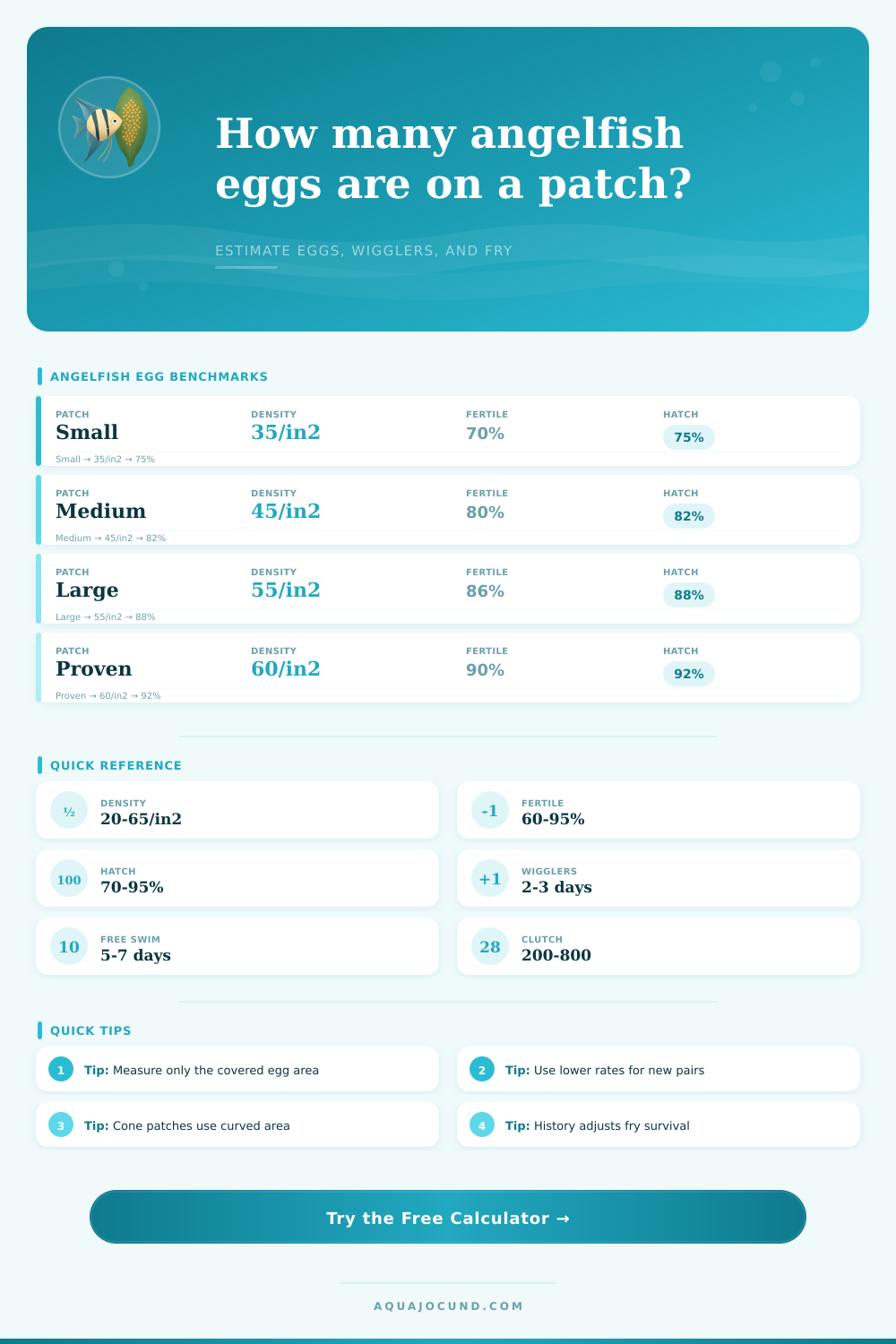
| Patch density | Egg spacing | Eggs per in2 | Eggs per cm2 |
|---|---|---|---|
| Loose | Wide gaps | 20 to 32 | 3.1 to 5.0 |
| Average | Small gaps | 33 to 43 | 5.1 to 6.7 |
| Dense | Mostly touching | 44 to 54 | 6.8 to 8.4 |
| Very dense | Stacked rows | 55 to 65 | 8.5 to 10.1 |
| Common surface | Typical size | Usable area | Likely eggs |
|---|---|---|---|
| Small slate | 4 x 3 in / 10 x 8 cm | 12 in2 | 335 to 575 |
| Tall slate | 6 x 3 in / 15 x 8 cm | 18 in2 | 500 to 865 |
| Cone band | 2.5 in dia, 4 in band | 16 to 22 in2 | 610 to 1055 |
| Broad leaf | 5 x 2.5 in / 13 x 6 cm | 9.8 in2 | 275 to 470 |
| Pair history | Use case | Survival factor | Planning note |
|---|---|---|---|
| New pair | First spawns | 0.62 | Expect losses |
| Inconsistent | Partial care | 0.78 | Lower wigglers |
| Average | Normal guarding | 0.90 | Balanced estimate |
| Proven or pulled | Reliable hatch | 1.00 to 1.08 | Higher fry count |
| Stage | Timing | Formula step | What changes it |
|---|---|---|---|
| Visible eggs | Day 0 | Area x density | Patch shape |
| Fertile eggs | Day 1 | Eggs x fertile % | Pair condition |
| Wigglers | Day 2 to 3 | Fertile x hatch % | Fungus and care |
| Free-swim fry | Day 5 to 7 | Wigglers x survival % | History factor |
So there it is…you wake up one morning and discover that your angelfish have spawned once again. Out comes the cone or slate, and there they are, those little pearls clinging to the glass. How many? Who knows, unless you count them, and who has time for that? Besides, estimating with your eyes works out better. Just measure the space; then multiply! Knowing which ones make it is hard.
Six hundred may sound like a lot but there’s no guarantee that all those eggs will survives. Poor water quality, inexperience, etc. Will lower your numbers. That’s where the calculator comes into play. It does the math for you. You input the surface area and then choose the density of the eggs (loose cluster or dense). Loose clusters tend to be new pairs. Dense patches tends to be experienced breeders.
How to Count Angelfish Eggs
The first thing is fertility. Some of the eggs won’t become fertile. Once they get infected with fungus (which is when they go white), those are unfertilized. On the first day, look and adjust the fertility percentage accordingly. So if 50 percent of a patch is looking cloudy, you drop it down. Then the tool figures out your viable pool.
Newly set eggs may not hatch because of temperature fluctuations. Established pairs will have higher egg survival rates. This affects your prepared food amount based off that. When will the eggs hatch? The timing is important with angelfish fry. By day two or three, they are wigglers. Wigglers stick to the yolk sac for nourishment. At five to seven days old, they swims on their own. Don’t feed them earlier than that. Earlier feeding causes water cloudiness and invites bacteria.
The calculator predicts this time frame for you. It also predicts how many free-swimmer there should be. That tells you when to add microworms or infusoria. Wait longer if the number’s low. Breeding cones are another example of adding curvature. How do you measure a cone? Is it width times length? No. You need to consider diameter and height of egg band, then factor in how much of circumference is actualy covered. The tool handles that math for you, too. It uses your desired rate of density on the curved surface. That way you don’t underestimate how many eggs might be on a cone versus a flat slate. A thin band up one side of a cone could have more eggs than a few scattered egg on glass.
Caring for breeding angelfish takes some calculations, and it requires patience. There isn’t a formula that covers egg-thieving tank mates or power outages. But having a good baseline allow you to manage your expectations. You should of prepared for anything. It transitions from worrying about whether or not a spawn failed to knowing when the numbers changed. From there, it becomes less about anxiety and more about watching slate to read the story of the pair’s health. And that knowledge is valuble.