Two-Part Dose by Alk Drop Calculator
Convert an alkalinity drop into correction dose, daily two-part demand, calcium balance, and split dosing limits.
| Strength Type | Alk Strength | Calcium Strength | Use Case |
|---|---|---|---|
| Light mix | 0.05 dKH per mL per 10 gal | 0.36 ppm per mL per 10 gal | Nano tanks and hand dosing |
| Standard mix | 0.10 dKH per mL per 10 gal | 0.714 ppm per mL per 10 gal | Most mixed reef systems |
| Balanced mix | 0.12 dKH per mL per 10 gal | 0.857 ppm per mL per 10 gal | Moderate automated dosing |
| Strong mix | 0.20 dKH per mL per 10 gal | 1.43 ppm per mL per 10 gal | High demand systems |
| Ultra mix | 0.30 dKH per mL per 10 gal | 2.14 ppm per mL per 10 gal | Large tanks with small reservoirs |
| Doses Per Day | Spacing | Best Fit | Watch Point |
|---|---|---|---|
| 1 to 2 | 12 to 24 hours | Low demand hand dosing | Larger pH swing |
| 4 to 6 | 4 to 6 hours | Small pumps or mixed reefs | Keep calcium separated |
| 8 to 12 | 2 to 3 hours | Steady alk demand | Verify pump minimum dose |
| 16 to 24 | 1 to 1.5 hours | High demand SPS systems | Prevent overlap with calcium |
| System | Net Volume | 0.5 dKH Standard Dose | Typical Split |
|---|---|---|---|
| Nano reef | 15 gal / 57 L | 7.5 mL alk part | 2 to 4 doses |
| Cube reef | 28 gal / 106 L | 14 mL alk part | 4 to 6 doses |
| 40 breeder reef | 35 gal / 132 L | 17.5 mL alk part | 6 to 8 doses |
| 75 mixed reef | 65 gal / 246 L | 32.5 mL alk part | 8 to 12 doses |
| 120 SPS reef | 105 gal / 397 L | 52.5 mL alk part | 12 to 16 doses |
| Alk Use | Balanced Ca Use | Correction Pace | Practical Check |
|---|---|---|---|
| 0.25 dKH/day | 1.8 ppm/day | Very gentle | Soft coral or new reef |
| 0.50 dKH/day | 3.6 ppm/day | Moderate | Mixed reef baseline |
| 0.80 dKH/day | 5.7 ppm/day | Active | Growing stony corals |
| 1.20 dKH/day | 8.6 ppm/day | High | SPS or clam-heavy system |
Sometimes your alkalinity decreases by too much in your reef tank which can cause some anxiety. Now you don’t want to overshoot adding 2-part but are not sure how much to add. The above calculator will do that for you. Simply put in amount of water you have and the amount that dropped, and the calculator will do the rest.
You do not need to guess units or coefficients. It trip up even veteran keepers. Know your water volume not your tank size. Your tank may be listed as a 75g but it’s only got 60 gallons of water in it. How do I know? Because you’ve got displacement due to sumps, substrate, sand, live rock, etc. When you use total shell volume you’re guaranteed to overdose. You’ll force parameters outside healthy ranges where they start stressing your livestock or causing cloudiness.
How to Fix Low Alkalinity in Your Reef Tank
Know what you have then measure it. There is never a constant demand for alkalinity. Alkalinity demand vary by the time of day you measure, growth rate of your corals, feeding schedule, etc. You get a far better idea about what’s actualy being consumed if you measure a decrease over a span of two days. If you only check once per day you run the risk of capturing some temporary swing instead of a long term trend.
The calculator lets you spread whatever deficit you calculate across multiple correction days. Why? It is smart not to add all alkalinity at once, because doing so risks calcium carbonate crashing out of solution. When this occurs, the precipitate coats rock and glass surfaces with white haze. That precipitation will remove both those factors from water column. So it negates the point of dosing altogether.
Most commercially available two-part solutions contains about 7.1 parts per million of calcium and raise one dKH, which are the natural balance levels. For those who burn alkalinity quicker then calcium, simply change your balance mode setting accordingly. Otherwise, the slower imbalance will cause one to starve and the other to spike, resulting in a slow drift that cannot be ignored.
Both is required for stony coral skeletal growth. Keeping them in step is a must for the long term health of corals. Dosing all at once causes a spike in your local environment and it is also causing that nutrient to be locally overloaded. By spacing it out, you are imitating nature, which gradually replenishes buffers and other nutrients into the ocean over time. This will keep things stable, lowering the chance for cloudy water.
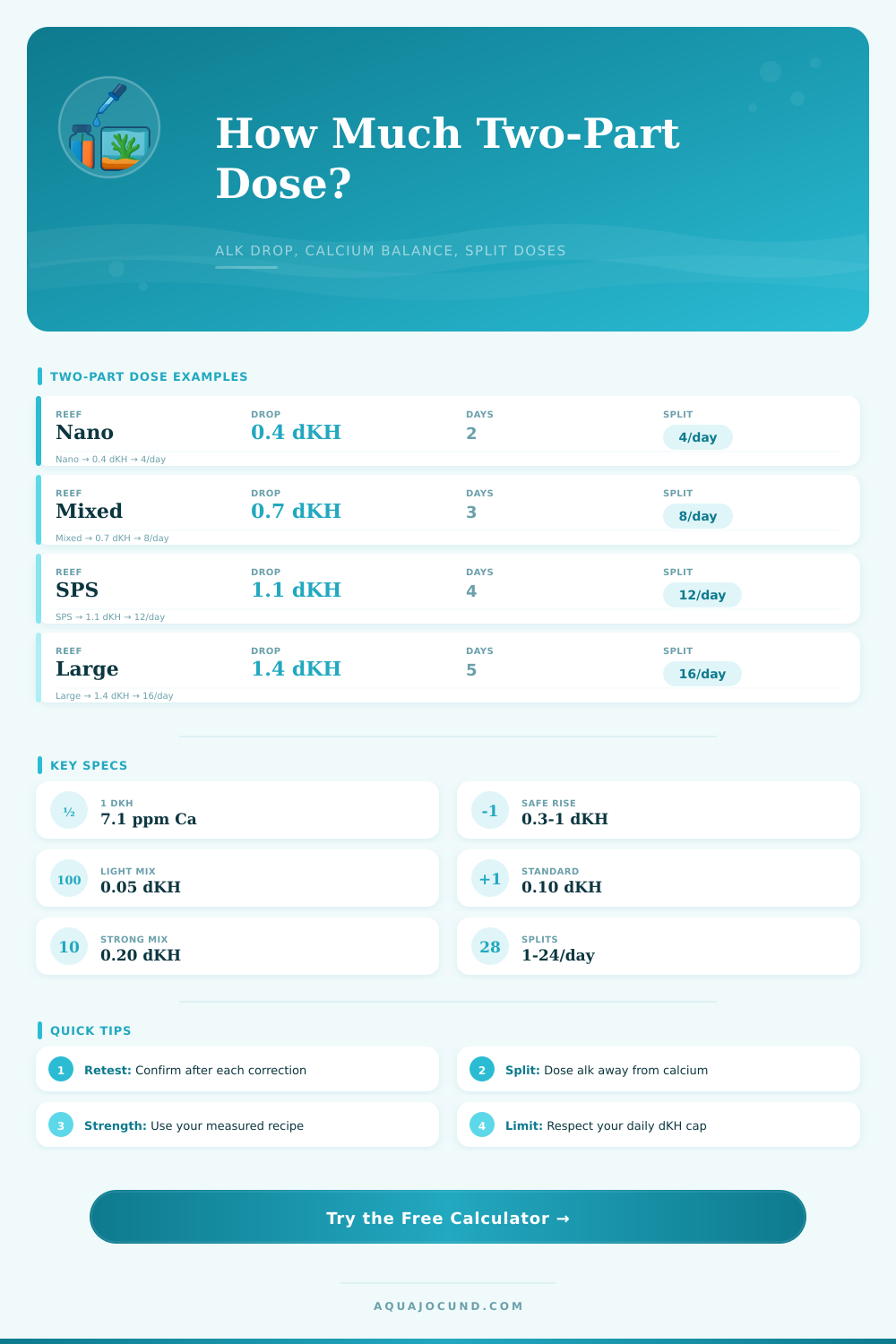
You can see this illustrated in the reference table on the page. How much you dose, when you do it, depends on size of your system and its demand. You also want strong stuff. With two-part mixes that you make yourself, you can be certain of what goes into them. With a commercial two-part mix, follow the recommended strength.
The first entry will skew all future calculations if you put in a custom value that isn’t correct. Be safe with an initial guess then tweak based off results. It’s better to start with a conservative estimate and adjust after testing than to assume maximum efficiency from the start. There’s a reason why there are safety caps on things. It’s because going beyond that amount can be dangerous and aggressive.
By doubling your alkalinity overnight? That’s dangerous. The calculator alerts you when it thinks you’re proposing too much. So, it urges you to spread out your correction period. This makes the change gentler so you don’t shock your invertebrates or any bacteria while still fixing the shortfall. You’re correcting something, not racing against time.
Successful dosing come from observation and consistency. Use the math to direct your hand. Use your eyes to confirm the results. Adjust slowly, test often, and enjoy thriving corals. When you respect the chemisty behind the glass, the uneasiness melts away into the plan.