🧪 Alk Dosing Split Per Day Calculator
Plan reef aquarium alkalinity dosing from daily dKH demand, solution strength, maximum swing, dose count, pump runtime, and schedule spacing.
| Solution profile | Typical strength basis | pH tendency | Best split style |
|---|---|---|---|
| Standard carbonate two-part | 0.071 dKH from 1 mL in 100 L | Raises pH | Small frequent pulses |
| Concentrated soda ash solution | 0.084 dKH from 1 mL in 100 L | Raises pH more | Many tiny doses |
| Sodium bicarbonate solution | 0.050 dKH from 1 mL in 100 L | Neutral to slight down | Moderate splits |
| Low-pH bicarbonate mix | 0.032 dKH from 1 mL in 100 L | Gentle pH effect | Larger but smoother doses |
| Balanced three-part alkalinity | 0.063 dKH from 1 mL in 100 L | Usually modest rise | Even daily schedule |
| All-in-one alk contribution | 0.035 dKH from 1 mL in 100 L | Usually mild | Daily or several splits |
| Saturated kalkwasser | 0.0011 dKH from 1 mL in 100 L | Raises pH strongly | Slow drip or ATO limit |
| Display size | Likely actual water | 0.3 dKH/day with standard carbonate | Suggested starter splits |
|---|---|---|---|
| 13.5 gal nano reef | 10-12 gal / 38-45 L | 1.6-1.9 mL/day | 2 to 4 doses |
| 25 gal all-in-one reef | 19-22 gal / 72-83 L | 3.0-3.5 mL/day | 4 to 6 doses |
| 40 breeder reef | 32-36 gal / 121-136 L | 5.1-5.7 mL/day | 6 to 8 doses |
| 75 gal reef | 58-68 gal / 220-257 L | 9.3-10.9 mL/day | 8 to 12 doses |
| 120 gal reef | 95-110 gal / 360-416 L | 15.2-17.6 mL/day | 12 to 24 doses |
| 180 gal reef | 145-165 gal / 549-625 L | 23.2-26.4 mL/day | 18 to 24 doses |
| Daily demand | Conservative split count | Typical per-dose swing | Use case |
|---|---|---|---|
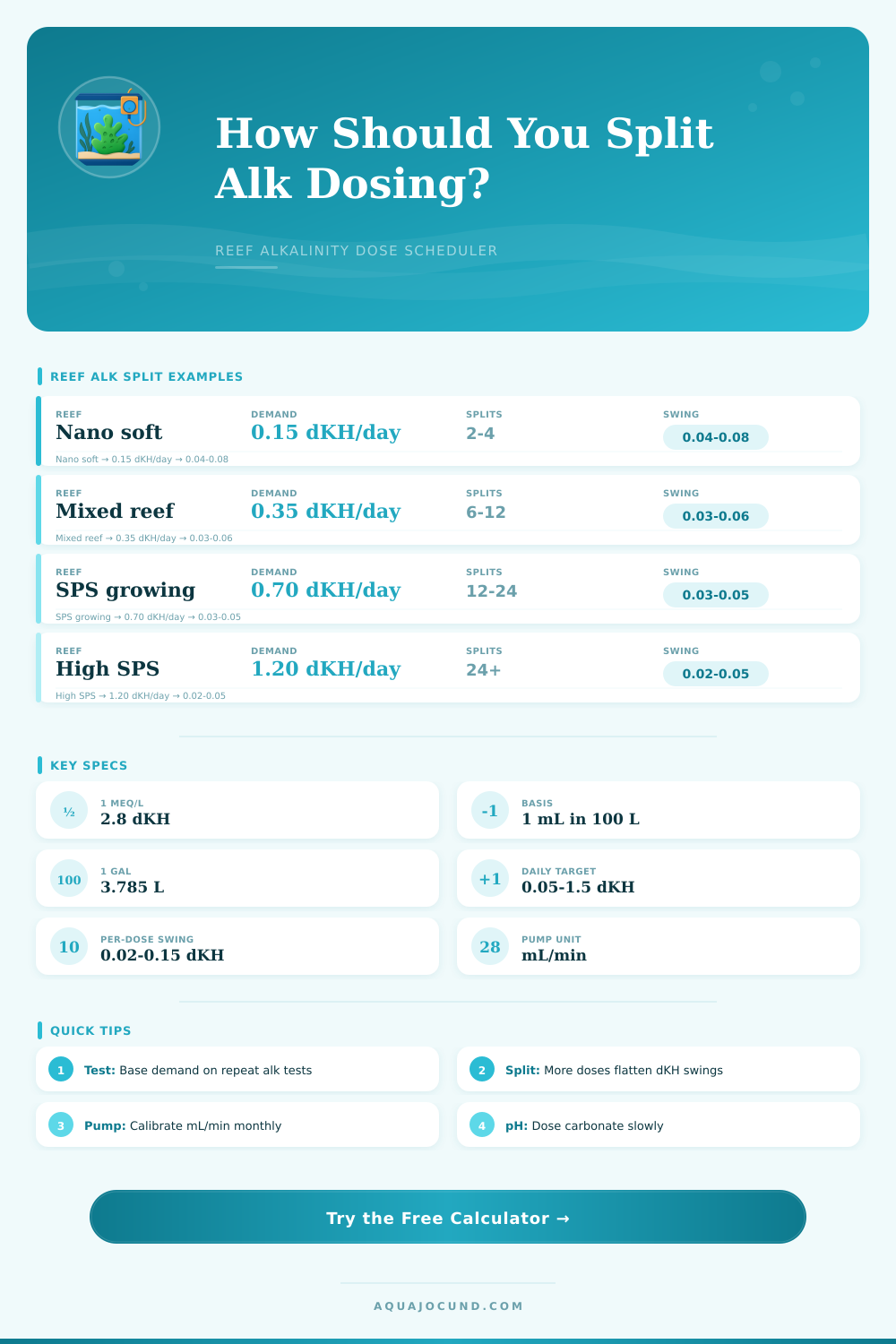
| 0.05 to 0.20 dKH/day | 1 to 4 | 0.03 to 0.10 dKH | Soft coral or new reef |
| 0.20 to 0.45 dKH/day | 4 to 8 | 0.04 to 0.08 dKH | LPS and mixed coral load |
| 0.45 to 0.85 dKH/day | 8 to 16 | 0.03 to 0.07 dKH | Growing SPS or dense frags |
| 0.85 to 1.50 dKH/day | 16 to 32 | 0.03 to 0.06 dKH | High SPS and clams |
| Over 1.50 dKH/day | 24 to 96 | 0.02 to 0.05 dKH | Large mature systems with monitoring |
| Dose | Time | mL | Runtime | dKH pulse |
|---|---|---|---|---|
| 1 | 00:00 | 0 mL | 0 sec | 0 dKH |
Additive, You dose a two-part additive into your reef tank and within minutes the alkalinity shoots upward. Great! Alkalinity climbs towards your desired 8 dKH goal. Then, as if by magic, it falls again just an hour or two after you dose. Now what? Did I miss something with my dosage plan?
Nope. The issue is that a static test does not show the action of the living coral skeleton taking up carbonate ions. Adding everything in one shot stress the system. It simply can’t handle such a big hit in one go.
How to Dose Your Reef Tank Correctly
The solution is to divide the daily dose into smaller doses delivered every minute or hour. This spreads out the delivery to better match open ocean conditions, where alkalinity remains level rather than rising and falling, which confuses delicate polyps. This prevents spikes and crashes that confuse sensitive polyps and can trigger calcification issues or even tissue retraction.
The calculator calculates the time to do it (how long should the pump be on) and the volume (how many milliliters per dose). No more guessing. Just forget about the fluctuating numbers and concentrate on keeping your tank biologically healthy.
Knowing how much water you have is essential, first. Most people rely on the capacity rating from manufacturer…but that includes the space taken up by sand, live rock, plumbing, etc. Your effective volume will be less than this (sometimes dramaticly). Dosing based off an inflated volume estimate means you’ll consistently under-dose. Over time, alkalinity will creep downward…slowly…weeks later. It is hard to detect until a coral turns white or shuts down. Knowing the exact amount of water you’re working with keep your math in line with real life.
How many pulses? That depends on the type of corals. For example, metabolic rate is moderate in soft corals and large polyp stony systems, which tend to be forgiving. They typically does well with only several pulses a day.
On the other hand, demand goes up when you add sps corals. Since these corals grow skeletons fast they consume carbonate from the water at a rapid pace. In high demand systems, the demand outpaces supply, meaning a single large pulse might is used up before the next one arrives. This causes low alkalinity periods which stress the coral colony. Frequent, small pulses is needed to sustain the baseline close to your target level.
Calibrating pumps is important, not horsepower. If a pump is rated at one milliliter per minute and has lost some performance (wear) or the batteries is weak, it may only deliver point nine or even one point two. Unless you know how much it delivers each time, you’re relying on the nominal rating but not actual measured performance. Periodically (monthly is good), fill up a graduated cylinder with water and time the pump’s delivery into the container. Then you’ll know that what the calculator says will be delivered for that run time is being deliverd. Otherwise, you can overdose and get precipitated salts and wild swings in your pH.
This is where the reference table comes in. As you enter your data, it will show you which of these reef profiles matches your parameters and give you a recommended split count. Essentially it’s a sanity check on your numbers. Is what you’re doing consistent with known norms? Whether you have a big breeding tank or a nano, the principles is similar. Dose often, test regularly, don’t make drastic changes.
Reef keeping isn’t about being perfect, it’s about stability. Providing a stable environment smooths out the day-to-day changes allowing corals to grow and thrive. Doing this makes dosing part of routine maintenance and sets the stage for long term success.
You should of used this tool earlier.