Algae Scrubber Flow Rate Calculator
Size waterfall or submerged algae scrubber flow from screen width, slot pipe length, target gph per inch, pump head, bypass split, and safety margin.
📏Screen, slot pipe, and flow style
For waterfall screens, use the cut slot length that actually wets the screen.
🚰Pump, head height, and bypass
Measure from pump water level to the slot pipe or chamber inlet.
Use 0 for a dedicated feed pump; use the bleed percentage for manifolds.
Calculation breakdown
📊Flow capacity markers
🌊Flow style comparison grid
Waterfall screen
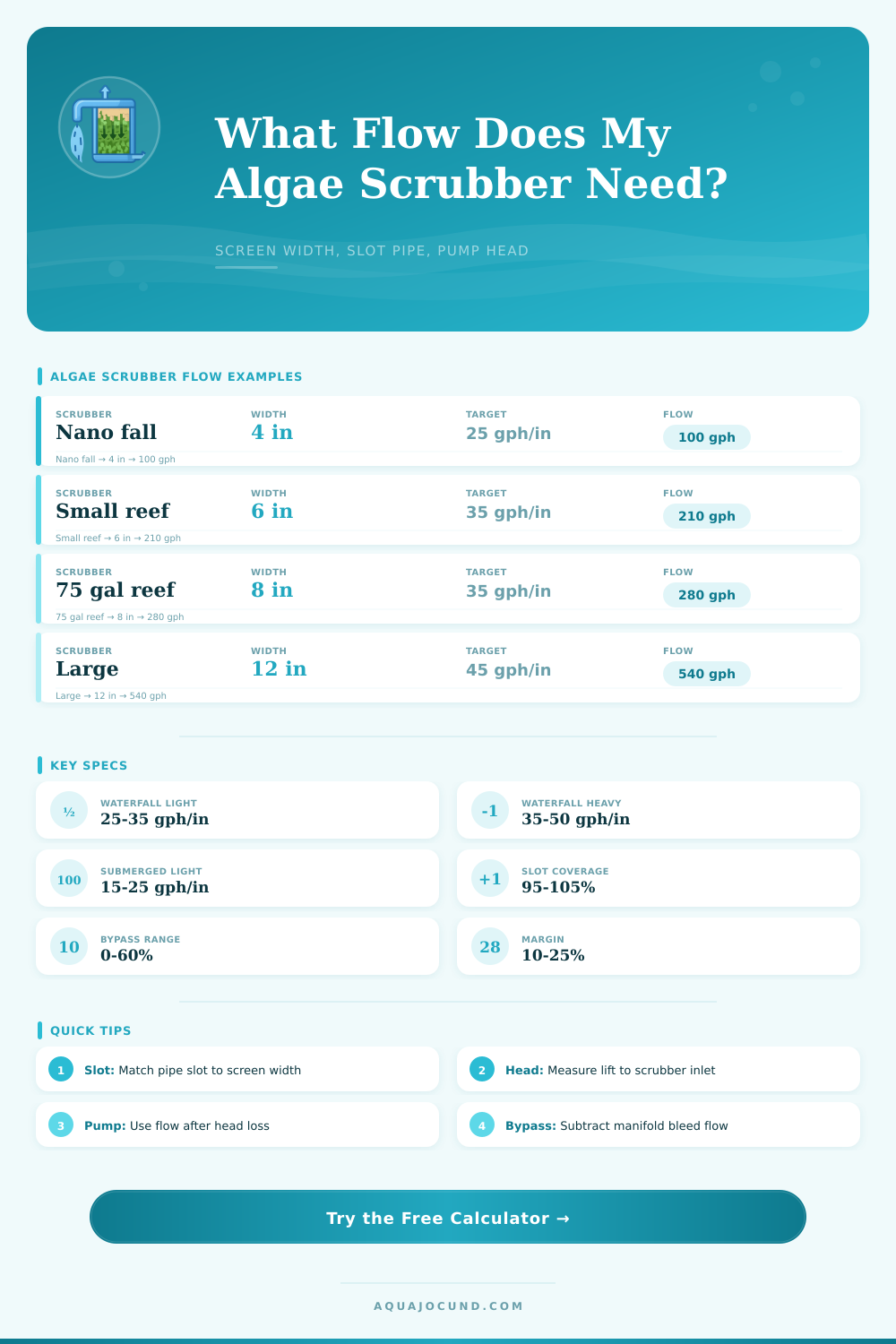
Best with an even horizontal slot. Typical targets are 25-50 gph per inch of active screen width.
Wide-slot waterfall
Handles stronger pump feeds, wider sheets, and heavier turf if the slot length fully covers the screen.
Submerged upflow
Uses lower linear flow and more contact time. Aim for steadier movement instead of a fast falling sheet.
Hybrid tray
Works between the two styles. Tilt, water depth, and outlet height make measured flow checks more important.
📘Reference tables
| Scrubber type | Starting target | Strong target | Flow character |
|---|---|---|---|
| Waterfall slot screen | 25-35 gph/in / 37-52 L/h/cm | 35-50 gph/in / 52-75 L/h/cm | Thin sheet across rough screen |
| Wide-slot waterfall | 30-40 gph/in / 45-60 L/h/cm | 45-60 gph/in / 67-89 L/h/cm | High wetting, higher splash control need |
| Submerged upflow | 15-22 gph/in / 22-33 L/h/cm | 22-32 gph/in / 33-48 L/h/cm | Gentler contact, less noise |
| Hybrid tray or tilted screen | 20-30 gph/in / 30-45 L/h/cm | 30-42 gph/in / 45-63 L/h/cm | Depends on water depth and outlet height |
| Screen width | 25 gph/in | 35 gph/in | 45 gph/in |
|---|---|---|---|
| 4 in / 10 cm | 100 gph / 379 L/h | 140 gph / 530 L/h | 180 gph / 681 L/h |
| 6 in / 15 cm | 150 gph / 568 L/h | 210 gph / 795 L/h | 270 gph / 1022 L/h |
| 8 in / 20 cm | 200 gph / 757 L/h | 280 gph / 1060 L/h | 360 gph / 1363 L/h |
| 10 in / 25 cm | 250 gph / 946 L/h | 350 gph / 1325 L/h | 450 gph / 1703 L/h |
| 12 in / 30 cm | 300 gph / 1136 L/h | 420 gph / 1590 L/h | 540 gph / 2044 L/h |
| Pump output after head | Bypass 0% | Bypass 25% | Bypass 50% |
|---|---|---|---|
| 200 gph / 757 L/h | 200 gph | 150 gph | 100 gph |
| 400 gph / 1514 L/h | 400 gph | 300 gph | 200 gph |
| 600 gph / 2271 L/h | 600 gph | 450 gph | 300 gph |
| 900 gph / 3407 L/h | 900 gph | 675 gph | 450 gph |
| Adjustment | Low impact | Moderate impact | High impact |
|---|---|---|---|
| Slot length vs screen width | 98-105% coverage | 90-97% coverage | under 90% coverage |
| Head height | 0-2 ft / 0-0.6 m | 3-5 ft / 0.9-1.5 m | 6+ ft / 1.8+ m |
| Bypass percentage | 0-10% | 15-35% | 40%+ manifold bleed |
| Slot condition | Clean even cut | Normal used slot | Salt creep or partial wetting |
| Cleaning interval | 3-7 days | 8-14 days | 15+ days of dense growth |
💡Scrubber flow tips
A lot of us begin our reef keeping journey with an impressive looking pump on paper then end up with a scrubber that looks more at home in a long-forgotten office tank. The difference typically boils down to the dynamic of the flow; something most don’t consider when making their initial purchase(s). You get a high gallon-per-hour pump. You don’t bother reading lift height. You figure it all flows onto your screen.
That’s where the biology break down long before the plumbing starts running. That’s where the calculator comes into play: It takes care of all the math for you by plugging in your specific set of variables, saving you from having to guess at what sort of bypass split and head loss coefficient to use. Knowing what those inputs mean lets you take good care of the system long past initial install, not just pumping water around but providing consistent access to nutrients by algae growing on that canvas screen.
Why You Need to Calculate Flow for Your Reef Scrubber
How long is your slot pipe compared to your screen width? Is it less than your wetted area on your screen? Starvation happens when your outer edges is running dry. You have dead zones in which waste collects, no longer functioning as a biological filter. Never calculate flow for ghost inches that never see water. Input your actual active width into this tool and don’t dose for what isn’t there. Nominal screen size vs. The wetted surface are critical for dosing flow accuratley.
But wait: There’s the matter of pump curve. Pumps is rated with zero head. That’s right, zero. No resistance, no lift. You’re in the real world now, battling friction and gravity over tubing and elbows. Tubing costs you pressure. An elbow cost you even more. Each foot of vertical rise sucks much more output out of your pump then simple linear math would predict. By entering your actual head height into the input field, you agree that the max rating of your pump is an upper limit, not a deliverable guarantee.
Likewise, people get tripped by the bypass setting too. For example, if your manifold sends some water to a skimmer and other water to a refugium, only a fraction of the total output will hit the scrubber. So unless you account for this division, you’ll have chronic underflow. Maybe you believe that you’re pushing out thirty-five gallons per hour per inch but in fact you’re only delivering twenty. This shortfall shows itself as sluggish algae growth and slow uptake of nutrients. The biomass isn’t cycling efficienty. This means you end up having to cut it back more frequently and manually trim it.
There is a safety margin; there always should of. Over time algae grows on screens, making them denser and coarser. The newer the plastic screen the easier it flow. A thicker carpet of chaeto makes it harder. This phase of biological growth add an additional 15%… 25% to your desired flow rate. This ensures the system will still work, even as the filter becomes heavier and more porous.
Waterfall vs. Submerged: Waterfall-style filters are different animals from those buried in the tank. The first type must have enough power to create a steady sheet of water across its entire width. The second type can use a gentler stream, as long as it circulates softly and keeps nutrients floating without washing them away. Because optimal flow per inch change based off whether you’re using a submerged or waterfall design, this mode is also factored into the calculator.
In the end, however, what good is a scrubber if you’re not regularly feeding nutrients and exposing them to light? Nothing will kill a scrubber’s efficiency quicker than flow stagnation. Verifying the flow you are delivering matches the biological targets allow you to take a basic box of plastic and turn it into a powerful chemical reactor. Moving water in and of itself is not the objective. It’s making sure algae stays hungry so they’ll work for you.