Air Pump LPH Calculator
Size aquarium air pump output from tank volume, water depth, air devices, manifold outlets, and real line losses.
| Air device | Typical LPH each | Pressure need | Best sizing note |
|---|---|---|---|
| Coarse bubble stone | 15-40 LPH | Low | Good for simple surface agitation |
| Fine pore stone or ceramic disc | 25-70 LPH | Medium-high | Needs more pressure when pores clog |
| Small sponge filter | 35-80 LPH | Low-medium | Use a gentle valve for shrimp or fry |
| Medium sponge filter | 60-140 LPH | Medium | Common choice for 10-29 gallon tanks |
| Large sponge filter | 100-220 LPH | Medium | Split large tanks across two filters |
| Undergravel lift tube | 80-180 LPH | Medium | Air demand rises with tube height |
| Moving bed media chamber | 150-360 LPH | Medium-high | Size for rolling media, not only bubbles |
| Deep diffuser or wand | 60-160 LPH | High | Depth and pore restriction dominate |
| Tank size | Typical dimensions | Light aeration | Multi-device setup |
|---|---|---|---|
| 5.5 gal / 21 L | 16 x 8 x 10 in / 41 x 20 x 25 cm | 15-35 LPH | 35-70 LPH |
| 10 gal / 38 L | 20 x 10 x 12 in / 51 x 25 x 30 cm | 30-60 LPH | 60-120 LPH |
| 20 long / 76 L | 30 x 12 x 12 in / 76 x 30 x 30 cm | 60-110 LPH | 110-220 LPH |
| 29 gal / 110 L | 30 x 12 x 18 in / 76 x 30 x 46 cm | 90-160 LPH | 160-300 LPH |
| 40 breeder / 151 L | 36 x 18 x 16 in / 91 x 46 x 41 cm | 120-220 LPH | 220-420 LPH |
| 55 gal / 208 L | 48 x 13 x 21 in / 122 x 33 x 53 cm | 170-300 LPH | 300-600 LPH |
| 75 gal / 284 L | 48 x 18 x 21 in / 122 x 46 x 53 cm | 240-420 LPH | 420-800 LPH |
| 125 gal / 473 L | 72 x 18 x 22 in / 183 x 46 x 56 cm | 400-700 LPH | 700-1400 LPH |
| Condition | Typical effect | Calculator factor | What to check |
|---|---|---|---|
| Shallow tank under 12 in / 30 cm | Low back pressure | 1.00-1.08x | Any normal aquarium pump usually works |
| 18-24 in / 46-61 cm water depth | Moderate output drop | 1.10-1.25x | Use a pump with real depth capability |
| Fine ceramic diffuser | Higher pore resistance | Device pressure factor | Clean or replace if flow fades |
| Long airline over 8 ft / 2.4 m | Friction and balancing loss | Line factor rises | Keep runs short when possible |
| Many valves or tees | Small losses add up | 2.5% per fitting | Use smooth manifolds and open valves |
| Rack manifold | Needs reserve for tuning | 15-50% margin | Size for the farthest active outlet |
| Open outlets | Typical device mix | Useful pump range | Balancing target |
|---|---|---|---|
| 1 outlet | Stone or small sponge | 30-120 LPH | Valve mostly open, steady bubbles |
| 2 outlets | Two sponges or stone plus sponge | 100-300 LPH | Similar bubble strength on both lines |
| 4 outlets | Breeder rack or divided tank | 250-700 LPH | Each valve has adjustment room |
| 6-8 outlets | Small fish room manifold | 600-1500 LPH | Far outlets still receive air |
| 10+ outlets | Rack pump or blower line | 1200+ LPH | Use a looped manifold if practical |
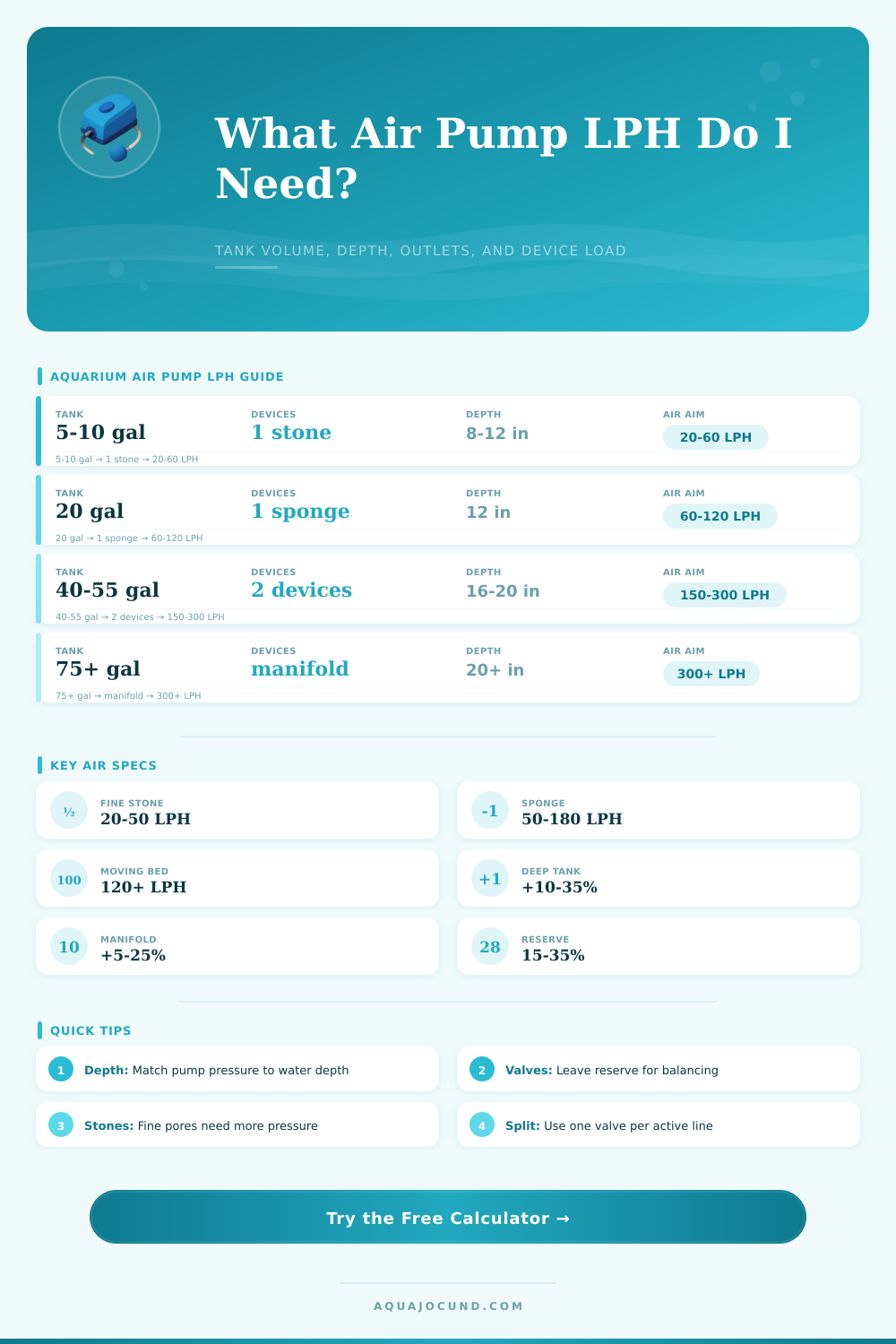
To choose the correct air pump for your aquarium, you have to determine how much air the aquarium require when it is operational. Several factor will play a role in how much air the aquarium requires. These factors include the volume of the aquarium, the depth of the water in the aquarium, the type of devices that use the air from the air pump, and the air that is lost through the airline tubing.
If you choose an air pump that has the correct balance of features, it will provide the necessary air for the aquarium for a long time. If you choose an air pump that does not have the correct balance of features, it will either not provide enough air for the filter in the aquarium or it will struggle to push the water through the airline tubing. The most important measurement for an air pump is the liter per hour of air that it can push.
How to Choose the Right Air Pump for Your Aquarium
This measurement is abbreviated as LPH. Many air pump boxes will indicate the number of liters per hour that the air pump can push in the free air. However, this is not an accurate reading of the performance of the air pump.
The actual performance of the air pump will be less than what is provided for the free air measurement. The actual performance of the air pump will drop again if the air have to pass through air stone or sponge media to reach the aquarium. Because the actual performance of an air pump is lower than what is indicated for the free-air ratings, many people purchases an air pump that is too small for there aquarium tank.
Another important factor to consider when determining the air pump that will best suit the aquarium is the depth of the water. Deeper tank will create more back pressure on the air pump. Fine-pore air stones will also add to the back pressure.
The air pump that works for a shallow tank may not provide the proper air pressure for a deep tank. Air pressure can also be lost in the airline if the airline is too long or if there are many fitting along the line. Friction in the airline will reduce the air that reaches the aquarium.
The same is true for every fitting along the airline to the aquarium. The type of device that you use in the aquarium will impact the amount of air that the air pump must provide. Coarse air stones require less air than sponge filter.
Filters that use moving-bed chamber or deep wands will require a strong and steady air flow in order to function properly. The air pump will have to overcome the back pressure created by all the device but still provide enough air to supply the device with the weakest air line. Air pumps should have some reserve capacity to ensure that all the device receive an adequate amount of air from the air pump.
The calculator included on this page will allow you to calculate the air pump size that you need for your aquarium. All you have to do is enter the dimensions of your aquarium, the types of devices in the aquarium, and the depth of the water. The calculator will apply factor that account for water pressure, friction in the airline, and include a safety margin.
Based off the information that you enter into the calculator, it will provide you the amount of air that will reach your aquarium and the free-air rating for air pumps that will work best in your aquarium. The table provided on this page will allow you to understand the air requirements of most device for your aquarium. These tables can be used to compare your air requirements to other aquariums.
Many people who purchase an air pump for their aquarium make the mistake of choosing one that is based only on the volume of the tank. If you make this mistake, it is possible that the air flow from the air pump will be weak once the air pump and device are installed into the aquarium. You must take into account the depth of the aquarium and the effect that the air restriction have on the air flow from the air pump.
For example, a 100-liter aquarium will require more air to fulfill the needs of a sponge filter than a 100-liter aquarium that contains a deep moving-bed chamber. By calculating the air requirements of your specific aquarium, you can avoid choosing an air pump that is too weak or too large. An air pump that is too large for your aquarium may produce too much noise and may produce too much heat.
Another common mistake that people make when choosing an air pump is to assume that each outlet on a manifold is equal. The device that is located the farthest from the air pump or the one that is the highest above the air pump will receive less air than the others due to the friction and elevation. You must provide the air pump with 15 to 35 percent more air capacity to allow for balancing of the valve so that no device is receiving too little air.
This extra capacity will also ensure that, over time, the air stones dont become clogged with debris in the aquarium. Water temperature can also change how much the air bubble rise in the aquarium. Air pumps are the simplest of device but can be used in the most complex of systems.
The most important measurement of an air pump is the liters per hour at depth. If you understand what the liters per hour at depth measurement mean, you will be able to determine what air pump will best suit the demands of your aquarium. The calculator will allow you to easily and accurately determine the air pump that will work best for your aquarium.