💨 Air Pump Depth Back Pressure Calculator
Estimate water depth pressure, diffuser resistance, airline friction, manifold losses, and pump airflow headroom.
✅ Back Pressure Estimate
| Diffuser Type | Typical Flow Range | Added Resistance | Pressure Pattern |
|---|---|---|---|
| Open airline or riser | 0.3-3.0 L/min | 0.03 psi / 0.2 kPa | Very low device restriction |
| Coarse air stone | 0.5-2.5 L/min | 0.12 psi / 0.8 kPa | Lower resistance, larger bubbles |
| Medium air stone | 0.7-3.5 L/min | 0.20 psi / 1.4 kPa | Common balance of flow and bubble size |
| Fine pore stone | 0.3-1.6 L/min | 0.35 psi / 2.4 kPa | Higher resistance and clog sensitivity |
| Wood air block | 0.5-2.0 L/min | 0.45 psi / 3.1 kPa | Fine bubbles, high cracking load |
| Bubble bar | 1.2-5.0 L/min | 0.18 psi / 1.2 kPa | Benefits from wider branch tubing |
| Membrane disc diffuser | 2.0-10.0 L/min | 0.55 psi / 3.8 kPa | Needs enough pressure to open evenly |
| Weighted diffuser hose | 4.0-20.0 L/min | 0.60 psi / 4.1 kPa | Long run and many pores add resistance |
| Water Depth | Static Pressure | Metric Equivalent | Typical Aquarium Use |
|---|---|---|---|
| 6 in / 15 cm | 0.22 psi | 1.5 kPa | Shallow tray or small bowl aeration |
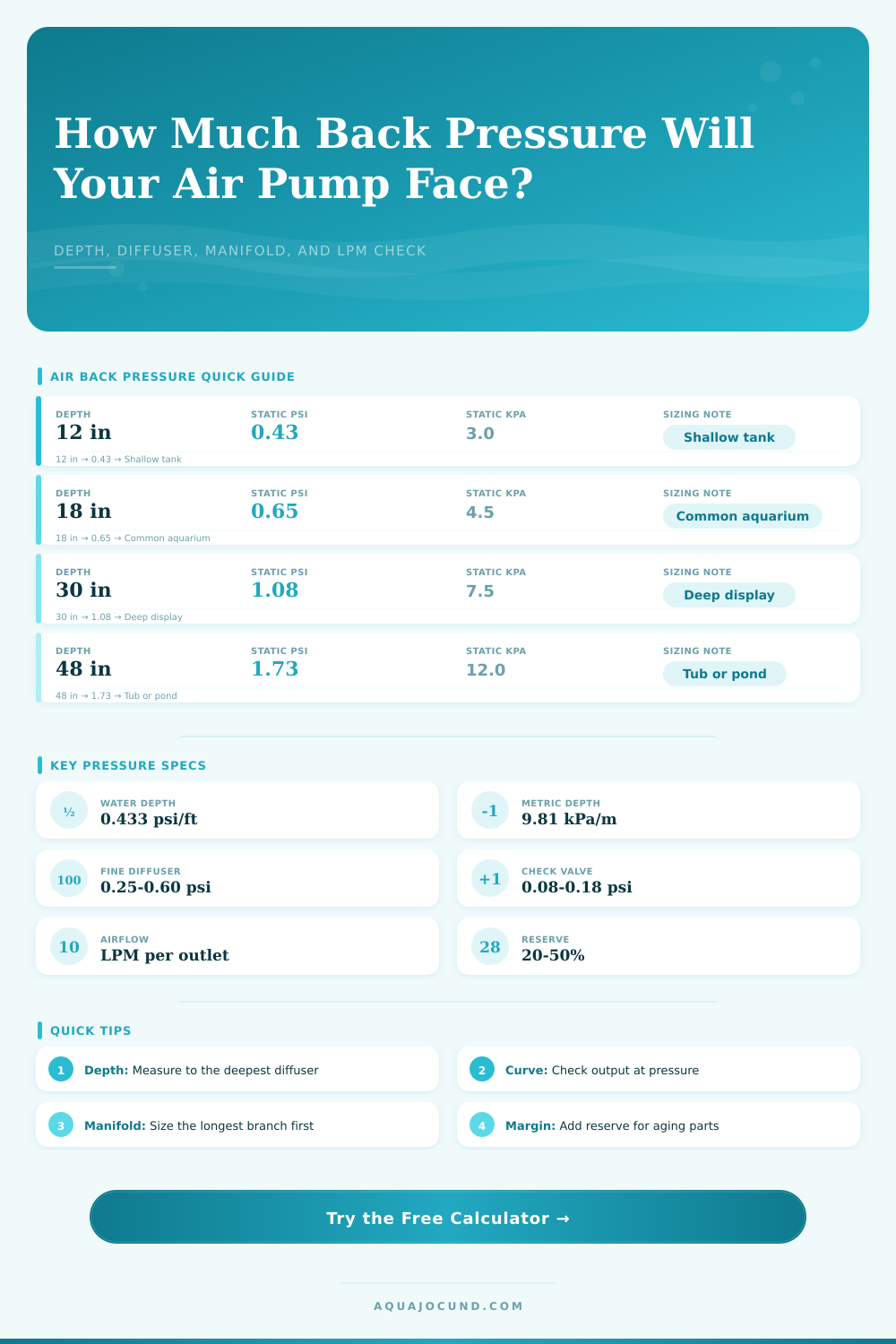
| 12 in / 30 cm | 0.43 psi | 3.0 kPa | Nano and low-profile tanks |
| 18 in / 46 cm | 0.65 psi | 4.5 kPa | Common 20-40 gal displays |
| 24 in / 61 cm | 0.87 psi | 6.0 kPa | Tall displays and many tubs |
| 36 in / 91 cm | 1.30 psi | 9.0 kPa | Deep bins or pond-edge diffusers |
| 48 in / 122 cm | 1.73 psi | 12.0 kPa | Deep tubs and small ponds |
| Airline Size | Inside Diameter | Best Use | Loss Pattern |
|---|---|---|---|
| Micro airline | 1/8 in / 3.2 mm | Very short single outlets | High friction once flow rises |
| Standard airline | 3/16 in / 4.8 mm | Most small tanks and sponge filters | Moderate branch loss |
| Wide airline | 1/4 in / 6.4 mm | Deep tanks or higher branch LPM | Lower loss than standard line |
| Manifold feed | 3/8 in / 9.5 mm | Small racks before valves | Low trunk loss for shared flow |
| Main trunk | 1/2 in / 12.7 mm | Longer manifolds and many ports | Very low friction at aquarium flows |
| Blower trunk | 3/4 in / 19.1 mm | Large room manifolds | Minimal trunk loss, branch valves dominate |
| Setup | Depth Range | Outlets | Typical Total LPM | Pressure To Check |
|---|---|---|---|---|
| 5-10 gal air stone | 8-12 in / 20-30 cm | 1 | 0.5-1.5 L/min | 0.6-1.2 psi |
| 20 gal sponge filter | 10-14 in / 25-36 cm | 1 | 0.8-2.0 L/min | 0.8-1.5 psi |
| 40 breeder split line | 13-16 in / 33-41 cm | 2-3 | 2.0-5.0 L/min | 1.0-2.0 psi |
| 55-75 gal diffuser pair | 18-22 in / 46-56 cm | 2-4 | 4.0-10.0 L/min | 1.4-2.8 psi |
| Rack manifold | 10-20 in / 25-51 cm | 8-24 | 10-45 L/min | 2.0-5.0 psi |
| Pond tub diffuser | 24-48 in / 61-122 cm | 1-6 | 8-60 L/min | 2.5-7.0 psi |
You don’t realize it until you put the stone into the water and find that bubbles are trickling out now instead of pouring. You bought the thing for the liters per minute number on the box. Now you’re wondering what gives?
That’s because free airflow doesn’t matter when under load. It’s not like you’re just blowing air down a tube, it’s water you’re pushing. Water adds pressure with every inch of depth. A pump rated to move five liters per minute in open air won’t deliver that amount at depth where it has to shares water. The rating is a curve and as it rises so too does its drop.
How to Choose the Right Air Pump
All you have to do is input your tank dimensions into the calculator above and let it do the work for you. You don’t have to guess at friction losses. It takes into account cracking pressure required to pop open your diffuser as well as water column pressure against it. It factors in tubing drag plus fitting drag. And yes, there’s a safety factor because diffusers do eventualy get clogged. After six months or so, you may need more pressure with a fine pore stone.
Size the pump too tight and it will fail to provide enough air before tank even breaks in. Resistance is a reason to choose the correct stone. Most pumps will work with a coarse stone which require minimal pressure. However, this also means fewer surface area for bubble gas exchange. Discs made of fine membranes oxygenate better but require consistent pressure. If there isn’t enough pressure to overcome that resistance they’ll lie flat. As the disc ages and wears out, you need extra capacity to keep it working propery.
Airflow is very dependent on tubing diameter. Air, like any other fluid, has viscosity, and narrow tubing causes friction. Using larger diameter tubing eliminates this loss. You can enter various tube sizes into the tool which will show impact. Often it’s more economical to upgrade your tubing rather than purchasing a new pump.
Complicating things is the addition of manifolds. With multiple ports branching off a single line, you now have furthest port fighting against distance and all the other ports. The calculator asks for your longest run and number of ports so you can size for the worst-case scenario. Size for the farthest, deepest port. Usually if the most difficult gets air, so do the rest. Without power they won’t back-flow due to check valves. These valves also add a bit of resistance. Although flow isn’t hurt much with one or two valve, many can slow things down. It is a tradeoff between safety and performance. Pressure cost for these fittings is captured in the tool. There’s space to track them so you can visualy see what the pressure cost will be.
Balance is key. You want enough bubble action to keep the water aerated without wasting energy. Back pressure lets the set-up get precise. Knowing exactly how much air reaches bottom is a confidence that fosters a thriving ecosystem.