🐟 Actual Water Volume Calculator Aquarium
Estimate true display and system water after air gap, substrate, rock, equipment, sump section water, and dosing reserve.
💧 Actual Water Volume Results
| Material | Solid Fraction | Void Water | Best Use | Notes |
|---|---|---|---|---|
| Bare bottom | 0.00 | 100% | Hospital or fry tanks | No substrate displacement |
| Fine sand | 0.46 | 54% | Freshwater and planted | Compacts more than gravel |
| Rounded gravel | 0.38 | 62% | Community tanks | More water remains in voids |
| Aquasoil | 0.42 | 58% | Planted aquascapes | Light granules vary by brand |
| Crushed coral | 0.44 | 56% | Reef or hardwater tanks | Irregular pieces trap water |
| Deep sand bed | 0.48 | 52% | Refugium or reef bed | Depth makes the loss notable |
| Planted soil mix | 0.40 | 60% | Dirted planted tanks | Layering changes the average |
| Coarse pebble | 0.34 | 66% | Cichlid or river layouts | Large gaps hold more water |
| Hardscape | Estimate | Porosity | Example | Calculator Use |
|---|---|---|---|---|
| Porous live rock | 14 lb/gal | High | Reef structure | Less displacement per pound |
| Dry reef rock | 16 lb/gal | Medium high | Reef arches | Good default for reef tanks |
| Dragon stone | 15 lb/gal | Medium high | Planted aquascape | Open texture traps water |
| Seiryu stone | 22 lb/gal | Low | Iwagumi layout | Dense stone displaces more |
| Lava rock | 12 lb/gal | Very high | Filter or scape base | Light rock displaces less |
| Slate | 23 lb/gal | Low | Caves and shelves | Dense plates displace more |
| Dense river stone | 22 lb/gal | Low | Cichlid rockwork | Close to solid mineral rock |
| Waterlogged wood | 8 lb/gal | Variable | Driftwood | Use direct volume if possible |
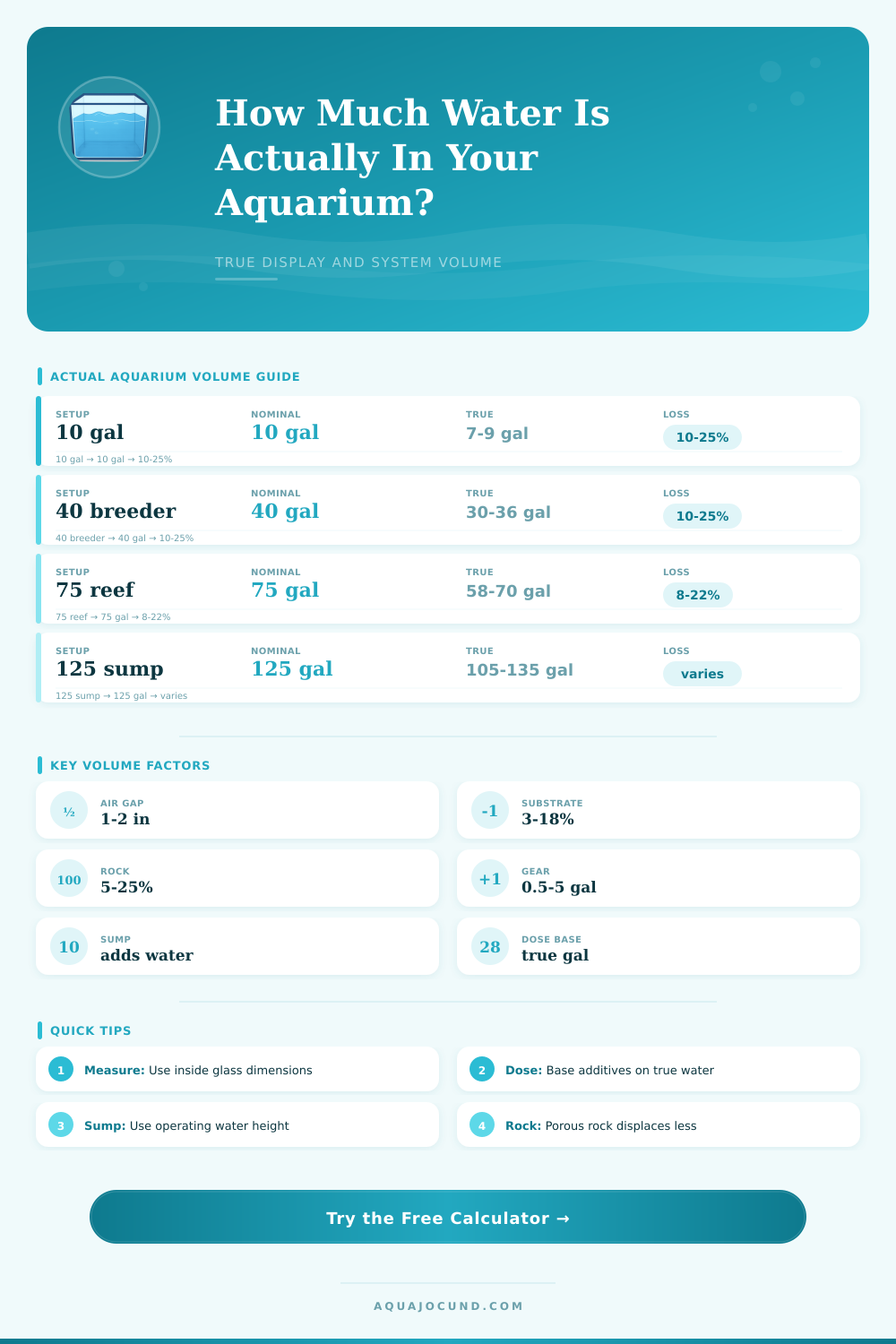
| Tank | Inside Size | Nominal | Typical True Display | With Sump |
|---|---|---|---|---|
| 10 gallon | 20 x 10 x 12 in | 10 gal | 7.5-9 gal | Usually none |
| 20 long | 30 x 12 x 12 in | 20 gal | 15-18 gal | Usually none |
| 40 breeder | 36 x 18 x 16 in | 40 gal | 30-36 gal | 40-55 gal system |
| 55 gallon | 48 x 13 x 21 in | 55 gal | 43-50 gal | 55-75 gal system |
| 75 gallon | 48 x 18 x 21 in | 75 gal | 58-70 gal | 75-100 gal system |
| 125 gallon | 72 x 18 x 23 in | 125 gal | 100-115 gal | 125-160 gal system |
| Use Case | Best Volume Basis | Reserve | Why It Matters | Common Mistake |
|---|---|---|---|---|
| Water conditioner | New water volume | 0-5% | Treats refill water | Dosing full tank for small changes |
| Medication | True system water | Subtract 5% | Prevents overdosing | Using printed tank size |
| Fertilizer | True display water | Best estimate | Targets ppm in display | Ignoring substrate and rock |
| Salt adjustment | True system water | Subtract 5% | Salinity shifts fast | Forgetting sump water |
| Trace elements | True system water | Best estimate | Includes sump and refugium | Using display only on reef tanks |
The 40 gallon breeders is rated for 40 gallons right? Wrong.
You bought a 40 gallon breeder, filled it with sand and rock and tossed in some algae supplement. A couple of days later, your parameters go haywire. Your fish look stressed. The manufacturer’s rating prove to be misleading. The manufacturer rates the tank based off its total internal volume (up to the top rim). They don’t take into account the live rock, the gravel, the air gap you left above water line to prevent splashing, or the fact that you stashed that huge canister filter in the back corner.
The Real Size of Your Tank
Bottom line: the amount of water you have is far less different than what you paid for. Nominal tank size is nice, a handy round number that never varies. It’s become sort of the rule for most hobbyist. But the truth is far less tidy. A so-called 10 gallon tank may contain only 7 gallons of water you can actualy treat after accounting for displacement. A big reef set up with a sump has half its water tucked away behind some drywall cabinet and can prove difficult to do accurately.
The calculator above do all that math for you. It takes the physical dimensions and converts them into an actual gallon count, one that matches how your body works. That makes a difference if you’re adding salt or medications, rather than purchasing fish food. Overdosing based on a conservative estimate is dangerous. Under-dosing by erring on the low side will keep everyone alive.
The air gap is probably the biggest cause of volume loss. I’m sure we’ve all got a few inches (or more) at the top of our glass to prevent the occasional inquisitive catfish from jumping out of our tanks and onto our carpets. That extra space is nothing but lost volume, and before you put one grain of substrate down on the bottom, that dead space is gone.
Next, let’s look at the gravel or sand substrate. If you use substrate, you’re probably pouring five gallons of gravel on the floor of the tank and assuming you just lost five gallons of water capacity. People make this mistake because most substrates is porous materials, meaning that water will fill the spaces between grains. This will compact into a tight layer that has less space to hold water compared to round river stones and the reference table on the page shows just how much actual mineral you have vs. How much of the substrate depth are filled with water.
Another twist involves the hardscape, where displacement depends entirely on material density. Live rock in a reef aquarium have plenty of nooks and crannies. Denser rocks like slate and Seiryu stone displace much more water than the same amount of porous live rock. For example, if you have a ten pound piece of a dense rock (which occupies some volume), it will displace much more water then a ten pound piece of live rock (also occupying some volume, albeit with lots of holes).
When constructing an aquascape with heavier rock, do you want to know how much space your stone occupy (whether it’s behaving more like a sponge or a solid block)? This distinction can mean avoiding an overdose of your fertilizers simply due to assuming your aquascape has taken up more space than it realy has.
You don’t usually consider equipment either, but overflow boxes, sponges filters, power heads, and heaters all hang out in the water column. All of them displace the same amount of water as rock and are, well, solid objects! So if you have multiple skimmer and return pump intakes and lots of tech in your tank, you may be losing a half gallon or more just to equipment. A five percent dosing error on any trace element can mean disaster for a sensitive coral system, though it may not seem important at first.
Next up is the sump. This is where things get a bit difficult for most people and where math comes into play. The sump contain water that is part of the overall system volume but not contained within the display. So, if you’re managing salinity or medicating, the sump is equally important as the primary tank. But, water displacement due to skimmer socks, media bags, and filter floss can reduce the actual amount of water in your sump, plus there may be sections dedicated solely to refugiums that consist of nothing but plants, which do not contribute to total dosing base (i.e., you have a 3 gallon section of the sump dedicated solely to plants).
Once calculated, using a tool, you have one solid number to work with, just plug in your rock weight, your substrate depth and type, your air gap height, etc. Then you get a number you can use as a conservative starting point for how much water to change and how much chemical to add. No more guessing at maintenance. Instead of relying on a sticker price that ignores physics, you start treating based on what is actualy in the glass.
And THAT is the difference between having a stable tank vs constantly needing to put out an emergency fire. You still get the forty-gallon tank; now you know you’re actually keeping thirty-five gallons of life.