📏 Acrylic Sheet Weight Calculator
Estimate aquarium acrylic panel weight from sheet size, thickness, count, cast or extruded density, cutouts, brace strips, waste, and protective film allowance.
| Acrylic type | Typical density | Best calculator use | Weight note |
|---|---|---|---|
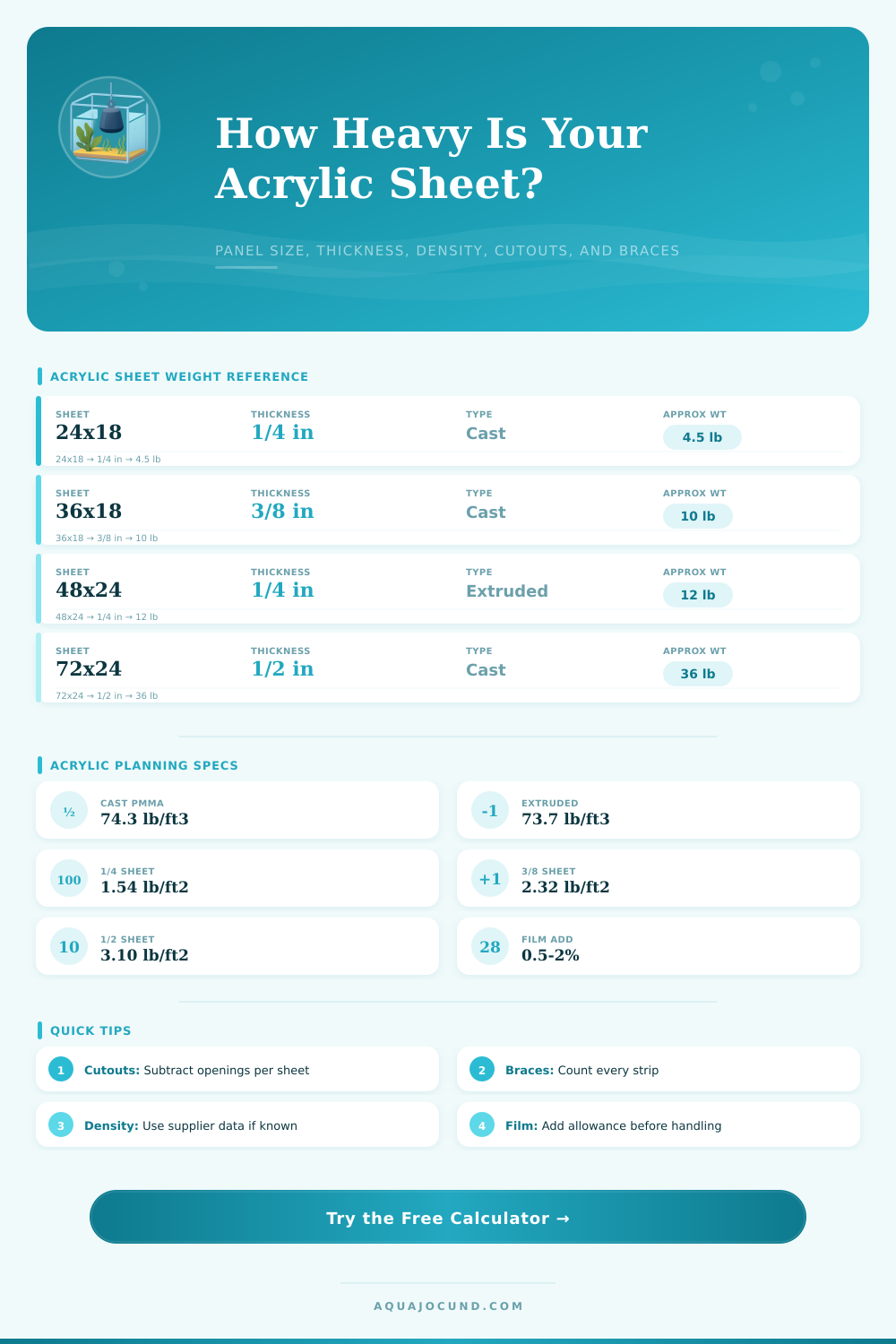
| Cell-cast PMMA | 1.19 g/cm³ / 74.3 lb/ft³ | Display panels, lids, machined parts | Good default for aquarium acrylic. |
| Extruded PMMA | 1.18 g/cm³ / 73.7 lb/ft³ | Simple covers, dividers, splash guards | Slightly lighter than cast. |
| Aquarium grade cast | 1.19 g/cm³ / 74.3 lb/ft³ | Thicker structural panels and bracing | Use supplier specs for large tanks. |
| Impact-modified acrylic | 1.15 g/cm³ / 71.8 lb/ft³ | Rack shelves and covers needing toughness | Usually a little lighter. |
| Colored or opaque acrylic | 1.20 g/cm³ / 74.9 lb/ft³ | Backgrounds, dividers, light shields | Pigments can shift density. |
| Piece | Typical size | Thickness | Approx cast weight |
|---|---|---|---|
| Nano lid panel | 20 x 10 in / 51 x 25 cm | 1/8 in / 3 mm | About 1.1 lb / 0.5 kg |
| 20 long baffle | 12 x 11 in / 30 x 28 cm | 1/4 in / 6 mm | About 1.4 lb / 0.6 kg |
| 40 breeder lid half | 36 x 9 in / 91 x 23 cm | 1/4 in / 6 mm | About 3.5 lb / 1.6 kg |
| 75 gallon brace strip | 48 x 2 in / 122 x 5 cm | 3/8 in / 10 mm | About 1.5 lb / 0.7 kg |
| Large access cover | 24 x 18 in / 61 x 46 cm | 3/8 in / 10 mm | About 7.0 lb / 3.2 kg |
| Thickness | Cast acrylic | Extruded acrylic | Use in calculator |
|---|---|---|---|
| 1/8 in / 3 mm | 0.77 lb/ft² | 0.77 lb/ft² | Lids, splash guards, templates. |
| 1/4 in / 6 mm | 1.55 lb/ft² | 1.54 lb/ft² | Small panels, baffles, covers. |
| 3/8 in / 10 mm | 2.32 lb/ft² | 2.30 lb/ft² | Stiffer baffles and braces. |
| 1/2 in / 12 mm | 3.10 lb/ft² | 3.07 lb/ft² | Large lids and display pieces. |
| 3/4 in / 19 mm | 4.64 lb/ft² | 4.60 lb/ft² | Heavy structural acrylic. |
| Adjustment | Calculator treatment | When to use | Practical note |
|---|---|---|---|
| Rectangular cutout | Length x width removed | Overflows, feeding doors, cable ports | Enter cutouts per sheet. |
| Round hole | Pi x radius squared removed | Bulkheads, cords, plumbing | Use diameter in the length field. |
| Rounded slot | Rectangle plus end radius estimate | Hinges, pump cords, skimmer slots | Use overall slot length and width. |
| Brace strip | Separate strip volume added | Eurobracing, lids, sump supports | Count strips in addition to panels. |
| Protective film | Percent weight allowance added | Handling and transport estimate | Remove film before final installed weight if needed. |
When you first try to pick up a piece of acrylic to build your own aquarium, it’s a shock. You’re thinking it will be light, maybe like glass but even lighter weight to handle. So you go to grab a 1/4 inch thick panel…and your arms is lifting the weight. That’s what this calculator is for. If you don’t know how much a material will weigh before cutting and counting all your pieces, you will regret it later. You’ll wish you had known when you go to ship it or when it breaks because you didn’t have enough support framing.
The calculator predicts what you will experience before it happens. Based off the size, thickness, quantity, and density of whatever you are using, it will calculate weight so you can anticipate the load on your framework.
Why You Should Know the Weight of Acrylic Before You Start
What most folks don’t know about acrylic is that it weighs much more then they think. Sure, it floats on water (hence its popularity with aquarium makers who may have leaks), but raw stock is heavy as all get out if you’re cutting panels of it. Though weight isn’t necessarily a factor, optical clarity and the manufacturing process; such as cell cast versus extruded, are usually what differentiate one type of acrylic from another.
Density matters because even slight differences add up. Depending upon the brand, cast acrylic runs about seventy-four pounds per cubic foot; extruded acrylic is just a bit less. On paper, that doesn’t sound like a lot, until you consider that display wall we’re talking about is a four-foot high piece. And then you do the math and figure out what kind of load that represents when you hoist it through a doorway. It is a little thing, yes. But it makes a big difference when you consider lifting that sheet across the threshold.
It’s also important to consider what isn’t in the sheet. Maybe you need circular holes for plumbing, rectangular ports for pumps or heaters etc. You can cut those out using the tool and it will subtract weight of them. In other words, the theoretical weight of a plain square sheet is not representative of a real world sump divider with 6 holes drilled through it and an edge profile routed into it. Removing that material allows you to get a closer approximation of how much you’ll actualy be lifting.
Adding brace strips can make a massive difference too. Long horizontal supports (Euro-brace) used in a Euro braced tank adds several pounds per strip. When you’re buying multiple panels as part of a complete build, those panel weights will add up quickly.
There’s one more thing that people frequently overlook, and then run into trouble with: protective film. You know, the super-thin plastic that sticks to either side of the sheet? Yeah, it only adds a fraction of a percent to the overall weight, but it does change how the material handles and its sliding properties. Again, the calculator has allowances for the film as well as edge trimming waste. You’re going to lose some material when you drill precise holes or rout out edges. By factoring in that waste, you know that your final number will be enough to cover what you need, not the hypothetical shape of what the completed part might look like. No more “oh crap I didn’t account for leaving myself any leftover material to correct mistakes” moments.
The biggest practical issue tends to be shipping. Either way… Whether dimensional weight or actual weight, carriers will charge for whichever is greatest. By knowing exactly how much your crate weighs, you can get accurate quotes in advance without any post-shipping surprises. This also helps you decide how to pack it. If you’re packing a heavy sheet, you’ll need stiffer blocking to keep it from bowing on the trip. Do you have what it takes to haul it up a flight of stairs yourself? Or are you going to need a dolly and an assistant? Knowing the number not only tells you the number but also tells you something about how you’ll move your project from factory to home.
In the end though, weight planning is about more than feasibility, it’s about safety. It takes those unseen dimensions and makes them real. It turns the inches into pounds you feel instead of see. When you’ve got exact weights in mind, you can make better plans for stands, select the proper lifting equipment and order the right amount of material without waste. Those numbers on the screen aren’t just hints; they’re an indication of all the work yet to come. If you get them correct up front you should of saved yourself some time down the road. That surprise panel that caught you off guard is easier to handle if you account for its weight at the beginning.