🧪 Acriflavine Dose Calculator
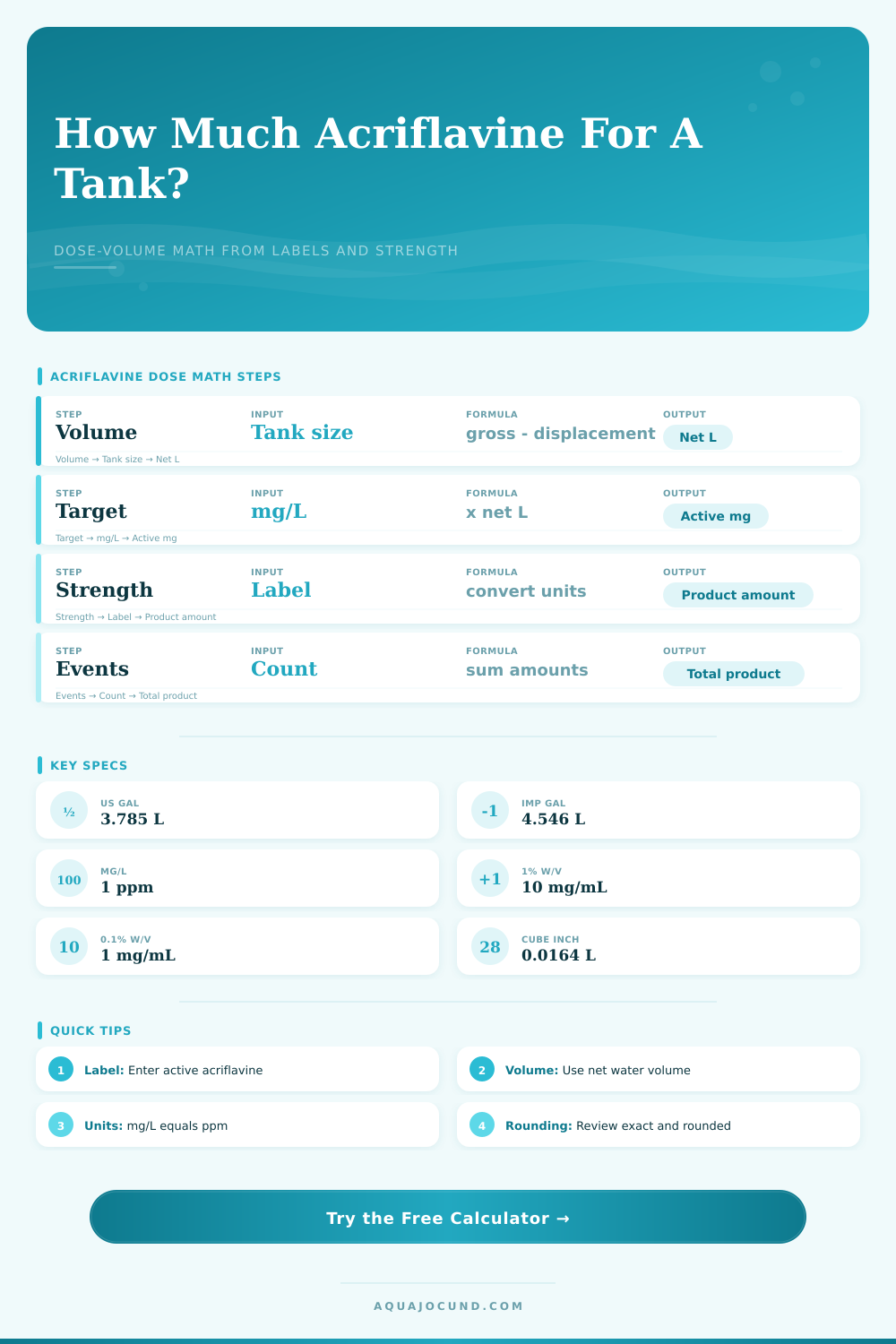
Convert tank volume, label concentration, active acriflavine strength, displacement, and event counts into neutral dose-volume arithmetic.
| Format | Strength field means | Product amount formula | Output unit |
|---|---|---|---|
| Liquid mg/mL | mg active acriflavine per mL | Active mg / mg per mL | mL |
| Liquid percent w/v | Percent weight per volume | Percent x 10 = mg per mL | mL |
| Dry powder percent | Percent active by weight | Active mg / percent decimal / 1000 | g |
| Dry blend mg/g | mg active acriflavine per gram | Active mg / mg per gram | g |
| Tablet or packet | mg active acriflavine in each unit | Active mg / mg per piece | piece count |
| Tank name | Nominal dimensions | Nominal volume | Active mg at 1 mg/L |
|---|---|---|---|
| 5.5 gallon | 16 in x 8 in x 10 in / 41 x 20 x 25 cm | 5.5 gal / 20.8 L | 20.8 mg before displacement |
| 10 gallon | 20 in x 10 in x 12 in / 51 x 25 x 30 cm | 10 gal / 37.9 L | 37.9 mg before displacement |
| 20 long | 30 in x 12 in x 12 in / 76 x 30 x 30 cm | 20 gal / 75.7 L | 75.7 mg before displacement |
| 29 gallon | 30 in x 12 in x 18 in / 76 x 30 x 46 cm | 29 gal / 109.8 L | 109.8 mg before displacement |
| 40 breeder | 36 in x 18 in x 16 in / 91 x 46 x 41 cm | 40 gal / 151.4 L | 151.4 mg before displacement |
| 55 gallon | 48 in x 13 in x 21 in / 122 x 33 x 53 cm | 55 gal / 208.2 L | 208.2 mg before displacement |
| Conversion | Exact or standard factor | Used for | Calculator note |
|---|---|---|---|
| US gallon to liter | 1 gal = 3.785411784 L | Volume conversion | All dose math uses liters internally |
| Imperial gallon to liter | 1 imp gal = 4.54609 L | Reference comparison | Inputs use US gallons unless metric is selected |
| Cubic inch to US gallon | 231 in³ = 1 US gal | Dimension volume | Rectangles and cubes use this factor |
| Cubic centimeter to liter | 1000 cm³ = 1 L | Metric dimension volume | Metric dimensions convert directly to liters |
| mg/L to ppm | 1 mg/L = 1 ppm in water | Target entry | Displayed as concentration arithmetic only |
While acriflavine was used as wound disinfectant in human medicine, it’s also commonly applied to aquariums for treatment of external parasites and fungal problems on fish. It works, but everything that comes into contact with acriflavine will turn a brilliant yellow! That makes accuracy even more important then with other medications that are less colored or clear. Unlike those, you can’t just go pouring it in until your water takes on a slight tinge. Since the decor, filter media, and even substrate will soak up some of this substance, there is no reliable link between how intensely yellow the water is and its actual concentration.
Dosing accurately is always part of a proper treatment plan. The core challenge with any aquarium medication are knowing how much actual water is in the tank. This is the heart of the issue with medicating an aquarium. Aquarium manufacturers rate their tanks at their maximum capacity. That means they include volume of all the glass. They also include the empty space above the waterline and the rock and equipment displacing water. Sure, your 20 gallon long has a capacity of 20 gallons but if you fill that up with a filter and some substrate, you don’t actualy have 20 gallons of water in there. Maybe you’ve got just 14 or 15 gallons of actual water volume.
How to Dose Acriflavine Correctly
When you dose according to the label assuming 20 gallons of water, you’ll dose below the recommended dosing and may end up with an ineffective dose of medication against the germ you’re attempting to remove from the tank. By plugging in your tank’s dimensions along with your best estimate of what is displaced, the calculator above do the math for you so you don’t have to guess how much empty space is in your tank.
The variable that most hobbyists overlook are displacement. Substrate and decor displace water, reducing volume available for medication, but substrate retains water and is also porous. However, substrate takes up some of the volume where medication can circulate. Decorations do too. Ceramic rings, sponges, and other equipment used in treating tanks displace volume as well. Your net water volume might be considerably less than the rated value if you have a lot of gravel and/or plants. Accounting for this discrepancy will result in the correct therapeutic level of the drug being reached in the water column. A simple calculation, but it’s the difference between curing something and wasting a product.
The strength of labels varies from product to product. Some come as tablets, some as powder and some as concentrated liquid. Regardless, the active ingredient (acriflavine) stays the same, but what differs is the carrier substance that affects the dosage calculation. A 1% by weight/volume solution equals ten milligrams of active ingredient per milliliter. A 10% solution equals one hundred milligrams per milliliter. These two numbers are easily confused resulting in a ten-fold dosing mistake… Potentially harmful to sensitive fish species.
Never assume you know what’s in the bottle, always read the label for the actual concentration of the active acriflavine ingredient, not just name of the product. This is explained simply with a reference table on the page showing conversion of different formats to standard units of milligrams per liter.
After you’ve determined the strength (dose) and volume (amount), it’s time to determine the dosing regimen. Is it once and done? Or are multiple doses helpful to keep the medicine at a steady level longer, since it will be processed or broken down over time? Remember, changing the water will also remove any meds. So with every water change you’ll have to recalculate. For example, if you change 25% of your tank water then you lost 25% of the active drug in the tank. Replenish what was removed to retain the drug concentration. Failure to account for this dynamic will cause the effectiveness to slowly decrease until the parasite/fungus has had time to rebound.
Acriflavine stains everything it touches. That’s unavoidable. Anything it comes into contact with will turn yellow. It will stain your decorations and even your tank walls yellow. The yellow doesn’t go away overnight either. Depending on how long it takes to clean it up (see below), it could take several weeks for the yellow tint to fade from the decorations and off the glass. While it won’t do any harm to your fish, it certainly makes the treatment more obtrusive visually.
To help eliminate both the yellow color and the medication itself from the water column, use activated carbon in your filter. If you want to be able to see through your tank again, this is a good way to do so. The warning here is that running the carbon too soon reduces length of time the medication remains effective. This could potentially shorten the treatment window below what is needed for efficacy. You are balancing wanting to see your tank again with maintaining the contact time between the pathogen and the medication.
This is the bottom line. Using acriflavine is a valid treatment option, though you should of know what to expect when you use it. I wouldn’t hesitate to reach for some acriflavine if I suspected my fish had fungal issues or external parasites. Because acriflavine requires precise dosing, it can be a great addition to your fishkeeping toolkit.
Accurate dosing is also an issue of respect for the biology of the tank. There are limitations for both medications and fish. Dosing below the threshold doesn’t solve anything. Dosing above the threshold can do more harm than good, either to the fish themselves or to the beneficial bacteria in the filter. Dosing should be as close to the sweet spot as possible, which minimizes impact on the host but still suppresses the pathogen. Getting there requires accurate measurement of the volume, proper interpretation of labels, and thoughtful timing.
It’s less about “following the recipe” and more about knowing what factors can modify the result. Treating the water like you treat the fish generally gets better results. The yellow might go away, but the long-term sign that it was a job well done comes from the health of the tank.