Plant Trimming Frequency Calculator
Estimate aquarium plant trim timing from plant type, growth conditions, height gap, biomass load, and your preferred maintenance style.
🌿Trimming Presets
📐Tank, Plant, and Maintenance Inputs
Plant Trimming Schedule
🌱Stem, Carpet, and Epiphyte Comparison
📊Plant Type Growth Reference
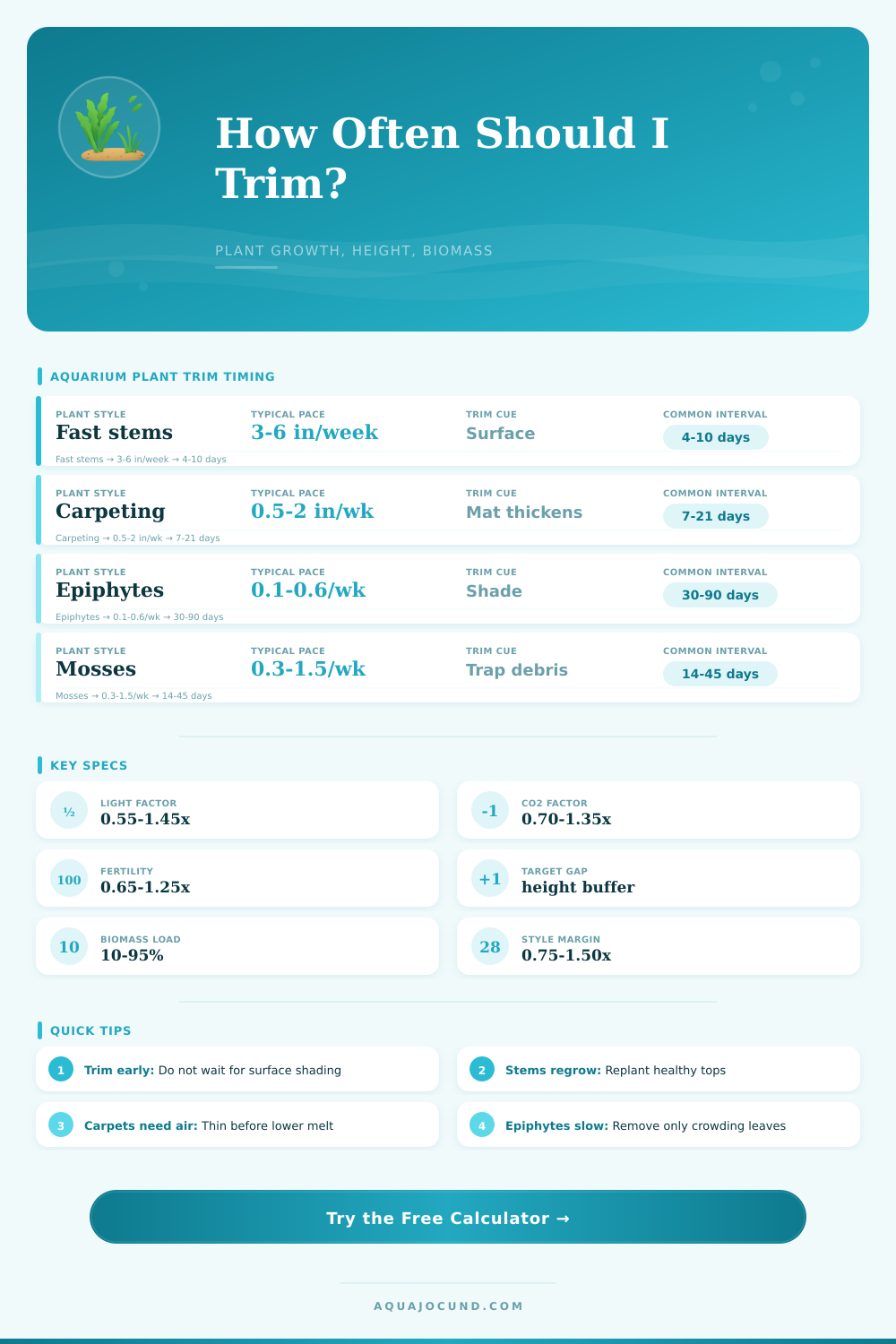
| Plant type | Base weekly growth | Trim behavior | Best timing cue |
|---|---|---|---|
| Fast stems | 5-10 cm / 2-4 in | Top, replant, or shape groups | Before shaded lower leaves decline |
| Moderate stems | 2.5-6 cm / 1-2.4 in | Shape tops and remove weak bases | When crowns close the planned gap |
| Slow stems | 1-3 cm / 0.4-1.2 in | Light tip pruning | When outlines blur or block flow |
| Carpets | 1-4 cm / 0.4-1.6 in | Mow high spots and thin mats | Before lower layers yellow or lift |
| Floaters | 5-15 cm spread weekly | Scoop excess coverage | When surface cover passes target |
| Epiphytes | 0.3-1.2 cm / 0.1-0.5 in | Remove old leaves and rhizome creep | When leaves shade neighbors |
| Mosses | 1-3.5 cm / 0.4-1.4 in | Shear surface and siphon fragments | When pads trap debris or detach |
| Rosettes | 1-4 cm / 0.4-1.6 in | Remove outer leaves and runners | When leaves hit glass or shade floor |
⚙Condition Factors Used
| Input | Low range | Middle range | High range |
|---|---|---|---|
| Light intensity | 0.55x low light | 1.00x medium light | 1.45x very high light |
| CO2 support | 0.70x no gas CO2 | 1.05x low gas CO2 | 1.35x high stable CO2 |
| Fertility | 0.65x lean dosing | 1.00x balanced dosing | 1.25x rich soil and dosing |
| Maintenance style | 0.75x show-tank timing | 1.00x balanced timing | 1.50x low-intervention timing |
📏Common Tank Starting Points
| Tank size | Dimensions | Typical plant footprint | Starting trim rhythm |
|---|---|---|---|
| 10 gallon | 20 x 10 x 12 in / 51 x 25 x 30 cm | 120-170 sq in / 775-1100 sq cm | Weekly for fast stems, monthly for slow plants |
| 20 long | 30 x 12 x 12 in / 76 x 30 x 30 cm | 200-300 sq in / 1290-1940 sq cm | 7-14 days for dense stem beds |
| 40 breeder | 36 x 18 x 16 in / 91 x 46 x 41 cm | 390-550 sq in / 2520-3550 sq cm | 10-21 days for mixed aquascapes |
| 55 gallon | 48 x 13 x 21 in / 122 x 33 x 53 cm | 370-520 sq in / 2390-3350 sq cm | Weekly tops if stems reach the surface |
| 75 gallon | 48 x 18 x 21 in / 122 x 46 x 53 cm | 520-720 sq in / 3350-4650 sq cm | 10-18 days in high light CO2 layouts |
| 120 gallon | 48 x 24 x 24 in / 122 x 61 x 61 cm | 690-980 sq in / 4450-6320 sq cm | 14-30 days unless stems are dominant |
✂Trim Style Reference
| Style | Schedule bias | Common removal | Use when |
|---|---|---|---|
| Show tank crisp lines | Early, before contact | 15-25% of height | Plant groups need clean terraces |
| Balanced planted display | Moderate buffer | 20-35% of height | Growth should look full but controlled |
| Natural loose growth | Later, fuller groups | 25-45% of height | Soft outlines and shaded retreats are desired |
| Low-intervention layout | Longest interval | 30-50% of height | Slow plants dominate and biomass is stable |
When you first envision your aquarium, you picture it being well planted; the lush carpet of Cryptocoryne curling around the hardscape, and those towering stem plants providing some sense of depth in the background. So you buy the plants, put them into the aquarium, fill up the tank with water, and wait. Soon (usually two weeks), your stems is touching the glass surface. Another week goes by and they break through, casting shadows on anything beneath them as the lower leaves yellow and rot off.
Before long, you learn that keeping an aquascape isn’t so much about planting and forgetting but rather constantly pruning. Instead of reacting to the mess, it’s a game of anticipating it. Unfortunately, most hobbyists don’t pick up scissors until the plants look messy. This not only affects the look but also the health of your plant.
How Often to Trim Your Aquarium Plants
This page helps you anticipate when the mess will occur so that you can stay ahead of it. How often to trim stems depends on the math. More specifically, it’s about growth pressure. It is not the “vacuum” growth rate (how quickly that species grows on its own). But rather how quickly your fish plants grow given the interaction between water temperature, water changes, nutrient dosing schedule, carbon dioxide injection regime, and light source strength/intensity.
For example, Hygrophila corymbosa (a common stem plant) may grow very slow when grown under low-intensity LED lights without any gas exchange support. In contrast, the exact same plant will shoot upwards in days when growing under very bright light with high flow CO2 pumping. These factors change the base growth rate a lot and must be considered.
The calculator assumes your observed growth rate and then multiplies it by a series of factors based off your tank conditions. Run moderate light + lean dosing? The system reduces the projected time. Intense photoperiods + rich soil columns? It increases the time. Why does this matter? Because basing guesswork on the mean from information found online tends to result in either overgrown tanks OR overly-frequent haircut sessions.
Both growth rates and height targets dictate the schedule. How high do you want your plants to grow? You need to know that before you start cutting. If you set your trigger height a little below water surface level, your stems won’t ever obstruct the light from hitting the nodes below. Shading those lower leaves makes them melt down, forming waste that feeds algal blooms.
Also knowing your desired height after trimming lets you know how much you’ll be cutting off. The more deeply you prune, the harder it is for the plant to just shoot up blindly; instead it must expend energy growing good solid basal shoots. By comparing your starting height to your desired end height, the calculator can figure out how many days of growth are needed to fill that gap. No more feeling rushed, it tells you with precision how long until you’re at that point.
The care also depends on plant type, how much work it takes to keep it looking good. Stem plants demand topping off (removing the top) and sometimes re-planting because they stretch otherwise and make the tank look sparse. Carpet plants must be thinned so that bottom layers aren’t starved of light & air. Epiphytic plants such as Java Ferns or Anubias grow slow but their outer leaves eventually block light from underneath if not trimmed once in awhile. Mosses form tight structures that hold lots of detritus, so they has to get sheared regularly to retain color.
This table below breaks them down by behavior so you know why carpeting plants may need frequent intervention while a clump of Anubias never sees a cut for months. Understanding the distinction allows you to target your weekend maintenance accordingly. You don’t want to spend an hour pruning one species only to realize there’s another that’s screaming for attention this very moment.
What about the other inputs? Many people forget one important factor (biomass density). Ninety percent coverage in a tank produces much more organic waste compared to thirty percent coverage in a sparsely planted tank. More biomass means nutrients is consumed faster and decomposing matter builds up more quickly after each trim. Take a moment to look at your calculator. Is it showing high clipping volume? Splitting the task into two shorter periods may be wise.
Shocking your filtration system’s bacterial balance by removing excessive amounts of plant matter at one time will lead to temporary ammonia spikes. Plus, it messes up water flow patterns (which certain plants depend on for nutrient uptake). Build a safety margin into your trimming schedule so you have a few days of wiggle room. This keeps the lines crisp and ensures no single plant take over the space.
In summary: Trimming is a balance between providing enough light to support plant growth and reducing waste production. Pruning the excess helps the remaining parts thrive. Take this as a guide but don’t treat it like a hard rule. Observe your tank closely after each maintenance session. Are they growing slower than expected even under best conditions? Maybe recheck your water parameters or maybe turn off your lights sooner if they are on longer then necessary. Did they go crazy and outgrow their space? Make sure you aren’t over-dosing with too much of the wrong kind of food for them, i.e. Algae-promoting fertilizers vs. Use a fertilizer that actualy grows healthy plant tissue.
Once you learn how to get along with your set up, your trim schedule will become naturaly second-nature. Do not be afraid to start slow, keep records, and let the information dictate which way your hand should of go. Always remember that it’s all about having a happy, well-balanced ecosystem where you have healthy plants that make not only your fish happy, but also you. Maintain a regular schedule and keep those cutters clean!