📐 Triangular Pond Volume Calculator
Calculate the exact volume of your triangular pond in gallons or liters — includes liner sizing, stocking capacity & pump recommendations
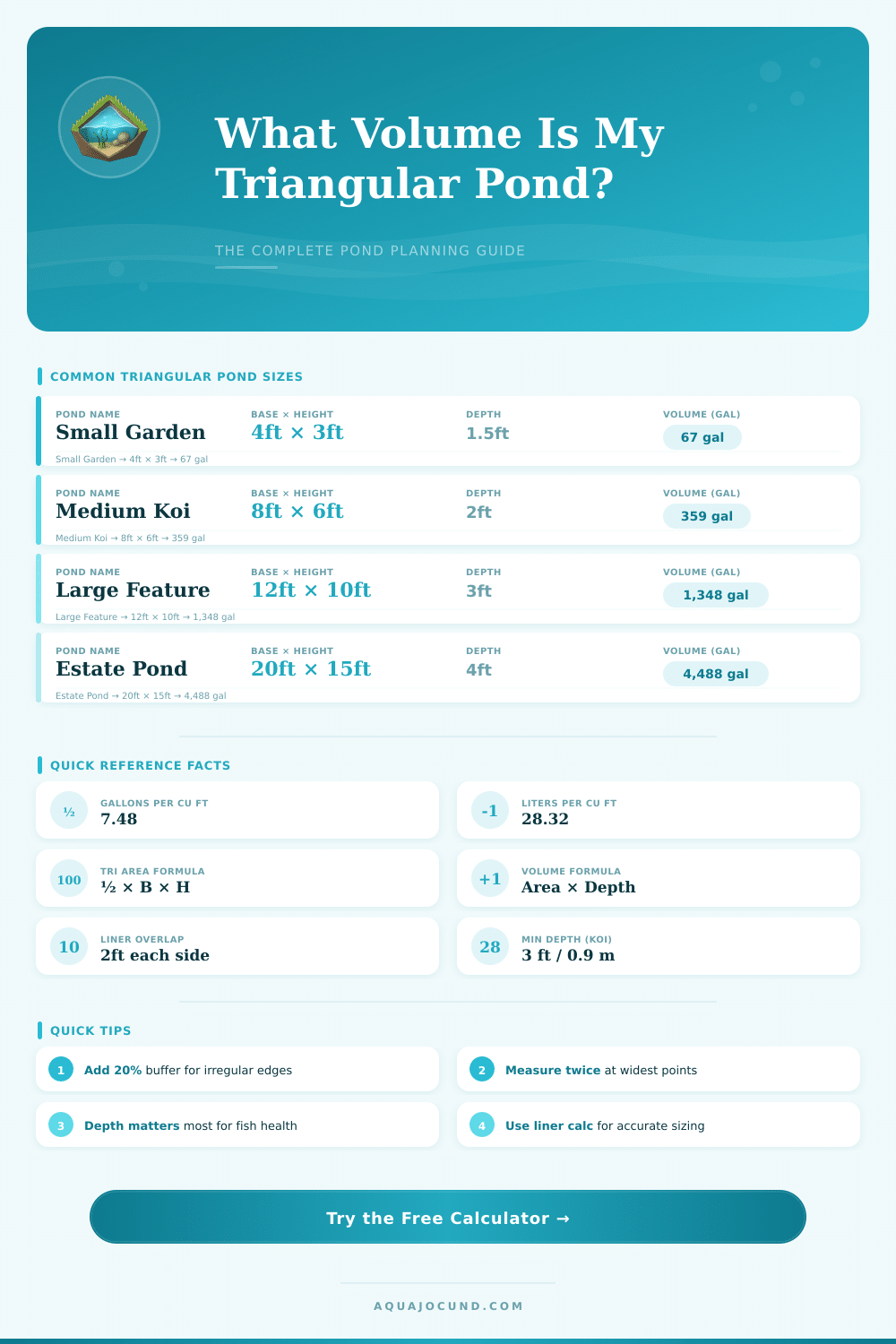
| Pond Name | Base x Width (ft) | Depth (ft) | Volume (gal) | Volume (L) | Liner Size Approx |
|---|---|---|---|---|---|
| Patio Mini | 3 x 2.5 | 1.0 | 28 | 106 | 7 x 5.5 ft |
| Small Garden | 4 x 3 | 1.5 | 67 | 255 | 9 x 8 ft |
| Goldfish Starter | 6 x 4 | 2.0 | 179 | 678 | 12 x 10 ft |
| Medium Koi | 8 x 6 | 2.5 | 449 | 1,700 | 15 x 13 ft |
| Feature Pond | 10 x 8 | 3.0 | 898 | 3,400 | 18 x 16 ft |
| Large Koi | 12 x 10 | 3.0 | 1,348 | 5,101 | 20 x 18 ft |
| Courtyard | 15 x 12 | 3.5 | 2,349 | 8,890 | 24 x 22 ft |
| Estate Pond | 20 x 15 | 4.0 | 4,488 | 16,992 | 30 x 28 ft |
| Fish Type | Min Volume / Fish | Space Rule (Imperial) | Space Rule (Metric) | Min Depth |
|---|---|---|---|---|
| Goldfish (small) | 50 gal / fish | 1 inch fish per 10 gal | 2.5 cm per 40 L | 2 ft / 0.6 m |
| Goldfish (large) | 75 gal / fish | 1 inch fish per 10 gal | 2.5 cm per 40 L | 2.5 ft / 0.75 m |
| Koi (standard) | 250 gal / fish | 500 gal min pond size | 1,900 L min | 3 ft / 0.9 m |
| Koi (jumbo) | 500 gal / fish | 1,000+ gal pond | 3,785+ L | 4 ft / 1.2 m |
| Wildlife Pond | N/A | No stocking rule | N/A | 1.5 ft / 0.45 m |
| Mixed Community | 100 gal / fish avg | Varies by species | Varies | 2.5 ft / 0.75 m |
| Pond Volume | Min Pump (GPH) | Turnover Rate | Filter Volume |
|---|---|---|---|
| Under 100 gal | 100-200 GPH | Full volume per hour | 10% of pond vol |
| 100 - 300 gal | 300-600 GPH | Full volume per hour | 10-15% of pond vol |
| 300 - 600 gal | 600-1,200 GPH | Every 1-2 hrs | 15% of pond vol |
| 600 - 1,500 gal | 1,500-3,000 GPH | Every 2 hrs | 15-20% of pond vol |
| 1,500 - 4,000 gal | 3,000-6,000 GPH | Every 2-3 hrs | 20% of pond vol |
| 4,000+ gal | 6,000+ GPH | Every 3-4 hrs | 20-25% of pond vol |
Knowing the size of a Pond is really important. It allows you to guess how many gallons of water the space holds, how big a pump one needs to install and how many fish can live there. A calculator for the Volume of pools is a handy tool that gives the surface area, the whole Volume, the right size for pump and even the lowest suggested filter power.
For a simple rectangular pool the math is quite easy. Take the length, width and depth in metres, then multiply them to get cubic metres. Those cubic metres equal tons or liters based on the wanted units.
How to Work Out Pond Volume and Pick the Right Pump
For liters, simply multiply the length in metres by width in metres by depth in metres, and then by 1000. When pools have sloping banks or odd forms, guess the mean depth and split the surface into basic rectangles.
Round pools need a bit different method. To count the Volume of a round pool, apply this: it equals 0,8 times the length times the width times the depth. For round pools multiply 3,142 by the square of the radius for the surface area, then by the depth.
When you measure in feet and inches, recall that one cubic foot equals 1728 cubic inches or 6,23 gallons.
Turning to gallons matters too. Because one cubic foot holds 7,48 gallons, multiply the Volume in cubic feet by 7,48. One can also multiply the Volume in cubic metres by 264,172 for gallons.
In bigger pools measured in acres the Volume in acre-feet one gets by multiplying the area of the Pond in acres by the middle depth in feet. One acre-foot of water equals 325 851 gallons. Like this a Pond of 0,5 acres with middle depth of 4 feet wood give 2 acre-feet or 651 702 gallons.
The middle depth of a Pond one finds by averaging several measures of depth across the whole space.
Where the banks curve, a guess by eye and middle values is enough. Take the width and length at the upper part, then same for the bottom and split the difference between them.
When a Pond has also a brook, add the Volume of the brook to that of the basin to give the whole number of gallons. The middle depth of most brooks is around 0,17 feet, which is about 2 inches. The filter system should match the Volume of the Pond, so a Pond of 1000 gallons needs 1000 gallons an hour, and one of 2000 gallons needs 2000 gallonsan hour.
There is also a way to use salt for a precise guess of the Pond Volume. The formula is made up of splitting 120 times the added salt in pounds by the difference between readings done before and after adding salt.